The Benefits of Physical and Occupational Therapy for your Loved Ones
Jan 03, 2024
Minnesota - Twin Cities Metro Area

Email US
Click to Email Us
Physical and occupational therapy are effective solutions to help with many aspects of our health and wellness. These disciplines aim to improve day-to-day function and quality of life. These therapeutic interventions are performed by licensed and registered physical therapists (PTs) and occupational therapists (OTs) in the home environment.
If your loved ones are experiencing pain, injury or decline in function, they may greatly benefit from working with a physical therapist or occupational therapist. In addition, we have an exceptional team of therapists who would love to help you and your loved ones reach their goals. CareAparent was named the Star Tribune readers’ choice Minnesota’s Best 2022 bronze winner in physical therapy.
Physical therapy is provided by physical therapists “examine each person and then develops a treatment plan to improve their ability to move, reduce or manage pain, restore function, and prevent disability.” Find out more about what physical therapists do.
Here are some reasons why your loved ones may benefit from physical therapy services performed in their homes:
Balance improvement: A physical therapist can help with fall prevention and provide skilled instruction and education in balance exercises.
Strength training: Physical therapy is one of the most effective treatments for strengthening, and these exercises can be individualized for your loved ones to perform at home.
Pain reduction: A qualified physical therapist delivers techniques to decrease pain that are very effective and can help improve your loved one’s quality of life.
Endurance training: Energy conservation techniques and other exercises can help with your loved one’s ability to efficiently perform daily tasks and activities of daily living.
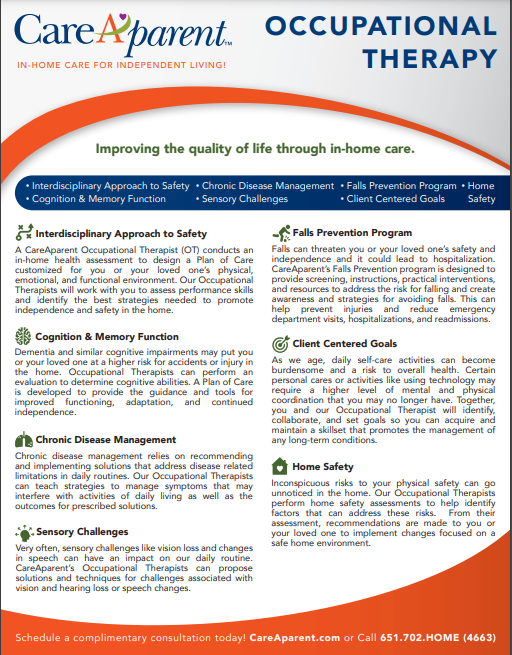
Occupational therapists help patients by looking at how you are currently doing a painful activity or task, and coming up with a plan to help make performing that activity less painful. Learn more about what occupational therapists do here. There are numerous reasons your loved ones may benefit from working with an occupational therapist. Here are a few examples:
Improvement with self-care tasks: An occupational therapist can help your loved ones with tasks related to self-care such as bathing and getting dressed in the morning.
Memory and cognitive skills: Occupational therapy may assist with improvement in sequencing and learning certain tasks.
Home safety: An occupational therapist can assess, educate and guide your loved ones in improvement of their home environment so that they are in the safest environment possible to adapt with aging in place.
Both physical and occupational therapy services are beneficial in helping your loved ones reach their goals. Our skilled and compassionate professionals work with clients so they can live effectively and safely in their homes. For more information please contact us at www.careaparent.com or call 651-702-4663.
- To view the original version of this article visit careaparent.com/occupational-therapy/
- Seniors Blue Book was not involved in the creation of this content.
Other Articles You May Like
When Care Needs Change, Starting Over Shouldn't Be Necessary
Aging rarely follows a predictable path. Learn how CareAparent helps Minnesota seniors remain at home with personal care, skilled nursing, therapy and support that evolves as care needs change.One month, an older adult may be living completely independently. Later, they may need a little help around the house, assistance after a hospital stay, physical therapy to regain strength, medication management or more advanced nursing support.For families, each change can bring another round of questions.Who should we call? What kind of care does Mom need now? Will we need to find another provider? Who will coordinate everything?Those questions can become especially stressful when a family is already dealing with a hospitalization, illness or sudden change in a loved one's abilities.That's why having a care provider that can adapt as needs change can make such a difference.For more than 10 years, CareAparent has helped Minnesota seniors and their families receive personalized care in the place many older adults most want to remaintheir own home. Today, CareAparent provides a continuum of in-home services throughout the seven-county Twin Cities metro area. CareAparentIt May Start With Just a Little HelpSometimes the first sign that an aging parent needs assistance is subtle.Maybe Dad isn't keeping up with housekeeping like he once did. Mom may be having difficulty getting dressed or safely taking a shower. Meals aren't being prepared regularly, medications are becoming confusing, or an adult child is spending more and more time helping with everyday tasks.That doesn't necessarily mean an older adult can no longer live independently.The right support can help make independence possible for longer.CareAparent provides personal care that can include assistance with bathing, dressing and grooming, as well as light housekeeping, laundry and medication reminders. Care can be customized based on the individual's needs rather than forcing the person into a predetermined schedule or level of service. CareAparentFor families, that flexibility matters.The goal isn't to take over someone's life. It's to provide enough assistance so the person can continue participating in it.Then Something ChangesA fall occurs.There's a hospital stay.A chronic condition becomes more difficult to manage.An older adult needs help recovering from surgery.Suddenly, the type of support that worked six months ago may no longer be enough.This is where continuity of care becomes particularly important.Instead of requiring a family to begin searching for an entirely different organization, CareAparent can provide skilled services through licensed medical professionals, including skilled nursing, medication management, wound care, physical therapy and occupational therapy. CareAparentThat allows care to evolve along with the person.Coming Home From the Hospital Can Be a Vulnerable TimeDischarge day can feel like a victoryand it is.But getting home doesn't necessarily mean the recovery is finished.There may be new medications to manage, mobility limitations, wounds requiring attention, exercises to complete or everyday activities that suddenly feel more difficult.Family members may receive discharge instructions but still wonder how they're going to manage everything once their loved one gets home.CareAparent specifically works with individuals transitioning home from hospitals, rehabilitation centers and other acute-care settings. Its skilled services are designed to support recovery and continuity of care in the home. CareAparentFor an older adult, recovering in familiar surroundings can also mean sleeping in their own bed, following familiar routines and remaining close to the people and things that bring comfort.Therapy Can Help Restore IndependencePhysical and occupational therapy aren't simply about completing exercises.They can be important tools for maintaining independence.Physical therapists can work with older adults experiencing pain, injury, illness or age-related declines in mobility. Treatment can address strength, balance, endurance and safer movement.Occupational therapists look at everyday functionhelping individuals find safer and more effective ways to accomplish the activities that are important in daily life.Together, those services can help an older adult work toward a very meaningful goal:Doing more for themselves. CareAparentFamilies Need Support TooWhen someone needs care, the impact extends beyond that individual.Spouses and adult children frequently become caregivers themselvescoordinating appointments, checking medications, helping with meals, managing household responsibilities and worrying about what happens when they aren't there.Over time, those responsibilities can become overwhelming.Professional in-home care can provide something important for both generations.The older adult receives personalized assistance.The family gets to spend more time being family.That distinction matters.A daughter shouldn't always have to be the nurse, housekeeper or care coordinator. A spouse shouldn't have to handle every caregiving responsibility alone.Having trusted support can make the entire family's situation more manageable.Specialized Support for Minnesota VeteransVeterans and their families may also have access to services they don't realize are available.CareAparent serves veterans throughout the seven-county Twin Cities metro as a Home Health Community Provider. Depending upon eligibility and authorization, VA-supported services can include skilled nursing, therapy, respite care, homemaking and home health aide assistance. CareAparentFor families of veterans, understanding available benefits can be an important part of developing a long-term care plan.One Relationship as Needs EvolvePerhaps one of the most reassuring things a family can hear is:You don't have to figure out the next step alone.CareAparent's model is designed around continuity. Personal care, skilled nursing, therapy and additional support can work together so that when circumstances change, the care plan can change too. CareAparentThat can mean fewer unfamiliar faces, fewer transitions between organizations and less time for families spent searching for the next provider.Instead, there is one relationship and a care team that already understands the individual.Aging at Home Should Still Feel Like HomeUltimately, home care isn't simply about completing tasks.It's about helping someone continue living a life that feels familiar and meaningful.It's having coffee in your own kitchen.Sleeping in your own bed.Seeing neighbors you recognize.Following your own schedule.Having family visit without visiting hours.And continuing to make choices about how you live your day.CareAparent describes its approach as combining clinical care with hospitality and personalized attention. The organization has served Minnesota families for more than a decade and provides care throughout Anoka, Carver, Dakota, Hennepin, Ramsey, Scott and Washington counties. CareAparentAs needs change, the answer doesn't always have to be changing where someone lives.Sometimes, the answer is bringing the right care to where they already call home. Learn more about CareAparent's personalized in-home care services and find resources to help your family navigate changing care needs. Call us at 651-702-HOME (4663) or visit our website at www.careaparent.com
Helping Aging Parents Stay Safely at Home
Discover how TruBlue Home Service Ally helps Minnesota families make aging parents' homes safer, easier to maintain and better suited for independent living. For many adult children, there comes a time when visiting Mom or Dad feels a little different.Maybe you notice a loose railing that hasn't been repaired. A lightbulb has been out for months because it's too difficult to reach. The bathroom could use a grab bar, the front steps are becoming harder to navigate, or the list of small home repairs seems to be getting longer.Individually, these things may not seem significant. Together, however, they can be signs that maintaining the home is becoming more difficult.For families who want to help an aging parent remain independent, one of the most important places to start is the home itself.The Home May Need to Change as We AgeA house that worked perfectly at age 50 may present very different challenges at 75 or 80.Stairs become more difficult. Reaching overhead becomes risky. Carrying items while navigating steps can be harder. Bathrooms may lack adequate support, and outdoor maintenance that was once routine can become physically demanding.That doesn't necessarily mean it's time to move.Often, relatively modest changes can make the home easier and safer to navigate while allowing an older adult to maintain the independence they value.For families in Plymouth, Maple Grove and surrounding communities, TruBlue Home Service Ally helps identify and address many of these everyday home concerns. TruBlue's services include home safety assessments, repairs, maintenance and modifications designed to support older adults who want to continue living at home. mn.gov // Minnesota's State PortalStart by Looking at the Home Through New EyesAdult children often know their parents' homes almost as well as their own. That familiarity can actually make potential problems easier to overlook.Instead of simply visiting, walk through the home while thinking about how your parent's needs may have changed.Are stairs adequately lit? Are handrails secure? Is getting in and out of the shower becoming difficult? Are frequently used items stored where they can be reached safely? Are there loose flooring, cords or other potential tripping hazards? Are exterior steps, decks and walkways in good condition?TruBlue's senior home safety assessment takes a more systematic approach. Minnesota's aging-services directory describes the company's assessment as covering dozens of areas, including walkways, garage access and lighting, porches and decks, doors, slipping and tripping hazards, water temperature, stairs and railings. mn.gov // Minnesota's State PortalThe goal isn't to completely remodel a parent's home. It's to identify practical improvements that can make everyday activities easier and safer.Don't Let the Small Repair List Keep GrowingOne of the biggest challenges for aging homeowners isn't necessarily a major renovation.It's the little things.A sticking door. A loose cabinet handle. A damaged step. A dripping faucet. A railing that wiggles. A light fixture that needs attention. Seasonal maintenance that keeps getting postponed.For an adult child, those tasks can quickly turn into another weekend "to-do" listespecially when you're also balancing your own home, career, children and other responsibilities.This is where having a trusted home service professional can make a significant difference.Rather than waiting until small problems become larger ones, families can have repairs and maintenance handled proactively.Home Safety Is About Independence, Not Just RepairsA grab bar isn't simply a piece of hardware.A sturdy railing isn't simply a home improvement.For an older adult, these improvements can provide confidence.Being able to move around the home comfortably, use the bathroom more safely, enter and exit the house with greater ease and keep the property maintained can all contribute to a person's ability to remain independent.That distinction is important.Aging-in-place improvements aren't about making a home look "medical." They're about adapting the environment so it continues to work for the person who lives there.Give Adult Children Peace of Mind, TooSupporting an aging parent from across townor across the countrycan be stressful.Adult children may wonder whether the house is being maintained, whether something needs repair or whether their parent is attempting projects that are no longer safe for them to tackle.Having a reliable local resource can relieve some of that pressure.TruBlue's approach combines handyman services, senior home modifications, home safety and ongoing maintenance. The Plymouth and Maple Grove operation describes its role as helping homeowners maintain their homes through different stages of life. LinkedInThat can allow adult children to spend less time worrying about the house and more time simply being a son or daughter.Have the Conversation Before There's a CrisisFamilies sometimes wait until after a fall, hospitalization or other major event before evaluating the home.A better approach is to start earlier.Ask your parent what has become difficult around the house. Walk through the home together. Talk about the chores they no longer enjoy or feel comfortable doing. Look for simple changes that could make daily life easier.Most importantly, involve your parent in the decisions.Aging in place works best when older adults feel that changes are helping them maintain control and independence, rather than taking those things away.A Trusted Home Ally Can Make a DifferenceHelping a parent remain at home doesn't have to mean doing everything yourself.For families throughout Plymouth, Maple Grove and surrounding Twin Cities communities, TruBlue Home Service Ally provides professional home repairs, maintenance, home safety assessments and senior-focused modifications that can help make aging at home more manageable. mn.gov // Minnesota's State PortalSometimes the best way to help Mom or Dad remain independent isn't a major life change.It may simply begin by making sure the home they love continues to work for them. Learn more about TruBlue Home Service Ally Plymouth & Maple Grove through their Seniors Blue Book profile, or contact their team at 763-400-3748 to discuss home safety, maintenance or aging-in-place needs.
Better Balance Can Help Minnesota Seniors Stay Independent
Discover how FYZICAL Therapy & Balance Centers can help Minnesota seniors improve balance, mobility and confidence with six Twin Cities locations.For many Minnesota seniors, independence is measured in everyday moments: walking confidently to the mailbox, shopping for groceries, getting together with friends, climbing the stairs, gardening, or simply moving around the house without worrying about falling.When balance begins to change, those ordinary activities can suddenly feel more difficult. A person may start reaching for furniture when walking across a room, avoiding stairs, turning down activities, or feeling nervous when navigating snow and ice.But balance problems should not automatically be accepted as a normal part of getting older. In many cases, physical therapy and specialized balance training can help older adults improve strength, stability, mobility and confidence.FYZICAL Therapy & Balance Centers focuses on physical therapy as well as balance, gait, fall-prevention and vestibular rehabilitation. FYZICAL's balance programs evaluate factors that can contribute to instability and develop individualized treatment plans designed to help people move more safely and confidently. FyzicalFor Twin Cities-area families, FYZICAL has convenient locations in White Bear Lake, Edina, Woodbury, Inver Grove Heights, Apple Valley and Lakeville.Why Does Balance Sometimes Change With Age?Good balance is more complicated than simply having strong legs.The body relies on information from several systems working together, including vision, the inner ear, muscles, joints, nerves and the brain. FYZICAL explains that gait and balance are closely connected and that problems involving strength, posture, reflexes or sensory systems can affect the way someone walks and feels while moving. FyzicalThat's one reason balance problems can look different from person to person.One person may experience dizziness when standing up or turning quickly. Another may notice that walking on uneven ground has become difficult. Someone else may feel fine inside the house but become uncomfortable walking through a parking lot or across Minnesota's snowy or icy sidewalks.These changes deserve attentionespecially when they begin interfering with normal activities.Watch for the Early Signs of Balance ProblemsA fall isn't necessarily the first indication that something has changed.Earlier warning signs can include feeling unsteady when walking, frequently grabbing walls or furniture for support, difficulty getting up from a chair, trouble navigating stairs, dizziness or vertigo, taking shorter or slower steps, or becoming increasingly afraid of falling.Sometimes the biggest change is behavioral.A person who once enjoyed shopping, attending church, visiting friends or going for walks may gradually stop participating because they don't feel confident on their feet.That loss of confidence can affect much more than mobility. It can begin to affect independence and quality of life.How Balance Therapy Can HelpBalance therapy begins by determining why someone is having difficulty.A physical therapist may evaluate walking patterns, strength, posture, flexibility, coordination and balance. When dizziness or vertigo is involved, the vestibular system may also need to be evaluated.FYZICAL's balance and gait programs can include assessment and evaluation, gait training, balance retraining, fall-prevention strategies, functional training and vestibular rehabilitation. Treatment depends on the individual's condition and goals, and services can vary by location. FyzicalThe goal isn't simply to perform exercises in a clinic.The larger goal is helping people function better in everyday life.That might mean being able to walk across the yard, get out of a chair more easily, navigate a busy store, attend a grandchild's event, travel, or simply feel more secure moving around the house.Strength and Balance Work TogetherMuscle strength plays an important role in stability.Weakness in the legs, hips and core can make recovering from a stumble more difficult. Physical therapy can incorporate exercises designed to improve strength, flexibility, posture and coordination while also addressing walking patterns.Balance exercises may progress as a person's abilities improve.For someone who has become fearful of falling, being able to practice in a supervised environment can also help rebuild confidence.The FYZICAL locations in White Bear Lake, Edina and Woodbury, for example, emphasize balance and vestibular-focused physical therapy in addition to orthopedic rehabilitation. The Inver Grove Heights and Apple Valley locations similarly offer balance, gait and fall-risk services. Dizziness and Vertigo Can Affect Balance TooNot every balance problem originates with muscle weakness.The vestibular system, located in the inner ear, helps the brain understand where the head and body are positioned in space. When that system isn't functioning properly, a person may experience dizziness, vertigo, motion sensitivity or unsteadiness.Vestibular rehabilitation is a specialized form of therapy intended to address these types of problems. Depending on the underlying condition, therapy may include balance retraining and exercises that help improve coordination between vision, movement and the vestibular system. FyzicalFor an older adult who has been limiting activities because of dizziness or fear of falling, identifying the source of the problem can be an important first step.Staying Independent Means Staying EngagedOne of the most important benefits of better mobility isn't measured in repetitions or test scores.It's measured in life.It's having the confidence to meet a friend for lunch.It's walking into a grandchild's school concert.It's continuing to live in the home you love.It's feeling comfortable going to the grocery store or taking the dog for a walk.And in Minnesota, it can mean feeling better prepared for the additional challenges that winter weather brings.Maintaining independence isn't about doing everything exactly as you did decades ago. It's about preserving the ability and confidence to continue doing the things that matter to you.Don't Wait for a Fall to Address Your BalanceSomeone doesn't have to experience a serious fall before talking with a healthcare professional about balance.If you or a family member has noticed increasing unsteadiness, dizziness, changes in walking, difficulty with stairs, or fear of falling, consider discussing those changes with a physician or physical therapist.Early attention may help identify areas that can be strengthened or improved.FYZICAL's approach emphasizes assessment and individualized treatment rather than assuming every balance problem has the same cause. FyzicalFind a FYZICAL Location Near YouMinnesota seniors and their families can connect with FYZICAL Therapy & Balance Centers in:White Bear Lake 2680 County Rd E East - (651) 504-2212Edina 5227 W 73rd Street - 952-207-2997Woodbury 670 Commerce Drive #130 - (651) 501-2010Inver Grove Heights 7751 Amana Trail #300 - 651-842-8100Apple Valley 15083 Flagstaff Avenue #A - 612-246-6900 Lakeville 17761 Kenwood Trail - 952-236-0415Contact the location most convenient for you to learn about available physical therapy, balance, gait, vestibular and fall-prevention services. Because FYZICAL locations are independently operated, specific services may vary by clinic. FyzicalBetter balance can mean more than steadier steps. It can mean greater confidence, greater freedom and more opportunities to remain active and independent.
Local Services By This Author

CareAparent
Homemaking/Housekeeping 2042 Wooddale Dr Ste 200, Woodbury, Minnesota, 55125CareAparent.com is a trusted provider of comprehensive in-home care services based in Minnesota, dedicated to helping seniors and individuals with health challenges live safely, comfortably, and independently in their own homes. With a strong focus on personalized care and clinical excellence, CareAparent offers a full continuum of services designed to support clients at every stage of aging or recovery. At the heart of CareAparents mission is the belief that aging in place leads to a higher quality of life. By delivering care in familiar surroundings, the organization helps reduce stress, promote independence, and maintain dignity for seniors and their families. Their services begin with a personalized consultation, ensuring each client receives a customized care plan tailored to their unique needs and preferences. One of the core offerings at CareAparent is personal care and companion services. These services include assistance with activities of daily living such as bathing, dressing, grooming, and mobility. Caregivers also provide light housekeeping, meal preparation, medication reminders, and transportation to appointments. Beyond physical assistance, companion care plays a vital role in reducing loneliness and improving emotional well-being through meaningful social interaction. In addition to non-medical support, CareAparent provides skilled nursing services delivered by licensed professionals. This includes medication management, chronic disease monitoring, wound care, and post-surgical support. These services are especially valuable for individuals recovering from illness or managing complex health conditions, allowing them to receive high-quality medical care without leaving home. CareAparent also offers therapy services, including physical and occupational therapy. Physical therapy focuses on improving mobility, strength, and balance, while occupational therapy helps clients regain independence in daily tasks and adapt their living environment for safety. These therapies are essential for recovery after injury or hospitalization and for maintaining long-term functionality. Another important component of CareAparents services is hospice support. For individuals receiving end-of-life care at home, the company provides compassionate assistance focused on comfort, dignity, and emotional support. Caregivers help with personal care, respite for family members, and monitoring of the clients condition, ensuring peace of mind during a challenging time. CareAparent is also proud to serve those who have served our country through its veteran services program. Eligible veterans can receive in-home care through VA benefits, including skilled nursing, therapy, and homemaking services. This program helps veterans access the support they need while remaining in the comfort of their homes. With over a decade of experience, CareAparent is licensed by the Minnesota Department of Health and Medicare-certified, reflecting its commitment to high standards of care and safety. Their multidisciplinary approach combines medical expertise with compassionate caregiving, creating a seamless and supportive experience for clients and families alike. In summary, CareAparent.com stands out as a full-service home care provider offering everything from basic daily assistance to advanced medical care. By prioritizing personalized service, clinical quality, and heartfelt compassion, CareAparent enables seniors to age in place with confidence, comfort, and dignityright where they feel most at home.
Careaparent
Transition Specialists 2042 Wooddale Dr Ste 200, Woodbury, Minnesota, 55125Transitional Care Services After Surgery from CareAparent Supporting Safe Recovery at HomeRecovering from surgery can be a challenging time, especially for seniors and adults who may need additional support once they return home from the hospital. Transitional Care Services from CareAparent are designed to provide short-term medical and personal care support during the critical period following surgery or hospitalization. These services help ensure a safe recovery, reduce the risk of complications, and provide peace of mind for both patients and their families.CareAparents transitional care team works closely with physicians, hospitals, and rehabilitation providers to create personalized recovery plans tailored to each individuals medical needs. Skilled nursing professionals may assist with wound care, medication management, monitoring vital signs, and ensuring that post-surgical instructions are followed correctly. This professional oversight helps detect potential concerns early and supports a smoother healing process.In addition to clinical care, caregivers provide essential non-medical support that helps patients regain strength and independence. Services may include assistance with mobility, bathing, dressing, meal preparation, medication reminders, and light household tasks. These services are especially valuable for individuals who may temporarily struggle with daily activities while recovering from surgery.Transitional care can be particularly beneficial for patients recovering from orthopedic procedures, cardiac surgery, joint replacements, or other complex medical treatments. Having experienced caregivers and nurses available at home allows patients to focus on healing in a familiar environment while receiving professional support.CareAparents goal is to bridge the gap between hospital care and independent living. By providing coordinated post-surgery care services, CareAparent helps patients recover safely, regain confidence, and return to their normal routines as quickly as possible.

Careaparent
Hospice 2042 Wooddale Drive, Ste 200, Woodbury, Minnesota, 55125Hospice Support Services from CareAparent Compassionate Care During Lifes Final JourneyHospice services from CareAparent provide compassionate support for individuals facing serious or life-limiting illnesses. These services focus on comfort, dignity, and quality of life, helping patients and their families navigate the final stages of life with the support of experienced caregivers and healthcare professionals. CareAparent works closely with hospice providers to ensure patients receive coordinated care that addresses both medical and emotional needs.Hospice support services are designed to help individuals remain in the comfort of their own home whenever possible. CareAparent caregivers assist patients with daily activities such as bathing, dressing, grooming, mobility support, and meal preparation. These services help maintain personal dignity and comfort while reducing the physical demands placed on family members during a difficult time.In addition to personal care assistance, caregivers provide companionship and emotional support for both patients and their loved ones. Having a compassionate caregiver present can bring reassurance, reduce stress, and help families focus on spending meaningful time together. CareAparent staff understand the sensitivity of end-of-life care and approach each situation with empathy, patience, and respect.CareAparent also collaborates with hospice nurses, physicians, and care teams to support the patients care plan. While hospice organizations provide medical oversight and pain management, CareAparent caregivers help with everyday needs and provide additional support that allows patients to remain comfortable and safe at home.Hospice services are centered on honoring each individuals wishes and maintaining dignity throughout the care journey. Through compassionate care and strong collaboration with hospice providers, CareAparent helps ensure that patients receive comfort-focused care while families receive the guidance and support they need during this important time.