A Room-by-Room Plan for a More Manageable Home
Residences at University Hills
For more information about the author, click to view their website: Residences at University Hills
Jul 07, 2026
Colorado - Denver Metro


A Room-by-Room Plan for a More Manageable Home
A move after age 55 is rarely about wanting less life. More often, it is about wanting less to manage.
A longtime home may include unused bedrooms, closets full of items saved for another season, a basement that has become difficult to organize, and a yard that demands attention no matter the weather. These spaces may hold meaningful memories, but they can also require time, money, and energy that no longer match the way a person wants to live.
Right-sizing is different from simply downsizing. It is the process of choosing a home and a collection of belongings that fit the life you want now. For some Denver adults, that means trading a large house for an apartment where laundry, meals, errands, social opportunities, and relaxation are easier to manage.
Residences at University Hills is a 55+ apartment community located at 2775 S. Brook Drive in Denver. The property currently lists one-bedroom, two-bedroom, and two-bedroom-with-den apartment homes, along with fully equipped kitchens, walk-in closets, in-home full-size washers and dryers, balconies or patios, secure underground parking, and shared community spaces.
For seniors considering a move, the question is not, “What do I have to give up?” A better question is, “What do I want my next home to make easier?”
Start With the Life You Want, Not the Items You Own
Many people begin preparing for a move by opening closets, storage rooms, or the garage. That can quickly become overwhelming because every object seems to demand an immediate decision.
A more useful first step is imagining your ideal ordinary day in the next home.
Think about questions such as:
- Where would you drink coffee in the morning?
- Do you want a table for family meals?
- Is there a favorite chair that needs a place near a window?
- Would a second bedroom help with overnight guests?
- Could a den become a home office, craft room, reading room, or paperwork space?
- What kitchen items do you truly use every week?
- Which possessions make a space feel familiar and comforting?
This approach shifts the focus away from loss. Instead of deciding what must go, you are deciding what deserves a place in the next chapter.
Let the Floor Plan Guide the Process
Before sorting a house, request the floor plan for the apartment you are considering. Measure your largest furniture pieces, including beds, dressers, sofas, dining tables, and favorite chairs. Mark the likely location of each item before committing to bring it.
Residences at University Hills currently offers one-bedroom, two-bedroom, and two-bedroom-with-den layouts. A den can provide useful flexibility for a resident who wants room for hobbies, a work area, visiting family, or personal storage.
A floor plan helps answer practical questions:
- Will the dining table fit without narrowing the living area?
- Is there space for a comfortable guest bed?
- Can a favorite bookcase move with you?
- Which furniture pieces would make the apartment feel crowded?
- What storage will be available for seasonal clothing, linens, or keepsakes?
Choosing furniture based on the new apartment—not the old house—can prevent stress on moving day.
Use a Four-Category Sorting Method
Once you know what the new home can hold, divide belongings into four categories. This keeps the process organized and prevents one difficult decision from stopping the entire project.
1. Moving With You
These are the things that support everyday routines or bring deep personal comfort. They may include practical furniture, essential clothing, favorite dishes, family photographs, a beloved lamp, or items connected to hobbies.
2. Sharing With Family or Friends
Some belongings may have a new life with relatives, neighbors, or close friends. Let family members know early if you are offering items, and set a deadline for pickup. This prevents last-minute confusion when moving day gets closer.
3. Donating or Selling
Items in good condition that no longer fit the new home may be donated, consigned, or sold. This can include duplicate kitchen tools, unused furniture, books, decor, and clothing that no longer suits your lifestyle.
4. Recycling or Disposing
Broken, expired, incomplete, or unusable items can be addressed first. Starting with easier categories—such as old papers, duplicate supplies, or worn linens—can build momentum before moving into sentimental areas.
Preserve the Story Without Keeping Every Object
A smaller apartment may not have room for every heirloom, collection, or piece of furniture. That does not mean the memories connected to those items need to disappear.
Take photographs of meaningful belongings before they leave the home. Add a short note explaining who owned the item, when it was used, or why it mattered. A family quilt, set of china, or old desk may be easier to pass along when the story travels with it.
Suggested quote for Christa Casabug’s approval: “Right-sizing is most successful when residents bring the belongings that support their comfort, routines, and personal history—not simply the largest number of items.”
That perspective can help families focus on meaning rather than quantity.
Build the New Home Around Daily Ease
A right-sized home should make ordinary tasks feel more manageable.
Residences at University Hills lists fully equipped kitchens, walk-in closets, balconies or patios, and full-size washers and dryers within apartment homes. These features may help residents maintain familiar routines while living in a smaller, easier-to-manage space.
When setting up the apartment, consider these practical choices:
- Place everyday dishes, coffee supplies, and pantry items within easy reach.
- Store commonly worn clothing where it is simple to access.
- Keep clear pathways between the bedroom, bathroom, kitchen, and living area.
- Put medications, glasses, chargers, and important papers in consistent locations.
- Arrange furniture around the way you actually use the room, not around how it looked in the previous house.
- Set up the bed, bathroom, and kitchen first so the first night feels calm and familiar.
The goal is not to recreate every room from the old home. It is to make the new home work well from the first week onward.
Make Space for Connection and Independence
Moving to an apartment can reduce household tasks, but it does not have to reduce a person’s social life.
Residences at University Hills lists a fitness room, clubhouse, landscaped garden areas, BBQ spaces, secure underground parking, and a calendar of community events. These amenities may provide opportunities to meet neighbors, spend time outdoors, or enjoy activities without needing to travel far.
The property also says it is about a five-minute walk from King Soopers and nearby shopping. For seniors who want to simplify errands or reduce long drives, nearby services may be an important part of deciding whether the location fits their lifestyle.
Give Yourself Permission to Take Time
A move does not have to happen all at once. Sorting through decades of belongings can bring up memories, sadness, relief, and even unexpected joy.
Work in short sessions. Begin with low-emotion spaces such as a utility closet or linen cabinet. Save photographs, family keepsakes, and sentimental furniture for days when you have more time and support.
A trusted family member, friend, move manager, or professional organizer can help keep the process moving. Still, the final decisions should remain with the person whose home is changing whenever possible.
Explore Residences at University Hills on Seniors Blue Book
Right-sizing can create room for a more manageable home, a clearer routine, and more time for the people and activities you value. Visit the Residences at University Hills listing on Seniors Blue Book to learn more about this Denver 55+ apartment community.
Contact the leasing office directly to verify current rent, availability, waitlist information, fees, eligibility requirements, and apartment features before applying.
Frequently Asked Questions
What is the difference between downsizing and right-sizing?
Downsizing focuses on reducing belongings or space. Right-sizing focuses on choosing a home and possessions that support the lifestyle, routines, and comfort you want now.
What should seniors keep when moving to an apartment?
Prioritize daily-use belongings, favorite furniture, essential documents, meaningful photos, comfortable clothing, and items that fit the new apartment layout.
Are there multiple apartment layouts at Residences at University Hills?
The community currently lists one-bedroom, two-bedroom, and two-bedroom-with-den apartment homes.
How can families handle sentimental belongings respectfully?
Start early, allow the older adult to guide choices, photograph meaningful items, share stories with relatives, and avoid rushing decisions.
Is Residences at University Hills an assisted living community?
No. The official property website identifies it as a 55+ apartment community.
Other Articles You May Like
Affordable-Subsidized Senior Housing in Theodore, AL
Finding a safe, comfortable place to live on a fixed income is one of the biggest worries families face as a loved one ages. Rent keeps climbing, Social Security checks do not stretch as far as they used to, and many older adults are left choosing between housing and other basics like groceries, prescriptions, and utilities. If you are helping a parent, grandparent, or neighbor in the Theodore, Alabama area, you may be wondering where to turn.Affordable-subsidized senior housing is one answer. This guide explains how it works, who qualifies, and what to know about two income-based senior apartment communities in Theodore: AHEPA 310 IX Apts and AHEPA 310 XI Apts.What Is Affordable-Subsidized Senior Housing?Affordable-subsidized housing is rental housing supported by government funding so that older adults with limited incomes can live independently without carrying a heavy rent burden. Instead of paying a flat market rate, residents typically pay a portion of their income toward rent.Who It Is ForThis type of housing is designed for seniors who: Are generally age 62 or older Have household income at or below limits set by the U.S. Department of Housing and Urban Development (HUD) or the Low-Income Housing Tax Credit (LIHTC) program Can live independently, or with services they arrange on their own, and can fulfill the terms of a leaseIt is important to know that this is independent living, not assisted living or nursing care. Residents have their own apartments. Many communities also offer supportive services coordination to help residents stay connected to resources as their needs change.How Rent WorksAt AHEPA Senior Living communities, apartments are subsidized by HUD, and rent is generally based on 30 percent of the resident's adjusted gross monthly income. That means the rent adjusts to what a household can realistically afford. Exact amounts depend on each applicant's income and circumstances, so the property's management office is the best source for a personal estimate.Affordable-Subsidized Options in Theodore, ALAHEPA 310 IX AptsAddress: 7560 Olympic Lane, Theodore, AL 36582Phone: 251-653-2294Property features and services include: Age-restricted community Controlled access and guest parking Handicap and wheelchair accessibility Fitness center Self-serve laundry Activities and social programs Pets: the listing indicates all pets are considered (confirm the current pet policy with the office)Safety and comfort features typical of AHEPA communities include smoke detectors and sprinklers, carbon monoxide detectors, well-lit parking with exterior motion lighting, an apartment-to-entrance intercom, an entrance camera monitor, emergency call systems, and grab bars in tubs and showers in accessible units.Common amenities typically include a community room with TV and cable, a computer room, a library, internet connectivity in common areas, landscaped grounds, and on-site management and maintenance Monday through Friday. Supportive services coordination and close proximity to public transportation are also part of the AHEPA model.A good fit for: Seniors who want a quiet, accessible, one-bedroom apartment with built-in safety features and a steady schedule of social activities.Learn more: https://seniorsbluebook.com/senior-housing/ahepa-310-ix-apts-mobile-alAHEPA 310 XI AptsAddress: 7560-A Olympic Lane, Theodore, AL 36582Phone: 251-653-9880Property features and services include: Age-restricted community Controlled access and guest parking Handicap and wheelchair accessibility Fitness center Self-serve laundry Activities and social programs Pets: the listing indicates all pets are considered, including small pets (confirm the current pet policy with the office)Like other AHEPA communities, AHEPA 310 XI is built with resident safety in mind, including emergency call systems, entrance monitoring, fire and carbon monoxide protection, and accessible bathroom features in designated units. Residents also have access to shared spaces such as a community room, library, and computer room.A good fit for: Seniors who want an affordable one-bedroom home, an accessible and secure building, and the option to keep a small pet. Comparing the Two CommunitiesBoth communities are subsidized by HUD, both offer one-bedroom floor plans, and both share the same address area and AHEPA management philosophy. The main differences are size (50 units versus 42 units) and the pet language in each listing. Because availability, waitlists, and policies can change, we recommend calling both offices.Why This Matters in TheodoreTheodore is a community in Mobile County where many older adults have deep roots. Families often want their loved ones to stay close to familiar churches, doctors, grocery stores, and friends rather than relocate to another city. Having two income-based senior communities right in Theodore makes that possible.Affordable housing for seniors is also in short supply across the country, and demand is often higher than the number of available apartments. That is why waiting lists are common in subsidized communities. Learning about your options early, before a crisis or a lease ending, gives your family time to apply and plan without pressure.Stable, affordable housing also supports better health. When rent is predictable, seniors are more likely to afford medications, nutritious food, and transportation to appointments. Communities with social activities and supportive services help reduce isolation, which matters just as much as a safe roof.How to Get StartedApplying for subsidized housing takes a little preparation. These steps can help you move forward with confidence.Step 1: Confirm EligibilityReview the basics. Generally, at least one head of household must be 62 or older, and household income must fall at or below HUD or LIHTC limits. The property office can tell you the current limits for your household size.Step 2: Gather Your DocumentsApplicants are usually asked for items such as photo ID, Social Security cards, proof of income (Social Security award letters, pension statements, or bank statements), and information about assets. Having these ready can speed up the process.Step 3: Call Both CommunitiesContact AHEPA 310 IX at 251-653-2294 and AHEPA 310 XI at 251-653-9880. Ask about current availability, waitlist length, application steps, and how to schedule a tour.Step 4: Submit an ApplicationResidency is based on acceptance of a submitted application. Fill it out completely and ask what happens next, including how you will be notified.Step 5: Ask Good QuestionsBefore you commit, consider asking about: Accessibility features in the specific unit Pet policy and any pet requirements Transportation options nearby Supportive services and activities offered Maintenance hours and emergency proceduresStep 6: Keep Your Information CurrentWhile you wait, let the office know if your phone number, address, or income changes so you do not lose your place on the list.Related CategoriesNot sure if subsidized independent living is the right level of support? These related categories may help: Independent Living Assisted Living Home Health
Affordable-Subsidized Senior Housing in Semmes, AL
Finding a safe, comfortable place to live on a fixed income is one of the biggest worries families face as a loved one ages. Rent keeps climbing, Social Security checks do not stretch as far as they used to, and many older adults are left choosing between housing and other basics like groceries, prescriptions, and utilities. If you are helping a parent, grandparent, or neighbor in the Semmes, Alabama area, you may be wondering where to turn.Affordable-subsidized senior housing is one answer. This guide explains how it works, who qualifies, and what to know about AHEPA 310 X Apts, an income-based senior apartment community in Semmes.What Is Affordable-Subsidized Senior Housing?Affordable-subsidized housing is rental housing supported by government funding so that older adults with limited incomes can live independently without carrying a heavy rent burden. Instead of paying a flat market rate, residents typically pay a portion of their income toward rent.Who It Is ForThis type of housing is designed for seniors who: Are generally age 62 or older Have household income at or below limits set by the U.S. Department of Housing and Urban Development (HUD) or the Low-Income Housing Tax Credit (LIHTC) program Can live independently, or with services they arrange on their own, and can fulfill the terms of a lease It is important to know that this is independent living, not assisted living or nursing care. Residents have their own apartments. Many communities also offer supportive services coordination to help residents stay connected to resources as their needs change.How Rent WorksAt AHEPA Senior Living communities, apartments are subsidized by HUD, and rent is generally based on 30 percent of the residents adjusted gross monthly income. That means the rent adjusts to what a household can realistically afford. Exact amounts depend on each applicants income and circumstances, so the propertys management office is the best source for a personal estimate.Affordable-Subsidized Option in Semmes, ALAHEPA 310 X AptsAddress: 9180 Hellenic Way, Semmes, AL 36575 Phone: 251-645-2405AHEPA 310 X is an income-based senior apartment community in Semmes and part of the AHEPA 310 network, which operates eleven locations across Mobile and Baldwin Counties. AHEPA Senior Living is a not-for-profit organization built on a commitment to service, philanthropy, and dignity for older adults. This community is a HUD Section 202 supportive housing property for the elderly, sponsored by the AHEPA National Housing Corporation. Public HUD records describe it as a three-story building of one-bedroom apartments on about four acres in the Semmes area of Mobile County.Property Features and ServicesAccording to its Seniors Blue Book listing, the community offers: Age-restricted housing for seniors 64 one-bedroom apartments Controlled access and guest parking Handicap and wheelchair accessibility Fitness center Self-serve laundry Activities and social programs Pets: the listing indicates all pets are considered, including small pets (confirm the current pet policy with the office) Safety FeaturesAHEPA affordable independent living communities are built with resident safety in mind. Typical features include: Smoke detectors and sprinklers Carbon monoxide detectors Well-lit parking with exterior motion lighting Emergency electric apartment door releases Apartment-to-entrance intercom and an entrance camera monitor Emergency call systems Grab bars in tubs and showers in accessible units Common AmenitiesAHEPA communities generally include on-site management and maintenance Monday through Friday, a community room with TV and cable, a computer room, a library, internet connectivity in common areas, coin-operated laundry, central trash collection, landscaped grounds, and supportive services coordination. Access to public transportation is also part of the AHEPA model, so ask the office what is available near the Semmes location.Eligibility BasicsResidency is based on acceptance of a submitted application. AHEPA lists these general requirements, which can vary by community: Age 62 or older for any type of unit In certain communities, ages 18 to 61 for a mobility-accessible unit For two people, one head of household must meet the minimum age requirement of 62 Ability to fulfill the lease on your own or with services you provide Income at or below levels established by HUD or LIHTC A Good Fit ForSeniors who want an affordable one-bedroom home with built-in safety features, an accessible and secure building, social activities close by, and, for many, the option to keep a small pet.Why This Matters in SemmesSemmes is a community in western Mobile County where many older adults have deep roots. Families often want their loved ones to stay close to familiar churches, doctors, grocery stores, and friends rather than relocate to another city. Having an income-based senior community right in Semmes makes that possible.Affordable housing for seniors is also in short supply across the country, and demand is often higher than the number of available apartments. That is why waiting lists are common in subsidized communities. With 64 units, AHEPA 310 X is a meaningful local resource, but openings can take time. Learning about your options early, before a crisis or a lease ending, gives your family time to apply and plan without pressure.Stable, affordable housing also supports better health. When rent is predictable, seniors are more likely to afford medications, nutritious food, and transportation to appointments. Communities with social activities and supportive services help reduce isolation, which matters just as much as a safe roof.How to Get StartedApplying for subsidized housing takes a little preparation. These steps can help you move forward with confidence.Step 1: Confirm EligibilityReview the basics. Generally, at least one head of household must be 62 or older, and household income must fall at or below HUD or LIHTC limits. The property office can tell you the current limits for your household size.Step 2: Gather Your DocumentsApplicants are usually asked for items such as photo ID, Social Security cards, proof of income (Social Security award letters, pension statements, or bank statements), and information about assets. Having these ready can speed up the process.Step 3: Call the CommunityContact AHEPA 310 X at 251-645-2405. Ask about current availability, waitlist length, application steps, and how to schedule a tour.Step 4: Submit an ApplicationFill out the application completely and ask what happens next, including how you will be notified when a unit becomes available.Step 5: Ask Good QuestionsBefore you commit, consider asking about: Accessibility features in the specific unit Pet policy and any pet requirements Transportation options near the community Supportive services and activities offered Maintenance hours and emergency procedures Step 6: Keep Your Information CurrentWhile you wait, let the office know if your phone number, address, or income changes so you do not lose your place on the list.Related CategoriesNot sure if subsidized independent living is the right level of support? These related categories may help: Independent Living Assisted Living Home Health
Affordable-Subsidized in Saraland, AL
Housing costs can be difficult to manage on a fixed income, especially when rent competes with groceries, transportation, and healthcare expenses. For an older adult considering a move, affordability matters alongside privacy, access, and the ability to keep familiar routines.Affordable-subsidized housing in Saraland, AL includes options families can investigate before a move becomes urgent. AHEPA 310 IV Apts, identified by its operator as AHEPA 310 IV Senior Apartments, is one local community to contact about eligibility, applications, and current availability.Understanding Affordable-Subsidized HousingHousing assistance has specific rulesSubsidized housing is different from a standard apartment advertised at a lower price. Eligibility, rent calculations, and application procedures depend on the program and property. Ask the management team to explain the rules that apply to the apartment you are considering.AHEPA Senior Living describes its affordable independent housing as serving adults age 62 and older who meet federal income qualifications. The organization says its apartments are HUD-subsidized and rent is generally based on 30 percent of adjusted gross monthly income. These are general program descriptions, not a personal rent quote or guarantee of eligibility. Separate housing needs from care needsAn independent apartment is not the same as assisted living or a nursing facility. Before applying, identify any help needed with bathing, medications, meals, or other daily tasks. Ask which services are offered and which must be arranged separately.Supportive services coordination can connect residents with resources, but it should not be assumed to provide ongoing hands-on care. Clarify the role with the community. AHEPA 310 IV Apts in SaralandPhone: 251-679-0770Location: 100 Ahepa Way, Saraland, AL 36571The property advertises on-site management and maintenance, a community room, computer room, library, fitness center, arts and crafts space, and coin-operated laundry. Its website also lists an elevator in the three-floor building, educational activities, supportive services coordination, and weekly van transportation for shopping. Confirm current arrangements and any charges. Apartment features include a full-size stove and refrigerator. Ask to see the available floor plan and discuss accessibility, storage, utility responsibilities, and the features of the specific apartment being considered. Questions that turn a brochure into a housing decisionAsk how maintenance requests are handled and whom residents contact when the office is closed. Discuss the actual schedule for shopping transportation, how seats are reserved, and whether assistance is provided getting to the vehicle.On a tour, consider the route between parking, the entrance, the elevator, and the apartment. Ask about available accessibility features instead of assuming that all units have identical layouts.For services coordination, ask what help is offered with finding local resources, how residents request assistance, and whether outside services carry separate costs.Eligibility and Application PlanningRequest property-specific guidanceAsk management which age and income rules apply to your household and what information is required. Do not assume that the eligibility of a friend or relative establishes your own.AHEPA's general instructions distinguish a pre-application from the full application needed before a unit is offered. Final eligibility is determined before move-in approval. Ask how that process works at this property. Understand waiting lists and costsAsk whether applications are currently accepted, whether a waiting list exists, and how applicants keep contact information current. A submitted application does not guarantee an apartment or a particular move-in date.Request a written explanation of rent, deposits, utility arrangements, and any optional charges. Ask how income changes are reported and how rent is reviewed. Avoid making moving commitments until the property confirms the necessary approvals. Why This Matters LocallyStaying in Saraland may help an older adult preserve nearby relationships, familiar shopping routines, and established healthcare connections. Consider those practical ties when comparing apartments.The property lists shopping transportation, but families should discuss the full week's transportation needs separately. Medical visits, family outings, and errands may require different arrangements. A workable housing decision includes both monthly costs and daily logistics. How to Get StartedList your housing prioritiesWrite down the rent you can manage, accessibility needs, preferred routines, and services you may need outside the apartment agreement.Call managementContact 251-679-0770. Ask about current eligibility rules, applications, waiting lists, and tour arrangements.Gather the requested paperworkAsk for a document checklist. Keep copies of submitted materials and note whom you spoke with. Use the property's approved submission method for sensitive information.Review the proposed termsBefore accepting an apartment, confirm costs, included features, lease rules, and the move-in timeline. Ask questions until the arrangement is clear.Practical tip: Keep one housing folder with the application, document checklist, contact notes, and any follow-up dates. Update your phone number and address promptly if you are waiting for a response.
Local Services By This Author
Residences at University Hills
Affordable-Subsidized 2775 South Brook Drive, Denver, Colorado, 80222Residences at University Hills: Exceptional 55+ Living in a Prime Denver LocationThe Residences at University Hills is a vibrant and thoughtfully designed apartment community created specifically for adults aged 62 and older. Nestled in the desirable University Hills neighborhood of Denver, Colorado, this community offers a refreshing blend of comfort, convenience, and connectionideal for those seeking an active, independent lifestyle with a touch of luxury.This modern, age-qualified community features spacious one- and two-bedroom apartment homes, each crafted with quality finishes and senior-friendly design. Every apartment includes a state-of-the-art kitchen with contemporary appliancesperfect for preparing a favorite meal or entertaining guests. A full-size washer and dryer are conveniently located within each unit, eliminating the need for shared laundry facilities. Residents also enjoy individual climate controls, allowing for a personalized living experience all year round.Beyond the elegant apartment interiors, life at the Residences at University Hills is enriched by the convenience of the surrounding area and the wide array of amenities available on-site. Whether youre grabbing a morning coffee, enjoying a workout in the on-site gym, or meeting friends for a game of cards in the community lounge, each day offers new opportunities for engagement and enjoyment. The community encourages connectionwhether through planned events or informal gatheringshelping residents form lasting friendships and enjoy a true sense of belonging.The location itself is one of the Residences at University Hills greatest assets. Situated in a walkable, well-established neighborhood, residents are just steps away from the YMCA, offering a variety of fitness and wellness programs tailored to older adults. Dining, shopping, and entertainment options are also within easy reachwhether you prefer eating out, ordering in, or running errands nearby. Everything you need is right at your fingertips.For those who crave the cultural and urban attractions of city life, downtown Denver is just minutes away. World-class museums, theaters, parks, and professional sports venues await, making it easy to enjoy all the city has to offer without straying far from home.At the Residences at University Hills, residents experience the freedom of independent living combined with the comfort of a secure and welcoming community. The team behind the community is committed to creating an environment where residents feel respected, empowered, and truly at home.Whether youre looking for a relaxing place to retire or a lively community full of opportunities to stay active and connected, the Residences at University Hills offers the best of both worlds. Its more than just a place to liveits a place to thrive. Discover how fulfilling life after 55 can be at this exceptional senior apartment community in the heart of Denver.
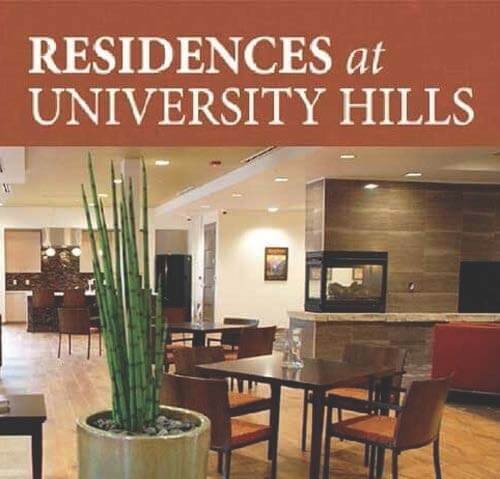
Residences at University Hills
Independent Living 2775 South Brook Drive, Denver, Colorado, 80222Residences at University Hills: Exceptional 55+ Living in a Prime Denver LocationThe Residences at University Hills is a vibrant and thoughtfully designed apartment community created specifically for adults aged 62 and older. Nestled in the desirable University Hills neighborhood of Denver, Colorado, this community offers a refreshing blend of comfort, convenience, and connectionideal for those seeking an active, independent lifestyle with a touch of luxury.This modern, age-qualified community features spacious one- and two-bedroom apartment homes, each crafted with quality finishes and senior-friendly design. Every apartment includes a state-of-the-art kitchen with contemporary appliancesperfect for preparing a favorite meal or entertaining guests. A full-size washer and dryer are conveniently located within each unit, eliminating the need for shared laundry facilities. Residents also enjoy individual climate controls, allowing for a personalized living experience all year round.Beyond the elegant apartment interiors, life at the Residences at University Hills is enriched by the convenience of the surrounding area and the wide array of amenities available on-site. Whether youre grabbing a morning coffee, enjoying a workout in the on-site gym, or meeting friends for a game of cards in the community lounge, each day offers new opportunities for engagement and enjoyment. The community encourages connectionwhether through planned events or informal gatheringshelping residents form lasting friendships and enjoy a true sense of belonging.The location itself is one of the Residences at University Hills greatest assets. Situated in a walkable, well-established neighborhood, residents are just steps away from the YMCA, offering a variety of fitness and wellness programs tailored to older adults. Dining, shopping, and entertainment options are also within easy reachwhether you prefer eating out, ordering in, or running errands nearby. Everything you need is right at your fingertips.For those who crave the cultural and urban attractions of city life, downtown Denver is just minutes away. World-class museums, theaters, parks, and professional sports venues await, making it easy to enjoy all the city has to offer without straying far from home.At the Residences at University Hills, residents experience the freedom of independent living combined with the comfort of a secure and welcoming community. The team behind the community is committed to creating an environment where residents feel respected, empowered, and truly at home.Whether youre looking for a relaxing place to retire or a lively community full of opportunities to stay active and connected, the Residences at University Hills offers the best of both worlds. Its more than just a place to liveits a place to thrive. Discover how fulfilling life after 55 can be at this exceptional senior apartment community in the heart of Denver.