Preparing to Go Home After Inpatient Rehabilitation in Boise
Saint Alphonsus Regional Rehabilitation Hospital-An Affiliate of Encompass Health
For more information about the author, click to view their website: Saint Alphonsus Regional Rehabilitation Hospital-An Affiliate of Encompass Health
Sep 16, 2026
Idaho - Boise and the Treasure Valley


Preparing to Go Home After Inpatient Rehabilitation in Boise
Leaving an inpatient rehabilitation hospital is a major milestone.
After days or weeks of physical therapy, occupational therapy, nursing care, physician visits, and repeated practice, a patient may finally be ready for the next stage of recovery.
But discharge does not necessarily mean everything has returned to the way it was before the illness or injury.
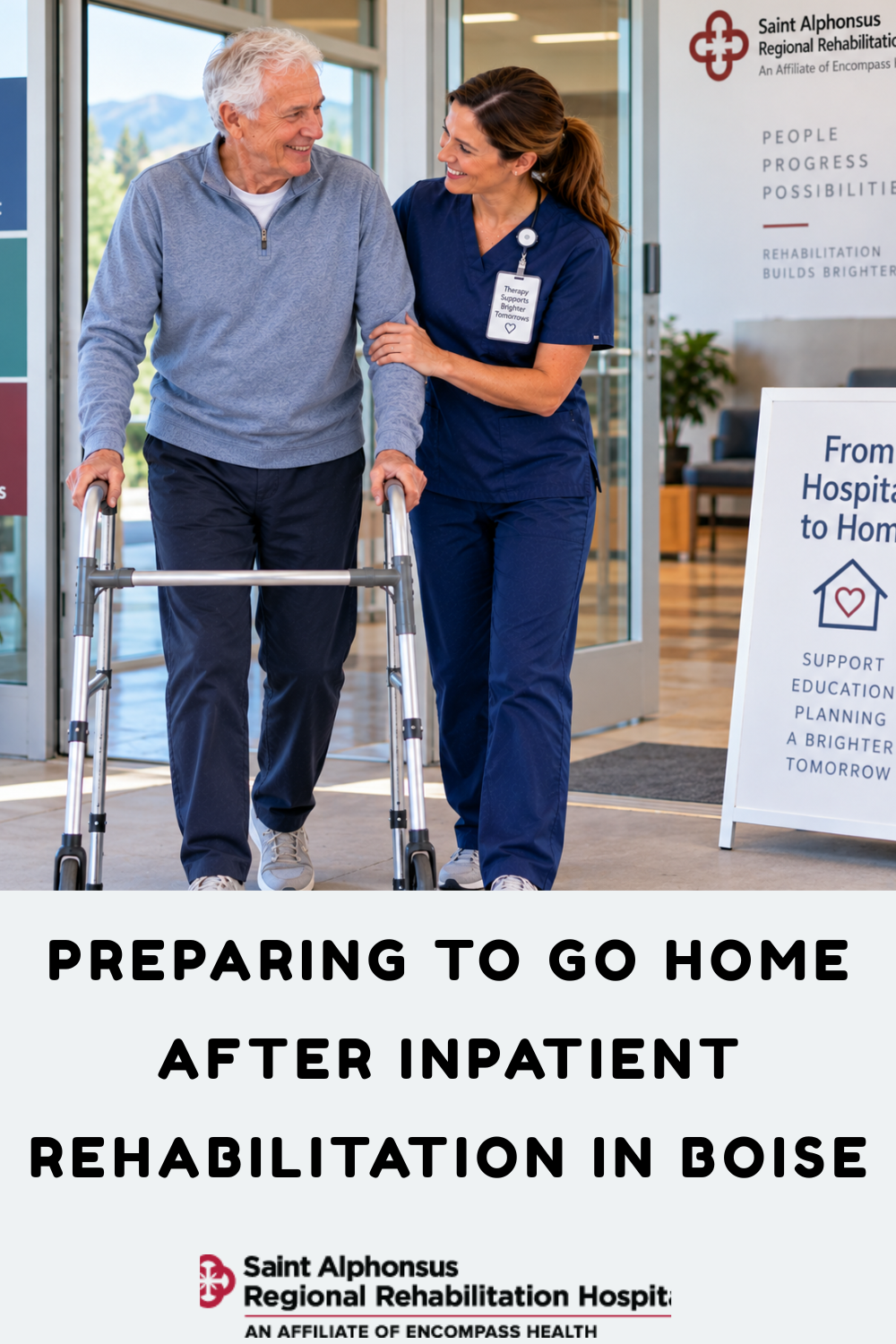
A patient may still use a walker.
Bathing may require new equipment.
Family members may need to help with certain transfers.
Medications may have changed.
Physical or occupational therapy may continue after discharge.
For families in Boise and Ada County, Idaho, preparing for these changes before the patient leaves inpatient rehabilitation can make the transition home safer and considerably less stressful.
Saint Alphonsus Regional Rehabilitation Hospital, an affiliate of Encompass Health, located at 711 North Curtis Road in Boise, combines intensive rehabilitation with 24-hour nursing, frequent physician visits, and coordinated support from therapists, dietitians, pharmacists, and case managers. Encompass Health states that discharge preparation begins during the rehabilitation stay, with the case manager helping patients and families identify equipment, services, and community resources needed for the next stage of recovery.
Discharge Planning Should Begin Before Discharge Day
One of the biggest mistakes families can make is waiting until the final day of rehabilitation to ask what will happen at home.
Good discharge planning begins much earlier.
Encompass Health states that patients are assigned a case manager who begins preparing for discharge during the rehabilitation stay. The care team works with patients and families to determine what resources, equipment, follow-up care, and support may be needed after leaving the hospital.
That preparation might involve questions such as:
Can the patient walk independently?
Is a walker or wheelchair required?
Can the person safely get in and out of bed?
Can they use the bathroom without assistance?
Is help needed with dressing or bathing?
Are stairs part of the home environment?
Will family members provide assistance?
Is home health appropriate?
Will outpatient therapy be needed?
The earlier these questions are discussed, the more time families have to prepare.
Discharge Tip: Ask the rehabilitation team what the patient will realistically be able to do on the first day home, not just what you hope they may be able to do several weeks later.
Understand What Has Changed Since the Hospitalization
A serious illness or injury can change everyday abilities.
The patient returning home may not function exactly as they did before.
After a stroke, someone may have communication or balance difficulties.
After a hip fracture, walking may require a mobility device.
After a brain injury, supervision or cognitive strategies may be needed.
After a spinal cord injury, equipment and home modifications may become important.
Before discharge, families should understand the patient's current abilities rather than relying on assumptions based on how they functioned previously.
Saint Alphonsus Regional Rehabilitation Hospital provides physical, occupational, and speech therapy designed around individual diagnoses and recovery goals, with treatment aimed at helping patients reach their highest practical level of independence.
Caregiver Training Can Make the Return Home Safer
Family caregivers often play an important role after inpatient rehabilitation.
They may help with:
Transfers
Walking
Transportation
Medication organization
Meals
Exercises
Personal care
Follow-up appointments
But family members should not be expected to automatically know how to perform these tasks safely.
Encompass Health provides caregiver education and training and notes that caregivers may participate in therapy. Its patient resources also include home assessments, access to community resources, support groups, and tools for following rehabilitation progress.
If a spouse or adult child will be helping after discharge, ask to practice important tasks before leaving the hospital.
Watching a therapist assist with a transfer is not the same as doing it yourself.
Ask:
“Can you show me how to help safely?”
Then practice while the rehabilitation team is present.
Know Which Mobility Device the Patient Should Use
A patient may leave rehabilitation using:
A cane
A walker
A wheelchair
A brace
Another assistive device
Families should understand exactly what the rehabilitation team recommends.
Do not substitute an old walker from the garage simply because it is already available.
Equipment should match the patient's current needs.
Ask:
What device should be used?
Is the height adjusted correctly?
When must it be used?
Can the patient walk without it for short distances?
Is wheelchair use temporary or ongoing?
Who arranges the equipment?
Encompass Health's discharge resources state that the case manager helps patients obtain appropriate medical equipment and community resources before leaving inpatient rehabilitation.
Look at the Home Through a Rehabilitation Lens
A house that worked perfectly well before an illness may feel very different after one.
Consider the route from the front door to the bedroom.
Are there steps?
Can a walker fit through the hallway?
Is there enough room beside the bed?
Can the patient reach the bathroom safely?
The rehabilitation team may recommend a home assessment or specific adjustments before discharge. Encompass Health lists home assessments among its caregiver support resources.
Areas to review include:
Entrance
Look at steps, handrails, thresholds, and whether the patient can enter safely.
Bathroom
Consider grab bars, shower seating, toilet height, and flooring.
Bedroom
Make sure the patient can safely approach and get in and out of bed.
Living Areas
Remove unnecessary clutter and create clear walking paths.
Rugs and Cords
Loose rugs and electrical cords can become fall hazards.
Lighting
Make sure hallways, bathrooms, and nighttime routes are well lit.
Small changes may significantly improve safety.
Think About the First Night Home
Families often concentrate on daytime needs.
But nighttime can reveal additional challenges.
Ask:
Can the patient get to the bathroom safely?
Will they need help during the night?
Is the bedroom close enough to the bathroom?
Is a bedside commode recommended?
Can the patient safely get out of bed?
Is someone available if assistance is needed?
If the patient requires more nighttime support than the family can provide, discuss that with the discharge team before leaving the rehabilitation hospital.
Review Medications Carefully
Hospitalization and rehabilitation can result in medication changes.
A prescription may be added.
A dosage may change.
A previous medication may be discontinued.
That can create confusion if older medication bottles are still at home.
Before discharge, ask for a current medication list.
Make sure the family understands:
What each medication is for
When it should be taken
Which older medications should no longer be used
Whether prescriptions need to be filled before discharge
Who should be contacted with medication questions
Encompass Health includes pharmacists as part of its coordinated inpatient rehabilitation team.
A simple written or printed medication list can help reduce confusion when the patient first returns home.
Know Whether Therapy Continues After Discharge
Leaving inpatient rehabilitation does not necessarily mean rehabilitation is finished.
The patient may continue with:
Home health therapy
Outpatient physical therapy
Occupational therapy
Speech therapy
Home exercise programs
The appropriate option depends on mobility, medical needs, transportation, and the rehabilitation plan.
Encompass Health states that the case manager and rehabilitation team work with patients and families to plan the safest next setting and connect them with community resources.
Ask before discharge:
“What therapy should happen next?”
And:
“Who is arranging it?”
Do not assume follow-up therapy happens automatically.
Learn the Home Exercise Program
Patients often leave rehabilitation with exercises designed to continue progress.
Family members should understand:
Which exercises are recommended
How often they should be performed
Whether supervision is needed
Which symptoms mean the exercise should stop
What equipment is required
Encompass Health's caregiver portal can provide access to therapy documentation, clinical summaries, home exercise information, discharge instructions, and upcoming appointments.
Consistency can help patients maintain the gains achieved during inpatient rehabilitation.
Prepare for Follow-Up Appointments
Recovery may involve appointments with several providers.
Depending on the diagnosis, these may include:
Primary care
Orthopedic surgery
Neurology
Cardiology
Rehabilitation medicine
Physical therapy
Occupational therapy
Speech therapy
Before discharge, ask which appointments are already scheduled and which still need to be arranged.
Write them down.
Include transportation plans.
A patient who is newly using a wheelchair or walker may need more time and assistance getting to appointments than they did previously.
Set Realistic Expectations About Recovery
Going home is progress.
It is not necessarily the end of recovery.
A patient may still become tired easily.
Activities may take longer.
Someone who walked independently before hospitalization may temporarily need a walker.
A person recovering from stroke may continue working on speech or coordination.
Families should avoid making recovery feel like a test the patient has to pass.
Progress can include small milestones.
Getting dressed with less help.
Walking farther.
Completing exercises.
Preparing a snack.
Using stairs safely.
Recovery is often gradual.
Boise Families May Have a Significant Role in Post-Rehabilitation Care
Boise's 2025 population was estimated at 238,429, with approximately 16.2% of residents age 65 or older.
That means a substantial number of local families may encounter decisions involving hospitalization, rehabilitation, mobility changes, and recovery support.
Having inpatient rehabilitation available in Boise can make it easier for relatives from Boise, Meridian, Eagle, and other Ada County communities to participate in caregiver education and discharge planning.
Family involvement can make the transition home smoother, but families should also be realistic about how much care they can safely provide.
Ask Whether the Patient Can Safely Be Left Alone
One of the most important discharge questions is also one of the simplest:
“Can this person safely stay home alone?”
The answer may depend on:
Walking ability
Balance
Cognition
Medication management
Toileting
Emergency awareness
Communication
Fall risk
A patient may be physically stronger but still require supervision because of cognitive changes.
Another patient may walk safely but be unable to manage medications independently.
Do not base the decision only on mobility.
Consider Whether Home Health Is Needed
Some patients can return home but still need skilled nursing or therapy.
Home health may provide:
Nursing
Physical therapy
Occupational therapy
Speech therapy
Other qualifying services
The rehabilitation case manager can help determine whether home health should be part of the discharge plan.
A patient who is not yet ready to travel easily to outpatient appointments may especially benefit from having appropriate therapy or nursing delivered at home.
Know When Another Care Setting May Be Safer
Returning home is often an important goal.
But it is not always the safest immediate destination.
Some patients may require:
Skilled nursing
Assisted living
Additional rehabilitation
Another supportive environment
A discharge plan should reflect what the patient can safely manage, not simply where they want to go.
Encompass Health states that its case managers work with the care team, patients, and families to develop a discharge plan that fits the patient's needs and next setting of care.
Sometimes the best path home includes another step first.
Medicare and Inpatient Rehabilitation
Medicare Part A may cover medically necessary inpatient rehabilitation when eligibility requirements are met, while Part B covers physician services provided during the rehabilitation stay. Covered inpatient rehabilitation services can include physical therapy, occupational therapy, speech-language pathology, nursing, medications, meals, and hospital services and supplies.
For 2026, Medicare lists a $1,736 Part A deductible per benefit period, followed by specific daily cost-sharing rules depending on length of stay. Individual costs can differ depending on prior hospitalization, benefit-period status, supplemental coverage, Medicare Advantage plans, and other insurance.
Families should verify individual benefits before or during the rehabilitation stay.
Saint Alphonsus Regional Rehabilitation Hospital in Boise
Saint Alphonsus Regional Rehabilitation Hospital, an affiliate of Encompass Health, is located at:
711 North Curtis Road
Boise, Idaho 83706
Phone: 208-605-3000
The hospital provides rehabilitation for stroke, brain injury, spinal cord injury, orthopedic conditions, and other serious illnesses and injuries. Patients receive three hours of therapy daily, five days per week, along with 24/7 rehabilitation nursing and frequent physician visits.
The hospital also emphasizes coordinated care among therapists, nurses, physicians, pharmacists, dietitians, and case managers.
Questions to Ask Before Leaving Inpatient Rehabilitation
Before discharge, families should have clear answers to questions such as:
What can the patient safely do alone?
What activities still require assistance?
Which mobility device should be used?
What equipment is needed at home?
Are home modifications recommended?
Who will help with bathing or dressing?
Can the patient safely be alone?
What medications should be taken?
Which prescriptions changed?
What therapy comes next?
Are follow-up appointments scheduled?
Who should we call if something changes?
Do not worry about asking too many questions.
Discharge is exactly the time to make sure everyone understands the plan.
Frequently Asked Questions About Estate Planning, Conservatorship, and Elder Law
Should legal documents be reviewed after a major illness or injury?
It can be a practical time to review them, especially if health or care needs have changed. Families may want an Idaho attorney to review wills, trusts, financial powers of attorney, healthcare directives, and beneficiary information.
Does needing help after rehabilitation mean someone has lost legal independence?
No. A person may need physical assistance with walking, bathing, transportation, or household tasks while remaining fully capable of making their own medical, financial, and legal decisions.
What is conservatorship?
Conservatorship generally involves a court appointing someone to manage financial or property matters for an individual who cannot adequately manage those responsibilities independently.
Does discharge to home require a power of attorney?
No. A power of attorney is not automatically required because someone returns home after rehabilitation. However, some adults choose to establish financial or healthcare powers of attorney as part of broader planning.
When may an elder-law attorney be helpful?
An elder-law attorney may assist with estate planning, powers of attorney, long-term-care planning, Medicaid issues, guardianship, conservatorship, housing decisions, and other legal matters that arise after significant health changes.
A Safe Discharge Is Part of Rehabilitation
The goal of inpatient rehabilitation is not simply to help someone perform well inside a therapy gym.
The real goal is to help the person function more safely in everyday life.
That is why discharge planning matters.
A walker must work at home.
The bathroom must be accessible.
Family caregivers need to understand what help is required.
Medications must be clear.
Follow-up therapy needs to be arranged.
For patients and families seeking inpatient rehabilitation in Boise and Ada County, Saint Alphonsus Regional Rehabilitation Hospital, an affiliate of Encompass Health, combines intensive therapy with coordinated discharge planning aimed at helping patients return to the community with appropriate support. Encompass Health reports that more than 80% of patients at its Boise rehabilitation hospital return to their communities after inpatient rehabilitation.
Families can learn more and connect through the Saint Alphonsus Regional Rehabilitation Hospital profile on SeniorsBlueBook.com and the hospital's Boise rehabilitation team.
Going home is an important milestone, but successful recovery depends on what happens after the hospital doors close. With thoughtful preparation, caregiver education, appropriate equipment, and continued rehabilitation support, families can create a safer path from inpatient care back to everyday life.
Other Articles You May Like
Independent Living, Rehabilitation, or Skilled Nursing
The best senior care setting depends on what a person can safely do each day and whether they need medical treatment, temporary recovery support, or ongoing nursing oversight. Independent living is usually best for someone who manages most personal needs and wants fewer household responsibilities. Rehabilitation may fit a person recovering after an illness, injury, or hospital stay. Skilled nursing is intended for people whose health needs require care delivered or supervised by licensed healthcare professionals. Start With the Type of Help Needed Rather than choosing a community by its name alone, write down what help is actually needed today. Does the person dress and bathe independently? Can they move safely between bed, chair, and bathroom? Are medications or treatments difficult to manage? Has a clinician recommended therapy following hospitalization? Answers to these questions can help a family speak more productively with a physician, discharge planner, or senior care team. When Independent Living Makes Sense Independent living can be a good fit when someone is largely independent but would benefit from less cooking, cleaning, and maintenance. It offers privacy in an apartment with opportunities for meals and activities nearby. At Garden Valley Retirement Village in Garden City, Kansas, residents can choose from studio, one-bedroom, and two-bedroom layouts. The community lists a daily meal, weekly housekeeping, utilities, maintenance, and planned events among its independent living services. Some independent living residents need additional assistance with everyday tasks. Garden Valley reports that on-site home care and individualized personal care plans are available. Ask what those services cover before assuming they include nursing treatment or round-the-clock hands-on assistance. When Short-Term Rehabilitation May Be Appropriate After hospitalization, a person may be medically ready to leave the hospital but not yet ready to handle stairs, dressing, or daily movement at home. Short-term rehabilitation focuses on recovering function and preparing for the next setting. Garden Valley offers skilled nursing and rehabilitation stays, including individualized care planning and physical therapy focused on mobility, balance, and fall prevention. Its rehabilitation information also describes speech therapy addressing communication, swallowing, and some memory or problem-solving needs. The particular therapies and frequency appropriate for an individual should be discussed with the clinical team. Progress, discharge plans, and length of stay depend on medical needs and recovery, not a fixed timetable. When Skilled Nursing or Extended Care Is Needed Skilled nursing differs from independent living because it involves a higher level of medical care furnished by or under the supervision of licensed professionals. It may support short-term recuperation or longer-term needs. Garden Valley describes extended care for medically stable individuals who need intensive nursing care or monitoring over a longer period. Families should ask what clinical services the community can provide for a specific diagnosis, whether it can accommodate mobility or cognitive needs, and how treatment plans are reviewed. A medical professional should help determine whether the level of care is appropriate. Living on a campus that offers several services does not guarantee that every resident will qualify for every service. Where Does Respite Care Fit? Respite care answers a different question: Who can safely care for a loved one while the usual caregiver takes a break? It is generally temporary and does not necessarily mean a permanent change in living arrangements. Garden Valley describes a respite program for adults who need 24-hour care, with stays of 5 to 30 days. Availability, admission requirements, and the exact services provided should be confirmed directly. A respite stay may help when a family caregiver is traveling, dealing with an emergency, or needs time to rest. It can also give the family a clearer picture of daily support needs, although a respite stay should not be treated as a substitute for a medical assessment. Five Questions to Guide the Conversation What can the person do safely without assistance, and what has recently changed? Is the need primarily housing convenience, personal care, rehabilitation, or licensed nursing? Would a doctor or hospital discharge planner recommend a particular level of care? What is the expected duration of support, and how will progress be reassessed? What are the total costs, admission criteria, and possible coverage or payment options? Why Having Several Options in Garden City Can Help Garden Valley Retirement Village offers independent living, skilled nursing and rehabilitation, respite care, and extended care at its Garden City campus. Having several service types at one local address may make conversations about changing needs more straightforward. Still, the right placement must be based on the individuals health, preferences, eligibility, and current availability. If your family is comparing care options in Garden City, contact Garden Valley Retirement Village at 620-275-9651 or explore https://gvrvhealth.com/independent-living/ to discuss the next step and schedule a visit.
Independent Living in Garden City, KS
Choosing independent living in Garden City, KS, often starts with a practical question: What would daily life look like without home maintenance, regular housework, and the pressure to handle every meal alone? For older adults who want their own space but also appreciate nearby neighbors and planned activities, an independent living community can offer a useful middle ground between a traditional house and a more care-intensive setting. What Does Independent Living Include? Independent living is generally designed for older adults who can manage most of their daily routines and want housing with conveniences built in. Residents retain their own apartments and make decisions about how to spend their time. The community may handle maintenance, offer meals, arrange activities, and provide shared spaces for socializing. Unlike skilled nursing, independent living does not automatically include continuous medical care. Ask specifically how any personal assistance or health services are arranged and billed. Apartment Options at Garden Valley Retirement Village Garden Valley Retirement Village, a Frontline Management community at 1505 E. Spruce Street in Garden City, offers independent living apartments in a quiet residential neighborhood. Its available floor-plan types include studios, one-bedroom and two-bedroom apartments, plus deluxe one- and two-bedroom layouts. According to the community, standard apartment sizes range from 300 to 720 square feet, with deluxe options reaching up to 833 square feet. Each apartment includes a kitchenette with a refrigerator and microwave, window coverings, and vinyl, tile, or carpet flooring. When touring, think about more than square footage. Check whether there is room to move comfortably around furniture, where visitors might sit, and whether storage is sufficient for the belongings a resident uses every day. Which Everyday Services Are Included? At Garden Valley, the independent living services described by the community include: Interior and exterior maintenance, so residents do not have to coordinate routine upkeep. A daily meal, including options for special diets. Weekly housekeeping and paid utilities. Special events, entertainment, and worship services. Priority entrance into the Health Care Center, subject to individual care needs and admissions arrangements. Garden Valley advertises month-to-month terms without a long-term commitment. It also notes that all-inclusive rates may be available. Because the exact inclusions and charges can vary, request a written explanation of the monthly rate, possible add-on services, and what happens if care needs change. Social Life Without a Packed Schedule An appealing part of community living is having choices close to home. Garden Valley describes games, movies, and other resident activities. That can make it easier to join an event without arranging a drive across town. Equally important, residents can choose quiet afternoons in their own apartments. During a visit, ask for the current activity calendar and notice whether residents seem comfortable participating at their own pace. What If a Resident Needs Extra Help? A common concern is whether moving to independent living means someone must handle every task alone. Garden Valley says home care is available on-site for residents who need assistance with everyday activities, with personal care plans tailored to individual needs. The community also notes convenient access to home health services or personal care providers. Families should clarify who provides each service, how to request it, what it costs, and whether the support is appropriate for the persons needs. Garden Valley also provides skilled nursing and rehabilitation services on its campus. That does not mean an independent living apartment functions as a nursing room. Ask the team how care transitions are evaluated and whether a different setting would be needed if a resident requires regular skilled medical attention. Questions to Ask on an Independent Living Tour Which floor plans are available now, and can we see the actual apartment? What is included in the monthly fee, and what costs extra? Can meals accommodate specific dietary requirements? How are housekeeping, maintenance, and resident requests handled? What personal care or home health services can be arranged on-site? How do residents learn about activities and transportation options? Making a Local Decision in Garden City Staying in Garden City may allow an older adult to remain near familiar businesses, medical appointments, family, and friends while changing the amount of work involved in running a household. A good visit should include time to picture an ordinary Tuesday, not just special events: preparing breakfast, doing laundry, receiving visitors, or asking for help when something breaks. To learn about apartment availability or arrange a no-obligation tour of Garden Valley Retirement Village, call 620-275-9651 or visit https://gvrvhealth.com/independent-living/.
Can a Nursing Home Stay Be Temporary?
When a parent, spouse, or other loved one enters a nursing home after a fall, hospitalization, surgery, or serious medical event, families often assume that the move has become permanent.Sometimes it has. Sometimes it has not.A nursing facility can serve very different purposes depending on the persons needs. One resident may be there temporarily for rehabilitation and skilled nursing after a hospital stay. Another may need ongoing help with daily activities and long-term care. A third person may have lived in a nursing facility for months or years but later decide that returning to a home in the community is worth exploring.Pennsylvania has a program specifically designed for people who want to consider that possibility. The states Nursing Home Transition Program helps eligible nursing facility residents explore moving back to a home of their choice in the community with appropriate services and supports.For families, the important lesson is simple: entering a nursing home does not automatically answer the question of where someone must live for the rest of their life.A Nursing Home Stay Can Be Short-Term or Long-TermThe phrase nursing home can be misleading because not every person in a nursing facility is there for the same reason.Some people enter a skilled nursing facility after being discharged from the hospital. They may need physical therapy, occupational therapy, wound care, medication management, or other skilled services before they are ready to function more independently.Medicare explains that nursing homes may provide short-term rehabilitation after surgery or illness as well as long-term care for people who need ongoing assistance with activities such as bathing, dressing, or eating. Medicare may cover qualifying skilled nursing facility care for a limited period, while it generally does not cover long-term custodial care when that is the only type of care needed.That distinction can matter enormously for a family.Consider a parent who falls at home and breaks a hip. After surgery, the hospital may discharge that parent to a skilled nursing facility because going directly home would not yet be safe. Several weeks of rehabilitation may improve strength, mobility, and confidence.At that point, the family should not assume that remaining in the facility is automatically the next step. It may be appropriate to ask whether returning home is realistic and, if so, what assistance would be required.Families facing those larger care decisions may also benefit from understanding how long-term care planning works in Pennsylvania, especially when legal authority, Medicaid eligibility, the family home, and future care costs are all becoming part of the same conversation.What Is Pennsylvanias Nursing Home Transition Program?Pennsylvanias Nursing Home Transition Program was created to help nursing facility residents who want to move back into the community.According to the Pennsylvania Department of Human Services, the program is intended to help consumers understand available long-term services and supports and determine whether community living may be possible. The process can include evaluating the persons health needs, housing situation, available support, and barriers that must be addressed before a move can safely occur.This does not mean every nursing facility resident can simply choose to leave and automatically receive services at home.Eligibility and transition planning depend on the individual.A person may need significant assistance with mobility, medication, bathing, meals, transportation, or other daily needs. Their current home may require accessibility changes. A suitable home may need to be located. Benefits or services may need to be arranged before the transition can occur.The purpose of the transition process is to determine whether those pieces can be put together in a way that supports the individual outside the nursing facility.What Does Returning to the Community Mean?Returning to the community does not necessarily mean returning to the exact house where someone lived before entering the nursing home.Pennsylvania describes the Nursing Home Transition Program as helping people move to a home of their choice in the community. Depending on the persons circumstances, that may involve returning to a previous residence or establishing another appropriate community living arrangement. The larger question is whether the individual can receive appropriate care and support in a setting outside the nursing facility.Pennsylvania also provides information about alternatives to nursing homes, including programs that provide long-term services and supports in community settings for people who meet program requirements.For many families, this changes the conversation from:Can Mom manage completely on her own?to:What services would Mom need in order to live safely outside the nursing home?Those are very different questions.A person may no longer be able to live without assistance, yet still potentially be able to live in the community with appropriate support.What Kinds of Services May Help Someone Live at Home?Pennsylvania offers Home and Community-Based Services for certain people who qualify for long-term services and supports.The exact services available depend on the persons eligibility, care needs, program enrollment, and service plan. Families should not assume that a particular service will automatically be available simply because a person wants to leave a nursing home.Possible needs that may be considered as part of community-based care can include personal assistance, home health services, medical equipment, transportation, home accessibility needs, and coordination of long-term services and supports.Pennsylvanias Community HealthChoices program is one route through which qualifying Medicaid participants may receive long-term services and supports. The state explains that qualifying participants can include people who need the level of care provided by a nursing facility but receive long-term services and supports in another setting.The legal and financial side of that planning can become complicated quickly. Entrusted Legacy Laws Pennsylvania elder law and Medicaid planning services address the broader issues families may face when a loved one needs long-term care, including planning for care costs, Medicaid eligibility, legal documents, and asset protection.How Does the Nursing Home Transition Process Begin?Families do not have to wait for someone at the nursing facility to bring up the subject.Pennsylvania states that a resident or family member can begin exploring Nursing Home Transition assistance by asking nursing facility staff to initiate a referral. People enrolled in Community HealthChoices can contact their managed care organization for assistance. People who are not enrolled in Community HealthChoices can contact the state-designated Nursing Home Transition coordination provider. Pennsylvania also provides an Office of Long-Term Living Nursing Home Transition Helpline for people who have questions or encounter difficulties during the process.This is important because families may not realize that they can raise the issue themselves.A nursing facility may be focused on the persons immediate medical and care needs. Adult children may be focused on work, transportation, finances, and visiting. A spouse may simply be relieved that the loved one is receiving care.Weeks can pass before anyone asks whether the current living arrangement is intended to be temporary or whether the person wants to explore returning to the community.If returning home is important to the resident, that preference is worth discussing early.What Can Delay a Transition Back Home?Wanting to return home and being ready to return home are not always the same thing.Pennsylvania notes that the timing of a Nursing Home Transition can vary significantly because the process may depend on housing availability, home modifications, the arrangement of in-home services, and other individual circumstances.A transition plan may need to address several practical questions. Is there an appropriate place to live? Can the person safely enter and move around the home? Who will provide assistance with bathing, dressing, meals, or transfers if those services are needed? How will medications and medical appointments be managed? What equipment is necessary? What happens if the persons condition changes? Who has legal authority to help with financial or health care decisions? How will the cost of long-term care services be handled? None of these questions necessarily means community living is impossible. They do mean that a safe transition often requires coordination.The Legal Side of Returning Home Can Matter TooMost discussions about leaving a nursing home understandably begin with medical needs and housing. Legal planning can be just as important.A person who needs significant care may also need someone who can communicate with financial institutions, manage bills, coordinate benefits, sign documents, or make health care decisions if the person cannot do so independently.That is why powers of attorney and other estate planning documents should be reviewed as part of broader long-term care planning.The way assets are owned can also affect planning. Families may be worried about savings, the family home, Medicaid eligibility, or what will remain for a spouse or children.Those concerns can lead people to make quick decisions such as transferring a home to a child, adding someone to a deed, moving money, or giving assets away. Those steps can have significant legal and Medicaid consequences.Families should understand the rules before changing ownership of major assets.For people concerned specifically about their residence, Entrusted Legacy Law also explains how Pennsylvania Medicaid and the family home can intersect. The answer depends on circumstances such as ownership, marital status, Medicaid eligibility, and estate recovery, which is why a one-size-fits-all strategy can create problems. Does Medicaid Planning Still Matter If Someone Wants to Go Home?Yes, potentially.Returning home does not necessarily eliminate the need for long-term care. It may change where that care is delivered.A person who leaves a nursing facility may still need extensive assistance each day. Paying privately for ongoing care can place substantial pressure on a household, especially when care needs continue for years.Some people may qualify for Medicaid-funded long-term services and supports in the community, depending on their financial and clinical eligibility and the applicable Pennsylvania program.Pennsylvanias Community HealthChoices program, for example, includes long-term services and supports for qualifying Medicaid participants who require a nursing facility level of care.Financial eligibility for Medicaid can be complicated. Income, resources, marital status, prior transfers, and other circumstances may affect the analysis. Families who are beginning to think about these issues can use Entrusted Legacy Laws Medicaid Planning Checklist as an educational starting point before making major financial or property decisions.What If the Person Has Been in the Nursing Home for a Long Time?A long stay does not necessarily mean the resident should never ask about community living.Pennsylvania describes the Nursing Home Transition Program as a resource for people currently residing in nursing facilities who want to explore receiving services in a community setting. The state does not describe the program only as a discharge option for people who recently entered rehabilitation.That means a resident who has been in a nursing facility for a longer period may still have reason to ask about transition assistance.The actual feasibility of moving will depend on the individuals health, housing, support needs, program eligibility, and other circumstances.Some people may discover that a community transition is realistic.Others may determine that the nursing facility remains the safest or most appropriate setting.The value of asking the question is that the decision can be based on the persons current circumstances and preferences rather than an assumption that a prior placement can never be reconsidered.A Family Conversation Worth HavingImagine an older adult named Robert who enters a nursing facility after a serious fall.At first, his family is simply focused on getting him through rehabilitation. Robert needs help transferring from bed to chair, uses a walker, and cannot safely prepare meals.Two months later, he is stronger. He still needs assistance, but his needs have changed. Robert begins telling his daughter that he wants to return home.The family could assume that the answer is no because he still needs care.A more useful response would be to ask what support would be required for Robert to live safely in the community. Could he qualify for long-term services and supports? Would his home need modifications? Does he need help with bathing or meals? Is transportation available? Are his powers of attorney current? Could Medicaid planning affect how his ongoing care is funded? The answers might ultimately show that returning home is possible. They might also show that significant barriers remain.Either way, the family has more information. That is a much stronger position than making a permanent decision based on assumptions.What Families Should Ask Before Assuming a Nursing Home Stay Is PermanentIf someone you love is living in a Pennsylvania nursing facility and wants to return to the community, several questions can help start a productive conversation: What is the purpose of the current nursing facility stay? Has the persons condition improved or changed? What level of assistance is still needed? Does the resident want to return to the community? What housing would be available? What services would be necessary to make the move safe? Could the person qualify for Pennsylvania Home and Community-Based Services? Who should be contacted to initiate a Nursing Home Transition referral? Are current powers of attorney and other planning documents sufficient? Could Medicaid eligibility or asset planning affect the familys choices? These questions bring together medical, financial, housing, legal, and personal considerations rather than treating a nursing home placement as a single decision that can never be revisited.Start With the Question: What Does Your Loved One Want?Long-term care planning is not only about where care happens or how it will be paid for. It is also about preserving as much choice and independence as circumstances reasonably allow.For some people, a nursing facility will remain the appropriate setting.For others, rehabilitation may be one stage in a recovery that eventually leads back home.Some long-term nursing facility residents may also be able to explore returning to the community with services and support.Pennsylvanias Nursing Home Transition Program gives families a formal way to ask whether that option may be realistic.If your family is trying to understand how a nursing home stay, Medicaid eligibility, the family home, powers of attorney, and long-term care planning fit together, you can schedule a consultation with Entrusted Legacy Law to discuss your situation and the Pennsylvania planning options that may apply. This article is for educational purposes only and is not legal advice. Eligibility for Medicaid, Nursing Home Transition assistance, Home and Community-Based Services, and other long-term care programs depends on individual circumstances and current program requirements.