
PHONE
Click to View NumberGeneral Property Features
- Semi-Private Rooms, Private Rooms
- Scheduled Transportation, Nurse on Staff, Respite Care
- Secured Memory Care Unit
- Small Pets
Assisted Living
- 29
- $3,525.00
- Price Dependent Levels of Care
Additional Levels of Care Offered
Edgewood Eagle Island
Independent Living 77 N. Fisher Park Way, Eagle, Idaho, 83616Eagle Island is an Assisted Living, Memory Care and Independent Living Community located in Eagle Idaho. We have an Outpatient Therapy gym, pub, party room and separate fitness center
Edgewood Eagle Island
Memory Care 77 N. Fisher Park Way, Eagle, Idaho, 83616This free listing made possible by Seniors BlueBook
Continue Your Search! Explore More Local Options.
Start SearchingLet’s engage and get educated!
Browse through thousands of expert articles in over 100 different categories.
Browse NowArticles You May Like

Creating a Safer, Calmer Memory Care Experience in Eagle, Idaho
Creating a Safer, Calmer Memory Care Experience in Eagle, IdahoWhen someone you love begins experiencing significant memory loss, everyday situations can become increasingly difficult.A familiar hallway may suddenly feel confusing. A person may forget whether they have eaten, become anxious about where they are, or try to leave home because they believe they need to go somewhere familiar.For families, these changes can bring an enormous amount of worry.Is Mom safe when she is alone?What happens if Dad wanders outside?Are medications being taken correctly?Can one family caregiver realistically provide supervision day and night?As Alzheimer's disease or another form of dementia progresses, families often begin considering specialized memory care because the person needs more than occasional reminders or help with household chores.For seniors and families searching for memory care in Eagle, Idaho, Edgewood Eagle Island offers a dedicated memory care program within a broader senior living community. Located at 77 North Fisher Park Way in Eagle, Edgewood Eagle Island also provides independent living, assisted living, 55+ living options, and short-term stays.Its memory care program is designed specifically around the challenges associated with Alzheimer's disease and other forms of dementia, combining 24-hour staffing, nursing access, specialized dementia training, personalized safety checks, daily activities, meals, housekeeping, and a secure environment.For families, understanding how these pieces work together can make choosing memory care feel less overwhelming.Why Memory Care Matters in EagleEagle has a substantial and growing senior population.The U.S. Census Bureau estimates that Eagle had 34,658 residents in 2025, representing an 11.2% increase from its April 2020 population base. Approximately 24.3% of Eagle residents are age 65 or older, compared with 18.7% statewide in Idaho.That means nearly one in four Eagle residents is 65 or older.As more local families navigate aging, dementia, caregiving, and long-term support, access to memory care within Eagle itself becomes increasingly important.Keeping a loved one nearby can make family visits, care meetings, medical coordination, and continued involvement easier than relocating someone farther from their established community.Edgewood Eagle Island is located near Eagle Island State Park and provides multiple levels of senior living on one campus, giving families several care options to understand as needs change.What Is Memory Care?Memory care is specialized senior living for people experiencing Alzheimer's disease, dementia, or other forms of cognitive decline that significantly affect daily life.It differs from traditional assisted living because the environment, caregiver training, routines, and safety features are specifically designed around memory loss.A resident may need help with:Bathing and dressingMedication administrationMeals and hydrationMobilityToiletingOrientationWandering preventionCommunicationAnxiety or confusionMaintaining daily routinesEdgewood explains that memory care residents receive personalized support in a smaller, secured environment designed to reduce anxiety and frustration. Staff receive dementia-specific training and use communication techniques intended to help residents who may feel confused or upset.Memory Care Tip: When comparing communities, ask not only what services are offered but how caregivers respond when someone becomes confused, repetitive, frightened, or resistant to care. Those everyday interactions are an important part of dementia support.A Smaller Memory Care Setting Can Reduce ConfusionLarge, open environments can sometimes feel overwhelming for people with dementia.Someone may become confused by:Long hallwaysToo many doorsLarge shared spacesMultiple unfamiliar facesConstant noise or movementEdgewood describes its memory care communities as smaller settings designed to help residents feel calm. Its apartments are designed so residents can more easily see and understand their living space without having to navigate long hallways or multiple doors.The goal is not simply convenience.Reducing unnecessary visual and environmental complexity may help lower frustration for people who are already having difficulty processing their surroundings.For some residents, a more understandable environment can make daily life feel less intimidating.Specially Trained Dementia Care Staff MatterProviding memory care requires different skills than simply helping with household tasks.A caregiver may need to respond when a resident:Repeats the same question many timesBelieves they need to leave for workDoes not recognize a family memberBecomes anxious during personal careRefuses medication because they do not understand what it isBecomes upset in the late afternoonStruggles to communicate discomfortCorrecting or arguing with someone is rarely the most effective approach.Edgewood states that its memory care staff members receive training specific to Alzheimer's disease and dementia and use dementia-friendly communication to respond to residents experiencing confusion or distress.That training can help caregivers understand that behavior is often a form of communication.A resident who refuses to shower may be frightened.Someone pacing near a door may be looking for something familiar.A resident repeatedly asking about a spouse may be seeking reassurance rather than factual information.Understanding the reason behind the behavior can lead to a calmer response.Individualized Care Is Important Because Dementia Is Different for EveryoneNo two people experience dementia exactly the same way.One resident may still be physically active but need constant reminders.Another may remember family members but require extensive help with personal care.Someone else may need assistance with mobility, medications, or meals.Edgewood Eagle Island's current memory care information states that residents receive personalized care along with 24-hour staffing and access to an RN.Individualized care may take into account:Cognitive abilitiesMobilityMedication needsSleep patternsCommunication styleFood preferencesPersonal routinesInterestsSafety concernsLevel of assistance with daily tasksFamilies should ask how often care plans are reviewed and how the team communicates when needs change.Dementia is progressive, so a care plan that works today may need to be adjusted later.Safety Checks Can Help Families Feel More ConfidentSafety is one of the most common reasons families begin exploring memory care.Someone living with dementia may:Wander outsideForget where they areAttempt to leave at nightBecome confused about household hazardsForget to use mobility equipmentMiss medicationsBecome disoriented in unfamiliar surroundingsEdgewood's Eagle Island memory care program includes personalized safety checks and 24-hour staffing.Edgewood also describes its memory care environments as secure and designed around the needs of residents who may wander or become disoriented.Families touring the community may want to ask:How are exterior doors secured?What happens if a resident attempts to leave?How often are safety checks performed?How is nighttime wandering handled?Is outdoor space secured?How are falls addressed?Understanding these systems can help families evaluate whether the community matches their loved one's specific risks.Memory Care Should Still Encourage IndependenceA dementia diagnosis does not mean someone is incapable of participating in daily life.Residents may still be able to make choices and complete portions of familiar activities.Someone may need help getting dressed but still be able to select between two outfits.A resident may no longer prepare meals independently but may still enjoy helping with simple tasks.Edgewood states that memory care residents receive help and encouragement intended to support independence with daily activities.That approach matters.Doing everything for someone can unintentionally remove opportunities for participation.Providing the right amount of assistance can allow a resident to continue using abilities they still have.Activities Should Create Meaningful MomentsMemory care activities should be more than a way to fill time.Edgewood provides both individualized and small-group activities as part of memory care. Its broader memory care program describes wellness and enrichment activities such as music, movement, social opportunities, creative activities, familiar routines, and personalized experiences based on residents' interests and abilities.Meaningful activities might include:MusicArtGentle exerciseReminiscenceSimple gamesFamiliar household tasksGardeningSocial gatheringsLooking through photographsWalkingSpiritual activitiesEdgewood has also described "life stations" in its memory care model, using familiar objects associated with daily routines such as having coffee, getting the mail, attending church, caring for children, or using tools. These interactive areas are intended to evoke familiarity and positive memories.The goal is not to test memory.It is to create moments of connection and enjoyment.Home-Cooked Meals Can Add Structure to the DayMeals provide nutrition, but they also organize daily life.Breakfast marks the morning.Lunch creates a natural midpoint.Dinner helps residents transition toward evening.Edgewood Eagle Island's memory care program includes three nutritious, home-cooked meals plus snacks each day.Families may want to ask:How are dietary restrictions handled?What happens if someone refuses a meal?Are snacks available?Is assistance provided for residents who need help eating?How is hydration monitored?Can personal food preferences be accommodated?For a person living with dementia, familiar foods and consistent mealtimes can also provide comfort.Housekeeping and Laundry Reduce Daily BurdensMemory care residents may no longer be able to safely handle household tasks such as laundry or cleaning.Edgewood Eagle Island includes laundry and housekeeping services in its current memory care program.These services allow residents and caregivers to focus more on personal care, activities, relationships, and daily routines.For families, they also reduce the number of practical responsibilities that need to be managed outside the community.Transportation Coordination Helps Maintain Medical CareEdgewood Eagle Island's memory care program includes coordination of transportation to medical appointments.This can be helpful for families who have previously handled every appointment themselves.Families should ask how transportation coordination works, including:How much notice is requiredWhether family members need to accompany the residentWhether transportation fees applyWhat geographic areas are coveredHow appointment information is communicatedMaintaining continuity with familiar physicians and healthcare providers can be an important part of a senior's overall care plan.A Campus With Multiple Levels of Senior LivingEdgewood Eagle Island provides more than memory care.The community currently offers:55+ livingIndependent livingAssisted livingMemory careShort-term staysThis range may be worth considering for couples whose needs differ or for families thinking about longer-term care planning.For example, one spouse may require memory care while the other remains more independent.Families should ask whether couples can remain close if they require different levels of care and what happens if a resident's needs change significantly.What Families Should Look for During a TourA memory care tour should involve more than inspecting rooms.Pay attention to the atmosphere.Do caregivers greet residents by name?Do residents seem comfortable approaching team members?Is the environment calm?Are activities actually happening?Do shared areas appear easy to navigate?Families should also ask about:StaffingOvernight careDementia trainingNursing accessMedication administrationPersonal careActivitiesMealsTransportationSafety proceduresFamily communicationPricingShort-term stay optionsSeniors Blue Book's current Eagle memory care guide recommends visiting communities during active parts of the day so families can observe genuine staff-resident interactions rather than relying only on a prepared tour.Frequently Asked Questions About Memory Care in Eagle, IdahoWhat is the difference between assisted living and memory care?Assisted living helps residents with personal care, medication management, meals, and other daily tasks while supporting independence.Memory care provides those types of services in a more specialized setting designed specifically for people with Alzheimer's disease, dementia, or other cognitive impairment. Edgewood memory care also includes enhanced security, specialized dementia training, individualized routines, and higher staffing levels.Does Edgewood Eagle Island provide 24-hour memory care support?Yes. Its current memory care information lists 24-hour staffing with access to an RN.Are caregivers trained specifically in dementia care?Yes. Edgewood states that memory care staff receive specialized Alzheimer's and dementia training, including dementia-friendly communication techniques.Are activities offered in memory care?Yes. Edgewood Eagle Island provides individualized and small-group activities, while Edgewood's broader memory care program includes music, creative activities, movement, social opportunities, and other experiences designed around resident abilities and interests.Where is Edgewood Eagle Island?Edgewood Eagle Island is located at 77 North Fisher Park Way, Eagle, ID 83616. The community's current phone number is 208-939-6499.Memory Care Should Create Safety Without Losing MeaningFamilies often begin looking for memory care because they are worried about safety.That makes sense.But the right community should offer more than locked doors and supervision.It should help a resident continue experiencing recognizable routines, meals, activities, movement, personal choice, meaningful relationships, and moments of joy.For families searching for memory care in Eagle, Idaho, Edgewood Eagle Island provides a dedicated memory care program with 24-hour staffing, nursing access, specialized dementia training, personalized safety checks, home-cooked meals, individual and small-group activities, housekeeping, laundry, transportation coordination, and an environment designed specifically around memory loss.The community is located at 77 North Fisher Park Way, Eagle, ID 83616, near Eagle Island State Park. Edgewood lists 208-939-6499 as the community phone number.Families can also learn more about Edgewood Eagle Island through Seniors Blue Book's current Eagle memory care guide, where the community is included among the local memory care options serving Eagle-area families.With nearly one-quarter of Eagle residents now age 65 or older, having specialized memory care close to home gives families more options to keep loved ones connected to familiar people and places while receiving the level of support they need.Choosing memory care is never only about finding a safe place.It is about finding an environment where a person can still be known, supported, included, and treated with dignity through every stage of memory loss.
Sep 21, 2026

A Guide for Eagle, Idaho Seniors
A Guide for Eagle, Idaho SeniorsA longtime home can hold decades of memories.It may be where children grew up, holidays were celebrated, grandchildren learned to walk, and neighbors became friends. Every room can tell part of a familys story.That is why the idea of downsizing can feel complicated.For many older adults, moving to a smaller or more manageable home is not simply a real estate decision. It can bring questions about identity, independence, belongings, routines, and what the next chapter of life will look like.But downsizing does not necessarily mean giving up independence.For some seniors in Eagle, Idaho, moving into independent living can actually create more freedom by reducing the amount of time, money, and energy spent maintaining a house.Edgewood Eagle Island, located at 77 North Fisher Park Way in Eagle, offers independent living along with assisted living, memory care, 55+ living options, and short-term stays. Edgewood describes its independent living option as a maintenance-free lifestyle designed for older adults who want fewer household responsibilities while continuing to manage their own routines and activities.For older adults who are ready to simplify but not ready to slow down, that distinction matters.Why More Eagle Seniors Are Thinking About Their Next HomeEagle has a substantial older adult population.According to the U.S. Census Bureau, Eagle had an estimated 34,658 residents in 2025, representing an increase of about 11.2% from its 2020 population base. Approximately 24.3% of Eagle residents are age 65 or older.That means nearly one in four Eagle residents is in the traditional retirement-age population.As more older adults think about how they want to spend retirement, housing becomes an important part of the conversation.Some people want to remain in the same house for as long as possible.Others begin asking different questions:Do I really need this much space?How often am I using every room?Do I still enjoy maintaining the yard?What happens if major home repairs are needed?Would I rather spend my time doing something else?Would a smaller home make travel easier?Would I enjoy living closer to other older adults?Am I staying here because I love the house, or because moving feels overwhelming?There are no universally correct answers.The goal is to choose a living situation that supports the life you want now.Downsizing Is Not the Same as Losing IndependenceOne of the biggest misconceptions about independent living is that moving into a senior community means someone can no longer take care of themselves.Independent living is actually intended for older adults who remain largely self-sufficient.Residents generally continue to manage:Their personal careTheir scheduleTheir financesTheir medicationsTheir hobbiesTheir social livesTheir travelTheir family relationshipsTheir day-to-day choicesEdgewood describes its independent living communities as offering private residences with amenities that reduce household responsibilities while allowing residents to continue an independent lifestyle.The change is often less about giving up independence and more about deciding which responsibilities are still worth keeping.What Would You Rather Do Than Maintain Your House?One useful way to think about downsizing is to stop focusing only on what you are leaving behind.Instead, think about what you could gain.Owning a home requires ongoing attention.Even a well-maintained property may involve:Lawn careSeasonal cleanupSnow and ice managementRoof repairsExterior maintenanceAppliance replacementPlumbing issuesHeating and cooling maintenancePaintingLandscapingCleaningCoordinating contractorsMany older adults are perfectly capable of handling these responsibilities.The question is whether they still want to.Edgewood Eagle Islands independent living materials specifically highlight a more carefree lifestyle by reducing seasonal chores and larger building-related responsibilities.Imagine replacing some of that maintenance time with:Visiting grandchildrenTravelingMeeting friends for lunchWalkingReadingVolunteeringTaking a classAttending community activitiesSpending time outdoorsSimply relaxingThat is one of the potential benefits of simplifying.Start With the Lifestyle, Not the Floor PlanWhen people begin downsizing, they often start by asking how many square feet they need.A better first question may be:How do I actually live?Consider an ordinary week.Do you entertain large groups?Do overnight guests visit often?Do you need a dedicated office?Do you cook frequently?Do you need space for hobbies?Do you want a garage?Would one bedroom be enough, or would you prefer two or three?Edgewood Eagle Islands current Seniors Blue Book profile lists one-, two-, and three-bedroom independent living options. It also lists 49 independent living units, though families should verify current availability directly with the community.Choosing the right amount of space is not about getting the smallest residence possible.It is about choosing space that supports how you actually want to live.Decide What Deserves to Come With YouThe emotional part of downsizing often begins when it is time to sort belongings.A house may contain decades of:PhotographsFurnitureBooksHoliday decorationsFamily heirloomsChildrens belongingsClothingKitchenwareToolsHobby suppliesPaperworkCollectionsTrying to make decisions about everything in one weekend can become exhausting.A slower approach is usually easier.Start With the Easy DecisionsBegin with items that clearly need to go.Expired products, broken items, duplicate kitchen supplies, outdated paperwork, and clothing that has not been worn for years are often easier places to start.Keep What You Use and LoveAsk yourself:Would I choose this item again if I were furnishing my home today?If the answer is yes, it may deserve a place in the new residence.Take Photos of Meaningful ItemsSome belongings matter because of the memory attached to them rather than the object itself.Photographing an item can preserve the story without requiring you to keep every physical possession.Offer Family Items EarlyAdult children and grandchildren may want certain furniture, photographs, artwork, or heirlooms.Give them enough time to make decisions rather than waiting until moving day.Downsizing Tip: Do not try to decide what to eliminate first. Begin by identifying what you definitely want to bring. Building the new home around your favorite belongings can make the process feel more positive.Create a New Home, Not a Temporary SpaceOne concern seniors sometimes have about independent living is that the new residence will feel generic.It does not have to.Edgewoods independent living model allows residents to create a private home environment, and its Eagle Island materials describe residences with practical features such as full kitchens, dishwashers, washers and dryers in the unit, and garage availability.Bring the things that make your surroundings feel familiar.That could include:A favorite chairFamily photographsArtworkA treasured dining tableBooksA familiar bedspreadLampsPlantsKeepsakesSeasonal decorationsA smaller space can still feel deeply personal.In fact, many people discover that when they keep only their favorite belongings, those items become more noticeable and meaningful.A Kitchen Can Still Matter in Independent LivingDownsizing does not mean giving up cooking.For seniors who enjoy preparing meals, Edgewood Eagle Islands independent living materials list full kitchens with dishwashers as well as washers and dryers in the residence.Residents can continue making breakfast, preparing favorite recipes, or hosting family in their home.At the same time, Edgewoods independent living model also includes meal-plan options, giving residents flexibility on days when they would rather not cook.That flexibility can be especially appealing.Cooking can remain something you enjoy instead of something you have to do three times every day.Think About Location as Part of DownsizingA smaller residence is only part of the equation.Where you live matters too.Edgewood Eagle Island is located at 77 North Fisher Park Way in Eagle, next to the Eagle Island State Park area and within driving distance of local restaurants, coffee shops, healthcare providers, businesses, and outdoor recreation.For older adults who already live in Eagle or elsewhere in Ada County, staying nearby may make it easier to maintain familiar routines.You may still be able to:See the same doctorsAttend the same churchShop at familiar businessesMeet longtime friendsVisit familyEnjoy Eagle-area recreationRemain connected to the Treasure ValleyDownsizing does not have to mean leaving your community behind.Downsizing Can Also Simplify TravelMany retirees want to travel more.But leaving a traditional house for several weeks can create another list of concerns.Who will mow the lawn?Who will collect mail?What happens if a pipe leaks?Who will check the property?Does someone need to shovel snow?A maintenance-free residence can reduce many of those concerns.Residents still need to secure their homes and plan appropriately before traveling, but they may have fewer property-related responsibilities to coordinate.For someone who wants retirement to include more travel, that can be a meaningful benefit.Independent Living Can Add Social OpportunitiesMoving to a smaller home does not have to mean becoming isolated.Independent living can make it easier to meet people because neighbors and community activities are nearby.The Edgewood Eagle Island Seniors Blue Book listing identifies activities and meal options among its property services. It also lists a fitness center among the communitys features.Residents can decide how involved they want to be.One person may enjoy regular activities.Another may prefer occasional meals with neighbors.Someone else may spend most of their time with family and longtime friends outside the community.Independent living provides access to social opportunities without requiring residents to structure their lives around them.What if Your Needs Change Later?Downsizing often involves thinking several years ahead.You may not need assistance today, but what happens if that changes?Edgewood Eagle Island currently offers:Independent Living55+ Living OptionsAssisted LivingMemory CareShort-Term StaysHaving different levels of senior living in the same broader community may be worth considering for long-term planning.That does not mean a transition to another level of care will automatically happen or that availability is guaranteed.Ask during your tour:What happens if I begin needing help with medications?Can assisted living be accessed without leaving the campus?Would I need to change residences?How are care needs assessed?How would pricing change?Does availability affect transfers?What happens if spouses eventually need different levels of care?Thinking about those questions while you are still independent can make future planning less stressful.When Is a Good Time to Downsize?There is no perfect age.A better question is whether your current home still supports the life you want.Independent living may be worth exploring if:You are tired of home maintenanceYou use only a small portion of your houseYou want more opportunities to socializeYou want to travel more easilyYou would like access to activities nearbyYou want a simpler daily routineYou are healthy enough to make the decision on your own termsYou want to plan before a health crisis forces a moveWaiting until a fall, hospitalization, home emergency, or sudden health change can make downsizing much more stressful.Exploring options early gives you time to compare communities and make decisions thoughtfully.Frequently Asked Questions About Downsizing to Independent Living in EagleDoes moving to independent living mean I cannot live on my own anymore?No. Independent living is intended for older adults who can generally manage their personal needs independently but want fewer home-maintenance responsibilities and convenient access to amenities and activities.What kinds of independent living residences does Edgewood Eagle Island offer?The current Seniors Blue Book profile lists one-, two-, and three-bedroom independent living options. Availability can change, so prospective residents should ask Edgewood Eagle Island which floor plans are currently open.Can I still cook for myself?Yes. Edgewood Eagle Islands current independent living information lists full kitchens with dishwashers in the residences. Meal options are also available for residents who want additional convenience.Can I bring my own belongings and furniture?Independent living residences are meant to function as residents homes. Ask the community for current floor plans and move-in guidelines so you can determine which furniture and belongings will fit comfortably.Where is Edgewood Eagle Island located?Edgewood Eagle Island is located at 77 North Fisher Park Way, Eagle, Idaho 83616. The community currently lists 208-939-6499 as its phone number.Explore Independent Living at Edgewood Eagle IslandDownsizing can be emotional because a home often represents decades of life.But moving to a smaller residence does not erase those memories.The photographs come with you.The relationships continue.The traditions remain.The difference is that your next home may require less work, leaving more time and energy for the things you still want to do.For seniors considering independent living in Eagle, Idaho, Edgewood Eagle Island offers a maintenance-free senior living option near Eagle Island State Park, with independent living residences, activities, meal options, and additional levels of senior living available within the broader community.Learn more and connect with the community through the Edgewood Spring Creek Eagle Island listing on SeniorsBlueBook.com.Use the Seniors Blue Book profile to review independent living details and contact Edgewood Eagle Island about current floor plans, availability, amenities, pricing, and scheduling a tour.
Sep 22, 2026

Choosing Independent Living in Eagle, Idaho
Choosing Independent Living in Eagle, IdahoMost people spend years planning for retirement.They think about savings, Social Security, travel, hobbies, healthcare, and when they might stop working.Housing, however, is often treated differently.Many older adults simply assume they will remain in their current home indefinitely. That plan may work perfectly well. But others eventually discover that the house that suited them at 45 or 55 no longer matches the lifestyle they want at 70 or 80.The best time to think about senior living is not necessarily after something goes wrong.It can be while you are healthy, independent, and able to make the decision on your own terms.For older adults considering independent living in Eagle, Idaho, Edgewood Eagle Island offers an option designed around independence, convenience, social connection, and reduced household responsibilities. Located at 77 North Fisher Park Way in Eagle, the community currently offers independent living, 55+ living options, assisted living, memory care, and short-term stays.Planning ahead does not mean you are expecting your independence to disappear.It means deciding what you want the next chapter to look like before circumstances make the decision for you.Why Waiting for a Crisis Can Make Moving HarderMany senior living decisions happen after an unexpected event.A fall occurs.Someone is hospitalized.A spouse becomes ill.A home suddenly needs expensive repairs.Driving becomes difficult.An adult child realizes that maintaining the property has become overwhelming for a parent.When a major change happens, families may have only days or weeks to research communities, tour apartments, understand costs, sort belongings, and make a decision.That is a lot to manage during an already stressful time.Exploring independent living earlier gives older adults something valuable: choice.You can compare communities without pressure.You can visit several times.You can ask detailed questions.You can think about floor plans, lifestyle, location, amenities, and finances.Most importantly, you can decide where you would actually like to live instead of simply choosing whatever is available during an emergency.Planning Tip: Touring independent living does not mean you have decided to move. Think of it as researching one of your future options. Knowing what is available can be useful even if you ultimately remain in your current home for several more years.Eagle Is Home to a Large and Growing Older PopulationPlanning for independent living is particularly relevant in Eagle.The U.S. Census Bureau estimates that Eagle had 34,658 residents in 2025, up approximately 11.2% from its 2020 population base. About 24.3% of Eagle residents are age 65 or older.That means nearly one in four people in Eagle is already within the traditional retirement-age population.Eagle also has a high level of homeownership. Census estimates for 2020 through 2024 show that about 84.1% of occupied housing units are owner occupied.For many local seniors, retirement planning therefore includes an important housing question:Do I want to continue owning and maintaining my current home for the next five, ten, or fifteen years?There is no universal answer.Some people love maintaining their homes and want to remain there.Others begin to value convenience, flexibility, and a simpler lifestyle more than additional square footage.Independent living gives those seniors another option.Independent Living Is Designed for People Who Are Still IndependentSenior living terminology can sometimes create unnecessary confusion.Independent living is not the same as assisted living.It is typically intended for older adults who can still manage their own personal care and daily routines but would prefer fewer household responsibilities.Edgewood describes its independent living program as offering private residences and a maintenance-free lifestyle, giving residents more time for family, friends, activities, and other interests. Its broader independent living amenities include meal plans, activities, parking options, modern appliances, and access to on-site healthcare services depending on the community.At Edgewood Eagle Island specifically, independent living is one of several senior living options offered on the campus. Edgewood describes the community's independent and 55+ living choices as supporting an active, maintenance-free lifestyle.The emphasis is on making life easier, not taking control away.Ask Yourself What You Want Retirement to Feel LikePlanning ahead works best when you start with lifestyle rather than age.There is no magic birthday when someone should move to independent living.Instead, consider how you want everyday life to feel.Ask yourself:Do I still enjoy maintaining my house?Am I using most of the space I currently have?Would I like more opportunities to meet people?Would I travel more if I had fewer home responsibilities?Do I want activities and amenities closer to home?Would I prefer having meal options available?Am I spending more time managing my property than enjoying it?Would I like to live near other older adults?How important is staying in Eagle?What would happen if my health changed unexpectedly?These questions are not about what you can do.You may still be fully capable of mowing the lawn, managing repairs, cooking every meal, and maintaining a large home.The better question may be whether that is how you want to spend your time.Think Five Years Ahead, Not Just Five MonthsIt is easy to choose housing based only on today's circumstances.But retirement housing decisions often make more sense when viewed over several years.Imagine yourself five years from now.Would your current house still be manageable?Would stairs become frustrating?Would maintaining the yard still be enjoyable?Would you want to drive as much?Would you enjoy having neighbors and activities closer by?Would your spouse's needs be different?No one can predict exactly what will happen.Planning simply means considering possibilities.A community that works well today while offering additional senior living options later may be appealing to some people.Edgewood Eagle Island currently provides:Independent Living55+ Living OptionsAssisted LivingMemory CareShort-Term StaysThe availability of multiple options does not mean an independent living resident will eventually require additional care. Many older adults remain independent for years.However, knowing what other services exist can be useful when planning for the future.Consider What Happens if a Couple's Needs Change DifferentlyPlanning ahead can be especially important for couples.Two people of the same age can experience aging very differently.One spouse may remain active and fully independent while the other begins needing help with medication, mobility, bathing, or memory.When touring an independent living community, couples should ask how changing needs are handled.Questions might include:Can one spouse remain in independent living if the other needs more support?What assisted living services are available?Would a move to another residence be required?How are changing care needs evaluated?Can couples remain nearby if their needs differ?How does pricing change when additional care is needed?These questions may feel unnecessary while both spouses are healthy.That is precisely why it can be a good time to ask them.Decisions are often easier when they are theoretical rather than urgent.Location Matters More Than People Sometimes ExpectPlanning ahead does not necessarily mean leaving the community you know.Edgewood Eagle Island is located at 77 North Fisher Park Way in Eagle, Idaho, next to the Eagle Island State Park area and within a short drive of local businesses, restaurants, coffee shops, outdoor recreation, and medical resources.For someone who already lives in Eagle or elsewhere in Ada County, remaining nearby may make a transition easier.You may still be able to:See familiar healthcare providersAttend the same church or faith communityMeet longtime friendsVisit favorite Eagle businessesRemain near children or grandchildrenParticipate in local organizationsEnjoy Treasure Valley recreationMaintain established routinesA move to independent living does not need to mean starting an entirely new life somewhere unfamiliar.Ideally, the new residence supports the life you already enjoy.Compare the Cost of Living, Not Just the Monthly RateOne mistake people sometimes make when comparing independent living with remaining at home is looking only at the community's monthly rate.A traditional home has many separate expenses.Depending on the household, those may include:Mortgage or housing costsProperty taxesHomeowners insuranceUtilitiesLawn careSnow removalRepairsAppliance replacementHousekeepingInternet and televisionTransportationHome securityHOA feesMaintenanceMeal costsIndependent living combines some expenses differently.The exact services included vary by community and residence, which is why prospective residents should request detailed pricing.Edgewood's independent living program includes various amenities such as meal plans, activities, parking options, modern appliances, and maintenance-free living, although features differ by individual community.When comparing your options, create an honest monthly estimate of what your current house actually costs.Include repairs and maintenance averaged across the year.Then compare that with what would be included in independent living.The goal is not to prove one option is always less expensive.It is to compare them fairly.Tour While You Are Still Able to Be SelectiveOne advantage of planning ahead is that you can be picky.You do not have to choose the first available residence.During a tour, imagine that this will be your home rather than evaluating it as a visitor.Look at the ResidencesCould you comfortably arrange your favorite furniture?Would you have enough storage?Does the layout make sense for your lifestyle?Explore the Common AreasWould you actually use them?Do they feel welcoming?Are residents spending time there?Ask About ActivitiesDo programs reflect your interests?How often do activities change?Can residents suggest new programs?Understand MealsAre meals required or optional?Can you still cook for yourself?What does the dining experience feel like?Ask About Parking and TransportationIf you drive now, where would you park?What transportation might be available later?Learn About VisitorsCan family visit easily?What parking is available?Can grandchildren spend time with you comfortably?Ask About Future CareEven if you do not need assistance today, understand what happens if that changes.A good tour should answer practical questions rather than simply show attractive common spaces.Do Not Let Your Adult Children Make Every Decision LaterMany parents tell their adult children, "You'll figure it out when the time comes."That may sound easy, but it can place significant pressure on families.Adult children may not know:Which communities you likeWhat type of apartment you would wantHow much you are comfortable spendingWhich belongings matter mostWhether staying in Eagle is importantWhat amenities you valueHow you feel about assisted living if needs changeEven if you are not ready to move, sharing your preferences can be helpful.Tell family members what matters to you.Better yet, invite them on a tour.Planning together now can prevent family members from having to guess later.Create a Simple Retirement Housing PlanYour plan does not need to be complicated.Consider writing down answers to a few questions.Where Would I Prefer to Live?Would you like to remain in Eagle, elsewhere in Ada County, or closer to family?What Type of Housing Would I Consider?Independent living?55+ housing?A smaller private home?What Would Make Me Consider Moving?Examples could include:Home maintenance becoming frustratingLosing a spouseDifficulty drivingFeeling isolatedA significant health changeWanting to travel moreFinding a community you genuinely preferWhat Are My Financial Parameters?Understand your retirement income, housing equity, savings, insurance, and monthly budget.What Matters Most in a Community?Choose your priorities.Maybe they are:LocationApartment sizeActivitiesMealsOutdoor spaceParkingFuture care optionsSocial opportunitiesProximity to familyWriting these preferences down turns a vague future decision into a practical plan.Frequently Asked Questions About Planning for Independent LivingWhen should I begin looking at independent living?There is no required age. A useful time to explore independent living is while you are still healthy enough to compare options without urgency. Touring communities early can help you understand what is available even if you do not plan to move immediately.Does choosing independent living mean I need help with personal care?Generally, no. Independent living is designed primarily for older adults who manage their own daily needs but want greater convenience, reduced household responsibilities, and access to amenities and social opportunities.What if I need more care later?Edgewood Eagle Island currently offers independent living, 55+ living options, assisted living, memory care, and short-term stays. Prospective residents should ask how transitions between levels of living work, what assessments are required, and how availability affects future moves.Where is Edgewood Eagle Island located?Edgewood Eagle Island is located at 77 North Fisher Park Way, Eagle, Idaho 83616. The community currently lists 208-939-6499 as its telephone number.Can I tour even if I am not ready to move?Yes. Edgewood Eagle Island currently offers both in-person tour requests and a virtual tour resource through its website. Touring early can help seniors understand their options without the pressure of having to make an immediate decision.Make Your Next Move a Choice, Not a CrisisPlanning for senior living does not mean assuming the worst.It is similar to planning financially for retirement.You hope to have choices.You gather information.You think ahead.Then, if circumstances change, you already understand your options.For many older adults, the ideal time to choose independent living may be while they are still fully capable of enjoying everything it offers.They can choose their residence.Arrange their belongings.Meet neighbors.Explore activities.Continue driving.Travel.Visit family.And settle into a new home on their own terms.For seniors researching independent living in Eagle, Idaho, Edgewood Eagle Island provides a maintenance-free independent living option near Eagle Island State Park, along with additional senior living services that families can explore as part of long-term planning.Learn more and connect with the community through the Edgewood Eagle Island profile on SeniorsBlueBook.com.Use the Seniors Blue Book profile to review community information and connect with Edgewood Eagle Island about independent living availability, pricing, residences, amenities, and scheduling a tour.Planning ahead does not take away your independence.It helps protect your ability to decide what comes next.
Sep 22, 2026

Independent Living in Eagle, Idaho
Independent Living in Eagle, IdahoRetirement can bring more freedom, but having extra time does not automatically make life more fulfilling.For many older adults, one of the biggest changes after retirement is not financial or physical. It is social.Coworkers are no longer part of the daily routine. Friends may move away. Adult children have jobs and families of their own. A spouse may pass away. Driving after dark may become less appealing. Even people who are completely independent can gradually find themselves spending more time alone than they expected.That is one reason independent living in Eagle, Idaho can be worth exploring before someone needs personal care.Independent living communities are designed for older adults who can manage their own daily needs but want a lifestyle that makes activities, friendships, meals, recreation, and everyday conveniences easier to access.Edgewood Eagle Island, located at 77 North Fisher Park Way in Eagle, offers independent living alongside assisted living, memory care, 55+ living options, and short-term stays. Edgewood describes the Eagle Island location as supporting an active, maintenance-free lifestyle near Eagle Island State Park and local Eagle businesses and recreation.For older adults who value both independence and connection, that combination can offer a different way to think about retirement.Why Social Connection Matters in RetirementDuring working years, social interaction happens almost automatically.People talk with coworkers, neighbors, clients, parents at school activities, members of professional organizations, and other people they encounter while managing a busy household.Retirement changes that rhythm.Suddenly, maintaining friendships requires more intention.Someone who lives alone may go several days without meaningful face-to-face conversation. That person may still be perfectly capable of managing meals, medications, finances, transportation, and personal care. The challenge is not necessarily independence.The challenge is opportunity.Independent living can place potential social connections closer to home.Residents may see familiar neighbors at meals, organized programs, community gatherings, or simply while walking through shared areas.Nobody has to participate in every activity.That is an important distinction.Independent living should create opportunities for connection without taking away privacy or personal choice.Eagle Has a Significant Senior PopulationIndependent senior living is particularly relevant in Eagle because older adults make up a substantial portion of the local population.The U.S. Census Bureau estimated Eagle's population at 34,658 residents in 2025, an increase of approximately 11.2% from its 2020 population base. About 24.3% of Eagle residents are age 65 or older.That means nearly one in four Eagle residents falls within the traditional retirement-age population.For comparison, approximately 18.7% of Idaho's statewide population is age 65 or older, meaning Eagle has a notably larger share of older residents than the state overall.As Eagle continues to grow, older residents have more reasons to think about what they want their next chapter to look like.For some, that means remaining in a longtime family home.For others, it may mean choosing a community where they can continue living independently while having activities, neighbors, dining options, and amenities closer at hand.Independent Living Is About ChoiceIndependent living is sometimes confused with assisted living.They are not the same thing.Independent living is generally intended for older adults who can take care of themselves and manage their own schedules.Edgewood defines independent living as an option for adults 55 and older who remain actively independent but want a simpler lifestyle with fewer household responsibilities. Residents maintain control over their own routines while gaining access to community amenities and opportunities for social interaction.A resident might choose to spend the morning reading quietly at home.Another might meet friends for breakfast.Someone else may leave the community to volunteer, shop, attend church, visit grandchildren, or participate in an organization elsewhere in the Treasure Valley.Independent living does not mean residents stop living outside the community.Instead, the community becomes a convenient home base.Staying Active Can Look Different for EveryoneWhen people hear the phrase "active retirement," they sometimes picture fitness classes or organized sports.Those activities can certainly be part of an active lifestyle, but activity is broader than exercise.Staying active might mean:Walking regularlyGardeningAttending educational programsPlaying cards or gamesParticipating in community eventsReadingMeeting friends for coffeeVolunteeringVisiting local parksSpending time with grandchildrenPursuing art or musicTravelingAttending religious servicesJoining social gatheringsLearning something newThe best independent living environment should make it easier for residents to continue doing the things they already enjoy while also providing opportunities to discover new interests.Edgewood's independent living program specifically lists activities and social opportunities among the features of community living, and its Eagle Island independent living materials reference educational programs and recreational spaces.Independent Living Tip: When touring a senior living community, ask to see the current activity calendar. Do not simply count how many activities are listed. Look for variety and ask whether residents help influence the types of programs offered.The Value of Having Neighbors NearbyOne advantage of community living is that social interaction can become spontaneous again.In a private home, meeting someone for coffee may require calling ahead, driving somewhere, and coordinating schedules.In independent living, familiar people may simply be nearby.That does not mean everyone becomes best friends immediately.Like any neighborhood, personalities differ.Some residents may be highly social, while others prefer privacy.But living around peers can create small opportunities for connection that are difficult to schedule artificially.A conversation over a meal may lead to a friendship.Two residents may discover they enjoy the same hobby.Someone may find a walking partner.A new resident may meet another person who recently relocated from a longtime family home and understands exactly how that transition feels.Those small connections can gradually help a new community feel familiar.Dining Can Become a Social ExperienceMeals are another part of retirement that can change over time.Cooking for one person may feel very different from preparing meals for a family.Some older adults enjoy cooking and want to continue.Others become tired of planning meals, shopping for ingredients, preparing food, cleaning the kitchen, and dealing with leftovers.Independent living can provide more flexibility.Edgewood Eagle Island's current independent living materials describe homes with full kitchens and dishwashers, allowing residents to continue preparing their own meals. The same materials also reference fresh meals available in the community dining environment.That combination gives residents choices.Cook breakfast at home.Meet neighbors for a meal.Have lunch with family elsewhere in Eagle.Prepare a favorite recipe.The goal is convenience rather than dependence.Meals can also become social opportunities, particularly for residents who previously ate alone most days.Living Near Eagle Island State ParkLocation matters when choosing independent living.Edgewood Eagle Island is situated near Eagle Island State Park, while the community's official information also highlights access to Eagle businesses, restaurants, coffee shops, healthcare services, and outdoor recreation.For active older adults, being near familiar destinations can help maintain continuity after moving.A move to independent living does not have to mean disconnecting from Eagle.Residents can remain part of the surrounding community.Someone may continue seeing the same physician.They may still shop at familiar stores.They may continue meeting longtime friends at a favorite restaurant.Family living elsewhere in Ada County can still visit.The address changes, but a person's broader community does not have to.Wellness Goes Beyond Physical ExerciseHealthy aging is not only about physical strength.Wellness can also include:Emotional wellbeingSocial interactionIntellectual stimulationPurposeSpiritual connectionCreative expressionGood nutritionRestOutdoor activityMaintaining meaningful relationshipsAn independent living community can support several of these areas simply by making participation easier.Someone does not need to drive across town to find every activity.Social interaction may happen down the hall or across the dining table.Educational and recreational opportunities may already be available in the community.Edgewood's current independent living information emphasizes activities, wellness and enrichment opportunities, and social gatherings as parts of community life.Residents still choose what fits them.Someone who values solitude should not feel pressured to participate constantly.The benefit is having choices available.Creating a Home That Still Feels Like YoursMoving into independent living does not mean giving up personal belongings or individual style.Edgewood's independent living information states that residents are encouraged to personalize their homes with their own furniture, photographs, dcor, and belongings.This can make a significant difference when transitioning from a longtime house.A favorite chair can still sit by the window.Family photographs can remain on the wall.Books, artwork, keepsakes, and familiar furniture can help turn a new residence into a recognizable home.Edgewood Eagle Island's independent living materials also list practical residential features such as:Full kitchensDishwashersWashers and dryers in the residenceBasic cable televisionInternet access through recreational spacesGarage availabilityEducational programs and activitiesThe Seniors Blue Book profile currently identifies independent living residences in one-, two-, and three-bedroom configurations and lists amenities including covered parking, a fitness center, activities, and meal options. Prospective residents should confirm current availability and pricing directly with the community because both can change.Couples Can Benefit From Independent Living TooIndependent living is not just for older adults who live alone.Couples may also decide that maintaining a traditional house no longer fits the retirement lifestyle they want.One spouse might love yardwork while the other is ready to stop worrying about home maintenance entirely.They may want more freedom to travel without wondering who will watch the property.They may prefer a smaller or more manageable residence while still wanting enough room for guests and personal belongings.Couples should think carefully about what they want from the next several years rather than waiting until one spouse develops significant care needs.Questions to discuss might include:Do we still enjoy maintaining our current home?Are we using most of our living space?Would we travel more if home maintenance were easier?Do we want more opportunities to meet other people?How important is being near family?What would happen if one of us eventually needed more support?These conversations can help couples make a decision together rather than responding to a sudden crisis later.Planning for Future ChangesOne reason some older adults hesitate to move is the thought of having to move again if their needs change.Edgewood Eagle Island currently offers several senior living options at the same Eagle location:Independent Living55+ Living OptionsAssisted LivingMemory CareShort-Term StaysThat does not guarantee that every future care transition can occur automatically or without changing residences.Families should ask how transitions work, whether availability affects transfers, what assessments are required, and how costs change when someone needs a different level of support.Still, discussing future needs during an independent living tour can be valuable even when someone is healthy and fully independent today.Questions to Ask When Touring Edgewood Eagle IslandA tour should help you imagine what an ordinary Tuesday might actually feel like.Ask questions such as:What activities are happening this week?Look at real programming rather than relying only on examples.How do new residents meet people?Ask whether there are welcome programs, resident groups, dining arrangements, or introductions.What meal choices are available?Find out what is included, what is optional, and whether residents can continue cooking independently.What transportation options are available?Even if you currently drive, transportation may become useful in the future.How much privacy do residents have?Independent living residents should still feel that their residence is their own home.What happens when someone's needs change?Ask how assisted living or other services differ from independent living and how transitions are evaluated.What is included in the monthly cost?Request written information about housing, utilities, maintenance, meals, parking, activities, and optional fees.Frequently Asked Questions About Independent Living in EagleIs independent living appropriate for an active senior?Yes. Independent living is specifically designed for older adults who remain independent but want a simpler lifestyle and convenient access to amenities, social opportunities, and activities.Do independent living residents have to participate in activities?No. Activities are opportunities, not obligations. Residents can decide how they spend their time and which community programs interest them.Can residents cook their own meals at Edgewood Eagle Island?Edgewood's Eagle Island independent living information lists full kitchens with dishwashers, allowing residents to prepare meals at home. Community meal options are also available.What apartment sizes are available?The current Seniors Blue Book listing identifies one-, two-, and three-bedroom independent living options at Edgewood Eagle Island. Availability can change, so contact the community for current openings.Where is Edgewood Eagle Island located?Edgewood Eagle Island is located at 77 North Fisher Park Way, Eagle, Idaho 83616, near Eagle Island State Park. Edgewood currently lists 208-939-6499 as the community phone number.Explore Independent Living at Edgewood Eagle IslandRetirement is about more than having fewer responsibilities.It is also about deciding what you want to do with the time those responsibilities once consumed.Maybe that means seeing grandchildren more often.Maybe it means spending time outdoors, traveling, learning something new, meeting friends, participating in activities, or simply enjoying coffee with a neighbor instead of handling another household project.For older adults considering independent living in Eagle, Idaho, Edgewood Eagle Island offers a community designed around independence, convenience, activities, and connection while remaining close to familiar Eagle destinations.Seniors and families can review Edgewood Eagle Island's current independent living information through its Seniors Blue Book business profile. View Edgewood Eagle Island on SeniorsBlueBook.comUse the Seniors Blue Book listing to explore the community and connect with Edgewood Eagle Island about current independent living availability, floor plans, amenities, activities, meal options, pricing, and opportunities to schedule a tour.
Sep 22, 2026

Independent Living at Edgewood Eagle Island
Independent Living at Edgewood Eagle IslandRetirement can create something many people have spent decades looking forward to: more control over their time.There may finally be opportunities to travel, visit grandchildren, reconnect with friends, spend more time outdoors, return to favorite hobbies, or simply enjoy slower mornings without rushing into the next responsibility.But homeownership does not retire when you do.Lawns still need attention. Appliances eventually need repairs. Snow and seasonal maintenance continue. Groceries need to be purchased, meals prepared, rooms cleaned, and unexpected home expenses handled.For some older adults, the house that once represented freedom gradually begins to feel like another job.That is one reason seniors in Eagle, Idaho may consider independent living before they actually need hands-on personal care.Edgewood Eagle Island, located at 77 North Fisher Park Way in Eagle, offers independent living for older adults interested in maintaining their independence while reducing many of the responsibilities that come with managing a home. The community also offers assisted living, memory care, 55+ living options, and short-term stays, providing several senior living choices in one Eagle location.For the right person, independent living is not about giving something up. It can be about gaining more time for the parts of life that matter most.What Is Independent Living?Independent living is designed for older adults who are generally able to manage their own personal care and everyday routines but would like a simpler living arrangement.Residents typically do not need ongoing assistance with activities such as bathing, dressing, eating, or managing medications.Instead, they may be looking for benefits such as:Less home maintenanceConvenient meal optionsOpportunities to socializeOrganized activitiesA manageable living spaceTransportation optionsFewer household choresAccess to amenities close to homeA community of other older adultsEdgewood describes its independent living communities as intended for adults age 55 and older who remain actively independent but want fewer household responsibilities.That distinction is important.Choosing independent living does not necessarily mean someone needs "care." Many people choose it because they no longer want their schedule dictated by home repairs, yardwork, cleaning, or other everyday responsibilities.Why Independent Living Is Especially Relevant in Eagle, IdahoEagle has become a significant destination for older adults within the Treasure Valley.According to the U.S. Census Bureau, Eagle's estimated population reached 34,658 in 2025, representing an increase of approximately 11.2% from its 2020 population base. Even more notable for senior living planning, approximately 24.3% of Eagle residents are age 65 or older.That means almost one in four Eagle residents falls within the traditional retirement-age population.Eagle also has a high rate of homeownership. Census estimates for 2020 through 2024 indicate that approximately 84.1% of occupied housing units are owner occupied.For many longtime homeowners, this creates an important question:Do I still want to spend my retirement maintaining a house?Some people absolutely do.Others reach a point where they would rather spend Saturday morning meeting friends, going for a walk, visiting family, or pursuing a hobby instead of coordinating repairs or taking care of seasonal chores.Independent living gives those older adults another option.Independent Living Does Not Mean Giving Up IndependenceThe phrase "senior living" sometimes creates the wrong impression.People may picture losing control over their schedules, meals, belongings, or routines.Independent living is designed to work differently.Residents continue directing their own lives.They can generally decide:When they wake upHow they spend their dayWhich activities they attendWhether they go out with friendsWhen family visitsHow they decorate their homeWhich hobbies they pursueWhen they travelHow social or private they want to beThe difference is that many of the frustrating parts of maintaining a traditional house can be reduced.Independent Living Tip: Do not wait until maintaining your home becomes physically exhausting before exploring independent living. Touring while you are healthy and active allows you to evaluate communities based on the lifestyle you want rather than making a rushed decision after a health event.What Independent Living at Edgewood Eagle Island IncludesEdgewood Eagle Island is located near Eagle Island State Park, giving residents access to a quieter Eagle setting while remaining close to local businesses, restaurants, coffee shops, recreation, and healthcare resources.Current Edgewood materials for Eagle Island describe independent living options that may include amenities such as:Full kitchensDishwashersWashers and dryers in the residenceEducational programs and activitiesRecreation space with internet accessBasic cable televisionGarage spaceMeal optionsMaintenance-free livingThe current Seniors Blue Book profile for Edgewood Eagle Island lists one-, two-, and three-bedroom independent living options, along with community amenities including covered parking, a fitness center, activities, meals or meal options, and guest parking.Individual availability, pricing, floor plans, and included services can change, so prospective residents should confirm current details directly with the community.Imagine What You Could Do With Less Home MaintenanceOne of the biggest advantages of independent living may simply be time.Consider how many hours homeowners spend each year on responsibilities such as:Lawn careSnow or ice managementCleaningAppliance repairPlumbing problemsRoof or exterior maintenanceHVAC servicingLandscapingHome improvement projectsCoordinating contractorsEven when homeowners hire professionals, someone still needs to research companies, schedule appointments, wait for workers, review estimates, and pay the bills.Independent living can simplify many of these responsibilities.That extra time might be spent taking a walk, attending an activity, reading, traveling, enjoying lunch with friends, or simply relaxing.Retirement does not need to be filled with another list of chores.Social Connection Can Become EasierOne challenge older adults sometimes encounter after retirement is that social interaction becomes less automatic.During working years, people may regularly interact with coworkers, clients, neighbors, parents at children's activities, and community groups.Retirement changes those patterns.Friends may move.A spouse may pass away.Adult children may live in another city.Driving at night may become less appealing.Even an independent senior can gradually spend more time alone simply because meeting other people requires greater effort.Independent living places potential social opportunities much closer.Edgewood's independent living program includes activities and opportunities for community engagement.Residents can choose whether they want to participate.One person may enjoy attending several activities each week.Another may prefer an occasional meal with neighbors.Someone else may simply appreciate recognizing familiar faces while walking through the community.The important point is that connection is available without needing to organize every interaction from scratch.Meals Can Be About Convenience, Not DependenceCooking for one or two people every day can become tedious.Planning meals means grocery shopping, food preparation, cooking, dishes, leftovers, and starting the process again the next day.Independent living meal options can provide another choice.A resident may still enjoy preparing favorite recipes in their own kitchen while taking advantage of community meals at other times.Edgewood's general independent living program lists meal plans among its available amenities, while its Eagle Island independent living information describes access to fresh meals in a community dining setting.For some residents, meals also become a natural opportunity to socialize.Instead of eating alone every evening, they may have the option to share a meal and conversation with neighbors.Staying Active in EagleEagle offers a setting that can appeal to active retirees.Edgewood Eagle Island's location is adjacent to the Eagle Island State Park area, while shops, restaurants, coffee shops, and other local destinations are also accessible within the broader Eagle community.Residents who drive can continue following their normal routines outside the community.Independent living should complement someone's existing lifestyle rather than replace it.A resident might still:Meet friends for lunchAttend religious servicesVisit family elsewhere in the Treasure ValleySpend time outdoorsShop locallyAttend community eventsKeep regular medical appointmentsTravelVolunteerParticipate in clubs or organizationsIndependent living simply creates a home base with fewer responsibilities.What Happens if Care Needs Change?This is an important question to ask before choosing any independent living community.Someone may be completely independent today but wonder what happens several years from now.Edgewood Eagle Island currently offers multiple senior living services at the same Eagle location, including:Independent Living55+ Living OptionsAssisted LivingMemory CareShort-Term StaysThat does not mean every resident will eventually need another level of care.Many people may remain independent for years.However, having different senior living options available within the broader community can be worth discussing during a tour, particularly for couples whose care needs may change differently over time.Ask specifically what happens if a resident begins needing help with medications, bathing, mobility, or other daily activities.How Is Independent Living Different From Assisted Living?This is one of the most common questions families ask.Independent LivingIndependent living is generally appropriate for someone who:Manages personal care independentlyHandles their own medicationsCan make everyday decisions safelyDoes not need routine hands-on assistanceWants fewer household responsibilitiesWould enjoy community amenities and social opportunitiesAssisted LivingAssisted living is designed for residents who may need regular support with activities of daily living.That can include assistance with:BathingDressingGroomingMedication managementMobilityOther personal-care needsEdgewood makes the same distinction in its current service information: independent living is intended for adults who can care for themselves, while assisted living provides additional support when everyday personal-care needs increase.Understanding that difference can help families select the right starting point.Questions to Ask During an Independent Living TourBeautiful common spaces are nice, but practical questions will help you determine whether a community fits your actual lifestyle.Consider asking:What is included in the monthly rate?Ask about utilities, meals, housekeeping, parking, maintenance, activities, transportation, and other services.What costs extra?Understanding optional expenses makes comparing communities easier.What apartment or home sizes are available?Edgewood Eagle Island's Seniors Blue Book profile currently lists one-, two-, and three-bedroom options, but availability can vary.Can I bring my own furniture?Edgewood's independent living information states that residents are encouraged to personalize their homes with their own furniture, photographs, dcor, and belongings.Are pets allowed?The current Seniors Blue Book profile indicates that pets are considered at Edgewood Eagle Island. Confirm current policies, restrictions, and fees before moving.What happens if my health changes?Ask exactly how transitions between independent living and other levels of care are handled.Frequently Asked Questions About Independent Living in EagleDo I need medical care to move into independent living?Generally, no. Independent living is intended for adults who are still able to manage their own personal and medical needs. People who require routine assistance with bathing, dressing, medications, or mobility may need to consider assisted living instead.Is independent living only for people who live alone?No. Independent living can be appropriate for individuals or couples who want a simpler lifestyle. Couples may especially appreciate having a manageable residence, convenient amenities, and opportunities to socialize without maintaining a traditional home.Can residents still drive?Independent living residents generally maintain control over their own schedules and transportation. People who drive can continue using their own vehicles subject to community parking policies and their individual ability to drive safely.Does Edgewood Eagle Island offer different apartment sizes?The current Seniors Blue Book profile lists one-, two-, and three-bedroom independent living options. Contact Edgewood Eagle Island to confirm which floor plans are currently available.What if I eventually need assisted living?Edgewood Eagle Island currently offers independent living, assisted living, memory care, 55+ living options, and short-term stays. Families should ask the community how transitions are handled if a resident's needs change in the future.Explore Independent Living at Edgewood Eagle IslandChoosing independent living is a personal decision.For some seniors, remaining in a longtime house is exactly what they want.For others, there comes a point when maintaining that house takes more energy than it gives back.Independent living offers another possibility: keep the independence, privacy, hobbies, friendships, family relationships, and routines you value while reducing many of the chores that compete for your time.For older adults exploring independent living in Eagle, Idaho, Edgewood Eagle Island offers an option near Eagle Island State Park at 77 North Fisher Park Way, Eagle, ID 83616.Families and seniors can learn more through the Edgewood Spring Creek Eagle Island profile on SeniorsBlueBook.com.Use the Seniors Blue Book listing to review community information and connect with Edgewood Eagle Island to ask about current independent living availability, floor plans, amenities, pricing, and opportunities to tour the community.
Sep 22, 2026

When Dementia Care Needs Begin to Change
When Dementia Care Needs Begin to ChangeFor many families, dementia care begins at home.At first, the changes may feel manageable.An adult child starts helping with bills. A spouse organizes medications. Family members make more frequent phone calls. Someone begins stopping by to prepare meals or check that everything is okay.For a while, those adjustments may work well.But Alzheimer's disease and other forms of dementia are progressive. As memory, judgment, communication, mobility, and daily functioning change, the amount of supervision a person needs can increase significantly.Eventually, families may begin asking a difficult question:Is our loved one still safe at home, or has the time come to explore specialized memory care?There is no single moment that answers that question for every family.Instead, certain patterns can help signal that the current care arrangement is becoming increasingly difficult to manage.For families considering memory care in Eagle, Idaho, Edgewood Eagle Island provides a local option specifically designed for individuals living with Alzheimer's disease and other forms of dementia. Located at 77 North Fisher Park Way in Eagle, the community offers memory care along with independent living, assisted living, 55+ living options, and short-term stays.Understanding when memory care may be appropriate can help families make the decision thoughtfully rather than waiting for a crisis.Dementia Care Needs Often Increase GraduallyFamilies do not always notice how much care they are providing because responsibilities increase little by little.A weekly grocery trip becomes several weekly visits.A spouse begins managing medications.Adult children start coordinating doctor appointments.Someone begins staying overnight because wandering has become a concern.Eventually, a family member may be providing near-constant supervision without ever having made a formal decision to become a full-time caregiver.Memory care may become worth exploring when the person needs more assistance than family members can consistently and safely provide.Common areas of increasing need include:Medication managementBathing and dressingMeal preparationMobilityToiletingSafety awarenessTransportationSupervisionCommunicationWandering preventionNighttime supportMemory Care Tip: Instead of asking only, "Can we still manage this at home?" also ask, "Can we continue providing this level of care safely and sustainably?"Both questions matter.Sign 1: Wandering or Getting Lost Has Become a ConcernWandering is one of the most serious safety issues associated with dementia.A person may leave home because they believe they need to go to work, pick up a child, visit someone, or return to another familiar place.Once outside, they may become disoriented.Families may notice behaviors such as:Repeatedly trying to leaveWalking outside during the nightBecoming lost in familiar placesTrying to drive somewhere unexpectedlyFrequently checking doorsSaying they need to "go home" while already homeA single incident may not automatically mean a move is necessary.Repeated wandering, however, can make continuous supervision increasingly important.Edgewood describes its memory care environment as secure and specifically designed for people who may become disoriented or wander. Its memory care program also includes personalized safety checks and 24-hour staffing.Sign 2: Medication Management Is No Longer ReliableMedication routines can become difficult when memory and judgment change.A loved one may:Forget to take medicationTake the same dose twiceTake pills at the wrong timeMix medications togetherForget why medication is necessaryRefuse medication because it looks unfamiliarFamilies often try pill organizers, written reminders, alarms, or daily phone calls.Those approaches may work for a while.Eventually, direct assistance may be needed.Edgewood Eagle Island's memory care program includes access to nursing support and individualized care intended to address changing needs.When medication mistakes become frequent, families should take the concern seriously.Sign 3: Everyday Household Tasks Have Become UnsafeDementia can affect familiar activities long before someone loses every ability to perform them.A person may still know how to turn on the stove but forget food is cooking.They may know where cleaning products are stored but no longer recognize which substances are dangerous.Families may notice:Burned potsAppliances left runningWater left onDoors left unlockedFood spoiling in the refrigeratorUnsafe use of household toolsUnexplained household damageThese incidents can indicate that someone is losing the ability to recognize hazards consistently.Memory care removes many of these everyday household safety demands while providing a structured environment designed around cognitive impairment.Sign 4: Personal Care Is DecliningBathing, dressing, grooming, and toileting involve more steps than most people realize.Dementia can interfere with the ability to remember those steps.Someone may:Wear the same clothing for several daysStop bathing regularlyDress inappropriately for the weatherNeed increasing toileting assistanceForget how to use the showerBecome resistant during personal careThese changes are not necessarily caused by stubbornness.A person may genuinely believe they already showered.They may feel frightened because they do not understand why someone is trying to help them.Memory care staff are trained to provide assistance in ways that account for confusion and cognitive changes.Edgewood states that its memory care team receives specialized training in Alzheimer's disease and dementia and uses dementia-friendly communication strategies.Sign 5: Eating and Hydration Are Becoming ConcernsNutrition can also become difficult.A person living with dementia may forget to eat or drink.They may prepare food and leave it untouched.They may lose the ability to plan meals or recognize hunger.Families may notice:Weight lossSpoiled foodRepeatedly skipped mealsLimited food choicesSigns of dehydrationDifficulty using utensilsForgetting that a meal was already eatenEdgewood Eagle Island's memory care program includes three nutritious, home-cooked meals plus snacks each day.Regular meals also create predictable daily structure, which can be helpful for people experiencing memory loss.Sign 6: Nighttime Has Become Increasingly DifficultSome families manage reasonably well during the day but struggle at night.A person with dementia may:Wake frequentlyWander through the houseAttempt to leaveBecome confused about whether it is daytimeNeed help using the bathroomExperience increased anxiety later in the dayA spouse who repeatedly wakes throughout the night may become physically and emotionally exhausted.Over time, sleep deprivation can affect the caregiver's own health and ability to provide safe care.Edgewood Eagle Island's memory care program includes 24-hour staffing with access to an RN, meaning support is not limited to daytime hours.Sign 7: The Person Can No Longer Be Left Alone SafelyA useful question for families is:How long can my loved one safely remain alone?Several hours?Thirty minutes?Not at all?When someone requires continuous supervision, family caregiving becomes much more complicated.Work schedules may need to change.Adult children may rotate coverage.A spouse may feel unable to leave the house even for basic errands.Memory care becomes especially relevant when the person's safety depends on another adult being present almost continuously.Sign 8: Family Caregivers Are Becoming ExhaustedCaregiver well-being matters too.Families often focus so completely on the person with dementia that they overlook the health of the caregiver.Warning signs of caregiver strain may include:Chronic fatigueSleep problemsAnxietyIrritabilitySocial isolationMissing workNeglecting personal healthFeeling overwhelmedDifficulty maintaining other family responsibilitiesRecognizing caregiver exhaustion does not mean someone has failed.It may simply mean that the person's care needs have grown beyond what one household can reasonably provide.Moving to memory care may allow family members to return to being spouses, sons, daughters, or grandchildren rather than carrying every caregiving responsibility themselves.Sign 9: Social Isolation Has IncreasedSafety concerns can unintentionally reduce social interaction.A family may stop taking a loved one to restaurants because outings are difficult.Church attendance may end.Visits with friends may decrease.Someone who once enjoyed community activities may spend most of the day at home.Memory care can create social opportunities in a more supervised environment.Edgewood Eagle Island offers individualized and small-group activities within its memory care program.Activities may create opportunities for:MusicMovementConversationGamesCreative activitiesFamiliar routinesSocial interactionThe goal is not simply to keep residents busy.It is to help create meaningful moments throughout the day.Sign 10: The Home Environment Is Becoming Harder to NavigateThe physical environment can also become more difficult as dementia progresses.A person may struggle with:StairsLong hallwaysUnfamiliar roomsMultiple doorsClutterBathroom safetyChanges in lightingEdgewood describes its memory care program as using smaller, more comfortable settings intended to reduce confusion and anxiety.For some people, moving into an environment specifically designed around cognitive changes may be safer than continually modifying a private home.Why Memory Care Matters Locally in EagleMemory care is especially relevant in Eagle because the city has a significant senior population.The U.S. Census Bureau estimates Eagle's population at 34,658 in 2025, with 24.3% of residents age 65 or older. The city's estimated population increased 11.2% from its April 2020 population base to July 2025.That means nearly one in four Eagle residents is 65 or older.As the population grows and ages, more local families will likely navigate Alzheimer's disease, dementia, caregiving, and long-term care decisions.Having memory care available within Eagle can help families keep loved ones closer to familiar neighborhoods, healthcare providers, friends, and relatives.Edgewood Eagle Island Offers a Larger Community ModelFamilies searching for memory care in Eagle will find several different care models.Seniors Blue Book's current Eagle memory care guide describes Edgewood Eagle Island as a larger, purpose-built community compared with the smaller residential memory care homes also available locally. It notes that Edgewood's scale can provide a broader activity calendar, structured programming, nursing access, and more built-in social opportunities.For some residents, that larger community environment may be a good fit.Others may prefer smaller residential care homes.The best choice depends on the person.Consider:PersonalitySocial preferencesNoise toleranceMobilityDementia stageMedical needsActivity preferencesFamily involvementThere is no universal "best" size.A Community With Multiple Levels of Senior LivingEdgewood Eagle Island currently offers:Independent LivingAssisted LivingMemory Care55+ Living OptionsShort-Term StaysThis range can be useful for families thinking about changing needs.For example, couples may have different levels of care.One spouse may need specialized memory support while the other remains more independent.Families should ask how the community handles couples with differing care needs and whether transitions between service levels are possible.Start Researching Before a CrisisFamilies often wait until something serious happens before exploring memory care.A wandering incident.A fall.A medication mistake.A hospitalization.A caregiver emergency.Waiting until that point can make the decision more stressful.When possible, begin research earlier.Seniors Blue Book recommends calling communities, scheduling tours, asking about staffing and dementia training, reviewing current pricing, and visiting during an active part of the day so families can observe real interactions between residents and staff.Even if the family is not ready to make a move immediately, understanding available options can reduce pressure later.Questions to Ask During a Memory Care TourConsider asking:How are residents assessed before moving in?Ask who determines whether memory care is appropriate and how individualized care needs are identified.How are care plans updated?Dementia progresses differently for everyone.Ask how frequently needs are reassessed.What does nighttime staffing look like?Someone who wanders at night may need different support than someone who sleeps consistently.What dementia training does the staff receive?Edgewood states that its memory care team receives specialized Alzheimer's and dementia training.What happens if care needs increase?Ask what level of mobility assistance, nursing support, and personal care can be accommodated.How are families kept informed?Regular communication can help families remain involved even when they are not present every day.Frequently Asked Questions About Moving to Memory CareDoes a dementia diagnosis automatically mean someone needs memory care?No.Many people can remain safely at home during earlier stages of dementia with family support, home care, and appropriate planning.Memory care generally becomes more relevant when safety risks, supervision needs, personal care requirements, or caregiver strain become difficult to manage.Is wandering a reason to consider memory care?Repeated wandering or becoming lost can represent a significant safety concern.A secured memory care environment may be worth exploring when supervision at home is no longer reliable.Does Edgewood Eagle Island provide 24-hour memory care staffing?Yes. Edgewood's current memory care information lists 24-hour staffing with access to an RN.Does Edgewood Eagle Island provide activities for memory care residents?Yes. Its current program includes individualized and small-group activities designed around resident abilities and interests.Where is Edgewood Eagle Island?Edgewood Eagle Island is located at 77 North Fisher Park Way, Eagle, ID 83616, and the community's listed phone number is 208-939-6499.Choosing Support Before Caregiving Becomes a CrisisThere is no perfect moment to move someone into memory care.Families often wish there were one unmistakable sign.Instead, the decision usually becomes clearer when several concerns begin happening at the same time.Wandering.Medication mistakes.Personal care difficulties.Poor nutrition.Nighttime supervision.Social isolation.Caregiver exhaustion.Increasing safety concerns.When those patterns appear, exploring memory care does not mean committing to an immediate move.It means understanding what additional support is available.For families considering memory care in Eagle and Ada County, Edgewood Eagle Island provides a dedicated memory care program with 24-hour staffing, RN access, personalized safety checks, dementia-trained caregivers, home-cooked meals, activities, housekeeping, laundry, and transportation coordination.The community is located at 77 North Fisher Park Way, Eagle, ID 83616 and can be reached at 208-939-6499.Families can also learn more about local options through Seniors Blue Book's Eagle memory care resources, where Edgewood Eagle Island is included among the communities serving Eagle-area seniors and families.Beginning the conversation early gives families more time to tour, compare care models, ask detailed questions, and determine whether memory care may provide a safer and more sustainable next step.Sometimes the decision is not about whether a family can continue caring.It is about whether the person they love now needs a team.
Sep 21, 2026

How to Choose the Right Memory Care Community in Eagle, Idaho
How to Choose the Right Memory Care Community in Eagle, IdahoChoosing memory care for a parent, spouse, or other loved one involves much more than finding an available apartment.Families are deciding who will help with medications, personal care, meals, safety, and daily routines. They are choosing an environment where their loved one may spend every morning, afternoon, and evening. They are also deciding which team they will trust when dementia creates confusion, anxiety, wandering, communication changes, or increasing care needs.That makes comparing memory care communities in Eagle, Idaho, a deeply personal decision.Rather than asking only which community looks nicest, families can benefit from considering staffing, dementia training, nursing support, safety, daily routines, activities, dining, family communication, and long-term care options.Edgewood Eagle Island, located at 77 North Fisher Park Way in Eagle, is one local option offering specialized memory care alongside independent living, assisted living, 55+ living options, and short-term stays. Edgewood describes the memory care program at Eagle Island as providing personalized dementia support in a secure, comfortable environment, with 24-hour staffing, RN access, specialized caregiver training, safety checks, meals, activities, housekeeping, and other support.Knowing what to ask during your search can help your family make a more informed decision.Start With Your Loved One, Not the BuildingA beautiful lobby does not tell you whether a community can meet someone's actual needs.Before scheduling tours, consider writing down your loved one's current challenges and preferences.Ask:Is wandering becoming a concern?Does the person need help bathing or dressing?Are medications becoming difficult to manage?Is nighttime supervision needed?Does the person need mobility assistance?Are meals or hydration becoming concerns?Does the person enjoy social activity or prefer quieter surroundings?Are certain routines particularly important?Does the person become overwhelmed by noise or crowds?These questions give families a clearer framework for evaluating communities.A community should fit the person rather than requiring the person to fit the community.Compare the Memory Care EnvironmentMemory care environments should be designed differently from ordinary apartments or traditional assisted living.Edgewood explains that its memory care communities use smaller, secured environments intended to help reduce anxiety and confusion. Apartments are designed so residents can more easily understand their surroundings without navigating long hallways or multiple doors.During a tour, notice:Whether hallways are easy to followWhether residents appear comfortable moving through shared spacesWhether there are quiet areasWhether outdoor areas are secureWhether the environment feels calm or overstimulatingFor someone living with dementia, layout can affect everyday comfort.A space that seems easy for a visitor to navigate may still feel confusing to someone whose memory and spatial awareness have changed.Memory Care Tip: During a tour, imagine your loved one waking up there alone. Would the surroundings be easy to understand? Could they comfortably find familiar spaces without navigating a confusing building?Ask About Dementia-Specific TrainingMemory care requires more than general caregiving experience.A team member may need to respond when a resident:Repeats the same question many timesBelieves they need to leave for workBecomes frightened during bathingDoes not recognize a family memberRefuses medicationBecomes restless in the afternoonHas difficulty expressing pain or discomfortEdgewood states that memory care team members receive dementia-specific training and use dementia-friendly communication to help residents who may be confused or upset.Ask communities:What dementia training do caregivers receive?Is training ongoing?How do staff respond to agitation or resistance?How do they handle repeated questions?How do they communicate with someone whose verbal abilities have declined?Listen carefully to the answers.You are looking for a care philosophy based on understanding and support rather than constant correction.Understand Staffing and Nursing SupportFamilies should ask detailed questions about staffing instead of assuming that "24-hour care" means the same thing everywhere.Edgewood Eagle Island's current memory care information lists 24-hour staffing with access to an RN. It also includes personalized safety checks and specialized dementia caregivers.During a tour, ask:How many caregivers are available during the day?What does overnight staffing look like?When is a nurse physically present?How is the RN contacted after hours?Who manages medications?What happens after a fall or sudden health change?How are families notified?Dementia care needs can change over time, so understanding the nursing and staffing structure is important even if someone's current needs are relatively modest.Look at How Personal Care Is ProvidedMemory care residents may need help with:BathingDressingGroomingToiletingEatingMobilityMedication administrationHow caregivers provide this assistance matters.Watch staff interactions during the tour.Do caregivers speak directly to residents?Do they use people's names?Do they appear patient?Are residents given time to respond?Edgewood describes its memory care philosophy as helping residents continue doing what they safely can rather than simply taking over every task. Its approach emphasizes personalized care, dignity, and maintaining independence with daily activities whenever possible.For a resident, maintaining even small choices can be meaningful.Choosing between two shirts.Brushing their own hair.Helping set a table.Walking with assistance rather than automatically being transported.Memory care should support remaining abilities whenever it is safe to do so.Ask Specifically About Wandering and SecurityWandering is one of the most common reasons families explore dedicated memory care.A person may leave because they believe they need to go home, go to work, pick up a child, or complete another familiar routine.Edgewood's memory care model includes secure environments and secure outdoor courtyards intended to allow residents greater freedom of movement while reducing the risks associated with leaving unnoticed.Questions to ask include:How are exits secured?What happens if a resident tries to leave?Can residents access outdoor areas?How is nighttime wandering handled?How often are safety checks performed?How does the community balance security with independence?The goal should not simply be preventing movement.It should be creating safer opportunities for residents to walk, explore, and remain active.Evaluate Activities Based on Meaning, Not QuantityA calendar full of activities can look impressive.But memory care activities should be appropriate for residents' abilities and interests.Edgewood Eagle Island offers individualized and small-group activities, while Edgewood's broader memory care program includes structured social engagement and activities designed for people living with cognitive decline.Meaningful activities may include:MusicArtGentle exerciseReminiscenceHousehold tasksGamesOutdoor activitiesSpiritual programsConversationLooking through photographsAsk:Are activities adjusted for different stages of dementia?Are residents pressured to participate?Are one-on-one options available?How does the team learn each resident's interests?A former gardener and a retired accountant may find meaning in very different activities.Personalization matters.Ask What Meals Are Really LikeMemory loss can interfere with eating and hydration.Someone may forget that they have not eaten, struggle with utensils, or lose interest in meals.Edgewood Eagle Island's current memory care program includes three nutritious, home-cooked meals plus snacks each day.During a tour, ask:Are meals prepared on-site?Are residents given choices?How are dietary restrictions managed?What happens if someone refuses a meal?Is assistance available during dining?How is hydration encouraged?Can personal food preferences be accommodated?Also observe the dining atmosphere.Does it feel calm?Do caregivers sit nearby?Are residents rushed?Mealtimes happen every day, making dining one of the most important parts of community life.Compare Family CommunicationFamilies continue playing an important role after someone moves into memory care.Ask how the community communicates changes in:MedicationAppetiteMobilityBehaviorSleepPersonal-care needsHealth statusFind out who will be your main contact.Ask how often care plans are reviewed and whether families participate.The best care relationships often work as partnerships.Professional caregivers understand dementia care.Families understand the person's history, routines, preferences, and personality.Both perspectives matter.Think About Long-Term FitSomeone may need one level of support today and something different later.Edgewood Eagle Island offers independent living, assisted living, memory care, 55+ living options, and short-term stays within the broader community.That may be worth discussing when families are considering long-term planning.For example, ask:What happens as dementia progresses?Which mobility needs can memory care accommodate?Can couples remain near each other if one needs memory care and the other does not?What circumstances might require a different setting?How are transitions handled?No community can predict every future need.But understanding what is available can help families avoid making decisions based only on today's situation.Consider Short-Term StaysSome families are hesitant to make a permanent decision immediately.Edgewood offers short-term stays in assisted living or memory care apartments when availability permits. These stays may be used while caregivers travel, after a medical event, or as a way to experience community living before committing to a longer-term arrangement.Families interested in this option should ask Edgewood Eagle Island about:Current availabilityMinimum length of stayAssessment requirementsIncluded servicesMedication proceduresPricingA temporary stay may give both the resident and family a clearer sense of how the environment feels.Why Local Memory Care Matters in EagleEagle has a significant older-adult population.The U.S. Census Bureau estimates that Eagle reached 34,658 residents in 2025, with approximately 24.3% of residents age 65 or older. The city grew an estimated 11.2% from its April 2020 population base to July 2025.That means nearly one in four Eagle residents is 65 or older.As the community grows, local access to dementia care becomes increasingly relevant for families.Choosing memory care near Eagle can also make continued family involvement easier.Spouses may be able to visit more frequently.Adult children can attend care meetings.Friends can remain involved.Familiar physicians and other local connections may remain more accessible.Location alone should not determine the decision, but proximity can play an important role in maintaining relationships.Visit During Normal Daily LifeA scheduled tour gives families useful information, but try to see the community while normal life is happening.Visit around:MealtimeAn activityAfternoon social timeA quieter periodPay attention to what is happening naturally.Do caregivers appear rushed?Are residents engaged?Do team members greet residents by name?Does the community feel calm?Are residents comfortable approaching staff?You may learn more from watching five minutes of ordinary interaction than from a long list of amenities.Frequently Asked Questions About Choosing Memory Care in EagleWhat is the most important thing to compare between memory care communities?Start with the individual's needs. Then compare staffing, dementia training, nursing support, security, daily routines, personal care, activities, dining, communication, and how changing care needs are handled.What does Edgewood Eagle Island memory care include?The current Edgewood Eagle Island memory care program lists 24-hour staffing with RN access, personalized safety checks, dementia-trained caregivers, three meals plus snacks daily, individualized and small-group activities, housekeeping, laundry, basic utilities, and transportation coordination for medical appointments.Is Edgewood Eagle Island specifically equipped for dementia care?Yes. Edgewood Eagle Island offers dedicated memory care, while Edgewood's companywide memory care model uses secured environments, smaller settings, specialized dementia training, personalized routines, and higher staffing support for people experiencing memory loss.Can families tour Edgewood Eagle Island before making a decision?Yes. Edgewood's current community page allows families to request a tour and also provides a virtual tour resource.Where is Edgewood Eagle Island?Edgewood Eagle Island is located at 77 North Fisher Park Way, Eagle, Idaho 83616. Its current listed phone number is 208-939-6499.Choosing Memory Care That Fits the PersonFamilies sometimes ask which memory care community is "best."A more useful question is:Which community is the best fit for this person?Someone who enjoys activity and social interaction may need something different from someone who becomes overwhelmed easily.A resident who walks independently may have different priorities from someone who needs considerable mobility assistance.A person who loves music may respond to different programming than someone who prefers outdoor time and quiet conversation.The right community should recognize those differences.For families researching memory care in Eagle and Ada County, Edgewood Eagle Island provides specialized dementia care within a senior living community offering multiple levels of support. Its memory care program includes 24-hour staffing, RN access, specially trained dementia caregivers, personalized safety checks, meals, activities, housekeeping, laundry, and transportation coordination.Edgewood Eagle Island is located near Eagle Island State Park at 77 North Fisher Park Way in Eagle and can be reached at 208-939-6499.Families can learn more and connect with Edgewood Eagle Island through its SeniorsBlueBook.com business profile: [SBB Listing URL].Choosing memory care takes time.Tour more than one community when possible. Ask detailed questions. Observe how staff communicate with residents. Consider both current and future needs.Most importantly, look for a place where your loved one can receive appropriate support while continuing to experience dignity, familiarity, relationships, and meaningful moments throughout each day.
Sep 21, 2026
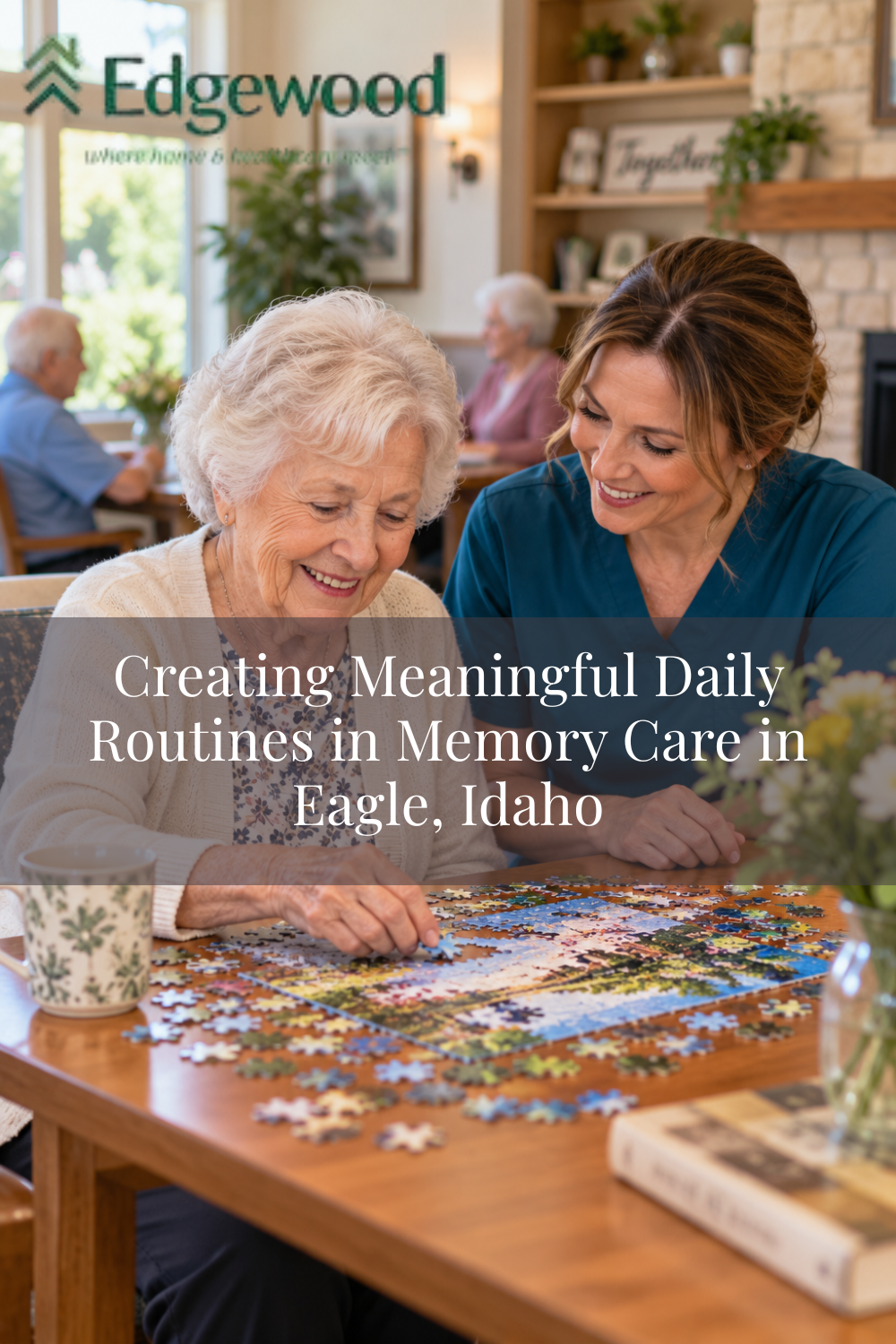
Creating Meaningful Daily Routines in Memory Care in Eagle, Idaho
Creating Meaningful Daily Routines in Memory Care in Eagle, IdahoWhen someone is living with Alzheimer's disease or another form of dementia, familiar parts of everyday life can become increasingly important.A person may forget the date, lose track of what happens next, or have difficulty recognizing a new environment. Yet they may still enjoy the smell of morning coffee, recognize a favorite song, smile when looking at family photographs, or feel comfortable following a routine they have practiced for decades.These seemingly simple moments matter.For families searching for memory care in Eagle, Idaho, it can be helpful to look beyond basic supervision and ask how a community supports the person behind the diagnosis.Does the care team learn residents' preferences?Are activities adapted to individual abilities?Can residents maintain familiar routines?Are there opportunities for social connection without overwhelming them?Edgewood Eagle Island, located at 77 North Fisher Park Way in Eagle, provides specialized memory care designed around personalized support, structured routines, dementia-trained caregivers, and activities intended to promote connection and quality of life. The community's current memory care program includes 24-hour staffing with RN access, individualized and small-group activities, personalized safety checks, home-cooked meals and snacks, housekeeping, laundry, and transportation coordination.For someone experiencing memory loss, these everyday details can help turn a care environment into a place where meaningful moments still happen.Why Routine Can Matter When Memory ChangesMost people have routines they barely notice.We wake up around the same time.We make coffee.We eat meals at familiar times.We listen to certain music, read the newspaper, walk the dog, call family members, or watch a favorite evening program.These patterns help organize life.For someone with dementia, predictable routines may become even more valuable because memory loss can make unexpected changes harder to process.Edgewood describes its memory care approach as providing personalized routines within smaller, secure environments designed to reduce anxiety and frustration. Its memory care residences are intentionally structured to make surroundings easier to understand, including apartments that reduce the need to navigate long hallways or multiple doors.A familiar daily rhythm might include:Waking and getting dressed at a comfortable paceEnjoying breakfast and a favorite morning beverageParticipating in light movement or a meaningful activitySpending time with other residentsEating lunchResting during the afternoonListening to music or participating in a smaller activityHaving dinnerFollowing a calm evening routineThe schedule does not need to be rigid.In fact, flexibility can be especially important.One resident may enjoy waking early, while another has spent a lifetime sleeping later.A person may be energetic one morning and tired the next.Good dementia support should provide enough structure to create familiarity while still responding to what the individual needs that day.Memory Care Tip: A helpful routine is not about making every resident follow the same schedule. It is about creating familiar patterns while respecting the person's lifelong habits, abilities, and preferences.Preserving Identity Starts With Knowing the PersonA dementia diagnosis describes a medical condition.It does not describe an entire person.Someone living at Edgewood Eagle Island may also be a retired teacher, veteran, parent, grandparent, artist, gardener, business owner, musician, homemaker, volunteer, or lifelong Idaho resident.These experiences can remain meaningful even when memory changes.Families can help the care team learn important details such as favorite music, former occupations, hobbies, foods, family relationships, spiritual traditions, preferred routines, and activities that bring comfort.Why does this information matter?Because it gives caregivers ways to connect.A retired teacher may enjoy looking through books or helping organize materials.Someone who spent years gardening may enjoy flowers or outdoor time.A person who raised a large family may find familiar household activities comforting.Care becomes more personal when caregivers know something about the life the resident has lived.Meaningful Activities Are Not About Testing MemoryMemory care activities should not make residents feel as though they are constantly being tested.Questions such as "Do you remember this?" or "What did we do yesterday?" can sometimes create frustration when the answer is difficult to retrieve.Meaningful activities take a different approach.Edgewood's memory care program includes individualized and small-group activities, and its broader memory care program identifies music, creative activities, movement, social opportunities, familiar routines, and personalized experiences as examples of enrichment.The goal is connection, participation, and enjoyment.A successful activity might be as simple as listening to a familiar song.It might involve looking through photographs.Someone may enjoy light exercise, a simple craft, conversation, or a familiar household task.What matters is whether the experience fits that resident.Edgewood's Life Stations Bring Familiar Activities Into Memory CareOne distinctive element described in Edgewood's memory care materials is the use of Life Stations.These areas include familiar objects and activities connected with everyday experiences residents may recognize from earlier in life.Edgewood provides examples such as morning coffee, getting the mail, attending church, caring for children, and using tools for household repairs. The items are interactive so residents can pick them up, touch them, and engage with them.The idea is simple but meaningful.A resident may not remember what happened yesterday, yet handling an object associated with a lifelong routine may still feel recognizable.Someone who worked with tools for decades may connect with a familiar object.A former homemaker may enjoy an activity associated with caring for family.A person who attended church every Sunday may respond to familiar spiritual routines.These activities are not designed to force someone to remember.They are designed to create familiar experiences that may support comfort, purpose, and connection.Helping Residents Continue Doing What They CanMemory care should not automatically mean caregivers do everything for residents.Edgewood specifically describes its approach as helping residents maintain independence with daily activities while providing assistance where needed.That might mean allowing a resident to choose between two outfits rather than choosing clothing for them.Someone may still brush their own hair but need help preparing for a shower.A resident may no longer safely prepare a meal but may still enjoy helping with a familiar table-setting task.These opportunities can seem small.But they allow people to continue participating in their own lives.Independence in memory care does not necessarily mean completing an entire task without assistance.Sometimes it means continuing to do the parts that remain comfortable and safe.Familiar Caregivers Can Support Familiar RoutinesRoutines involve people as well as activities.For someone living with dementia, repeated interactions with unfamiliar caregivers can feel confusing.Over time, caregivers who know a resident can become familiar with subtle personal patterns.They may notice that one person prefers quiet mornings.Another resident may become anxious late in the afternoon.Someone may respond positively to music.Another may become calmer after walking.Edgewood states that memory care staff receive dementia-specific training and are taught communication techniques to support residents who may feel confused or upset.This knowledge can help caregivers respond to behavior as communication rather than immediately treating it as a problem.For example, someone repeatedly walking toward an exit may not simply be "wandering."They may believe they are late for work.They may be looking for a spouse.They may feel restless.Understanding the person can help caregivers choose a more supportive response.Meals Can Provide Familiar StructureMeals are another important part of daily rhythm.Edgewood Eagle Island's memory care program includes three home-cooked meals plus snacks each day.Meals provide nutrition, but they also mark the passage of time.Breakfast signals morning.Lunch provides a natural midpoint.Dinner helps transition residents toward evening.Familiar smells, foods, and dining routines may also be comforting.Families touring memory care may want to ask how personal food preferences are handled, whether residents receive assistance during meals when needed, and what happens when someone does not want the scheduled option.Edgewood notes that its dining services take individual likes into account while offering health-conscious meal options.Social Connection Should Match the ResidentSome people have always been social.Others prefer quiet conversation with one or two people.Memory care should recognize those differences.Edgewood offers both group and individualized activities, which can allow residents to participate at a level that feels comfortable.For one resident, a group music activity may be enjoyable.Another may prefer sitting with a caregiver and looking at pictures.Someone else may enjoy simply being present in a common area without directly participating.The purpose of community is not forcing everyone to socialize in the same way.It is creating opportunities for connection.Quiet Time Is Important TooAn activity calendar filled from morning through evening may look impressive, but residents with dementia may also need time to rest.Processing conversations, navigating surroundings, participating in activities, and completing personal care can require considerable energy.Quiet periods might involve:Resting in an apartmentListening to soft musicLooking through a bookSitting with a family memberWatching a familiar programSpending time in a peaceful common spaceBalance matters.Meaningful memory care should include stimulation without overstimulation.Safety Can Create More FreedomFamilies sometimes think safety and independence work against each other.In a thoughtfully designed memory care environment, safety features can actually create more opportunities for residents to move freely.Edgewood's memory care environments include secure outdoor courtyards and smaller surroundings designed to reduce confusion and wandering risks.Someone who can no longer safely walk alone through an unsecured neighborhood may still be able to enjoy movement in a secure environment.Safety does not have to mean keeping someone seated or preventing activity.It can mean creating a space where meaningful activity can happen with less risk.Why Personalized Memory Care Matters in EagleEagle has one of the larger proportions of older adults among communities in the Treasure Valley.The U.S. Census Bureau estimated Eagle's population at 34,658 in 2025, with 24.3% of residents age 65 or older. Eagle also grew approximately 11.2% from its April 2020 population base to July 2025.By comparison, 18.7% of Idaho's overall population is 65 or older.As Eagle grows, more local households are likely to navigate Alzheimer's disease, dementia, caregiving, and long-term care planning.Having memory care within the local community can help residents remain closer to family, familiar physicians, friends, churches, and the broader Treasure Valley connections they already know.Family Involvement Still MattersMoving into memory care does not mean the family stops being important.Professional caregivers provide daily support, but family members still bring something no staff member can fully replace: lifelong history.Families know favorite stories.They know old nicknames.They know which songs Dad played repeatedly.They know Mom always loved gardening.Visits can remain meaningful even when a resident no longer remembers every detail afterward.Rather than focusing heavily on memory questions, families can enjoy activities together in the present.Listen to music.Have a snack.Take a walk.Look at photographs.Sit quietly.A positive moment still has value even when the memory of it later fades.Frequently Asked Questions About Daily Life in Memory CareWhy are routines helpful for people with dementia?Predictable routines can make the day easier to understand and may reduce unnecessary uncertainty. Edgewood's memory care approach includes structured and personalized routines designed around residents' individual needs.What kinds of activities does Edgewood offer in memory care?Edgewood describes memory care activities including music, creative activities, movement, social opportunities, familiar routines, and personalized experiences based on resident interests and abilities. Edgewood Eagle Island also specifically provides individualized and small-group activities.What are Edgewood Life Stations?Life Stations use familiar objects and activities associated with everyday experiences such as morning coffee, getting the mail, attending church, caring for children, or using household tools. They are designed to encourage interaction, familiarity, and meaningful engagement.Does Edgewood Eagle Island have 24-hour memory care support?Yes. The current Eagle Island memory care program includes 24-hour staffing with access to an RN.Where is Edgewood Eagle Island located?Edgewood Eagle Island is located at 77 North Fisher Park Way, Eagle, Idaho 83616, and the community lists 208-939-6499 as its phone number.Creating Meaningful Days Even When Memory ChangesMemory loss can change what a person remembers.It can change communication.It can change how someone understands time and surroundings.But it does not eliminate the need for belonging, purpose, familiarity, choice, and human connection.A meaningful memory care day may be built from very ordinary things.A familiar breakfast.A favorite song.A conversation with a caregiver.A recognizable activity.A quiet rest.A shared meal.A family visit.Those small moments matter.For families searching for memory care in Eagle and Ada County, Edgewood Eagle Island provides specialized memory support in an environment designed around safety, personalized routines, dementia-trained caregivers, meaningful activities, and quality of life. Its memory care program includes 24-hour staffing with RN access, personalized safety checks, home-cooked meals and snacks, individualized and small-group activities, housekeeping, laundry, and transportation coordination.Edgewood Eagle Island is located at 77 North Fisher Park Way in Eagle and offers independent living, assisted living, memory care, 55+ living options, and short-term stays within its broader senior living community.Families can learn more and connect with Edgewood Eagle Island through its SeniorsBlueBook.com business profile: [SBB Listing URL].When comparing memory care options, consider more than whether someone will be safe.Ask how the community will learn who your loved one is.Ask how favorite routines can continue.Ask how activities are personalized.And ask whether the environment provides opportunities for residents to keep experiencing meaningful moments, even as memory changes.