Analog Capital Partners Q3 2026 Summary
Oct 22, 2026

Email US
Click to Email Us
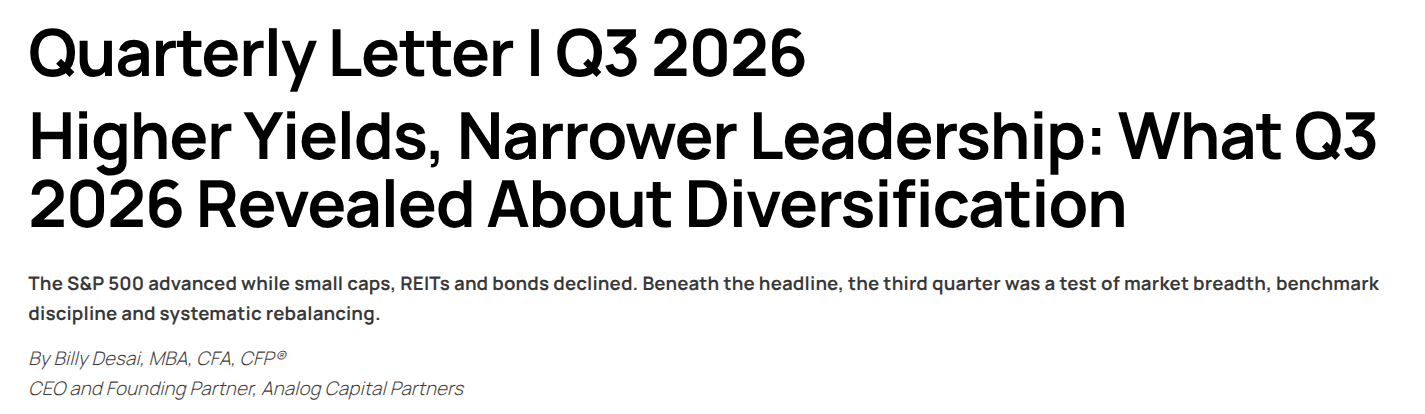
Analog Capital Partners Quarterly Market Summary, dated October 5, 2026
- To view the original version of this article visit www.acpfo.com/insights/higher-yields-narrower-leadership-what-q3-2026-revealed-about-diversification?utm_campaign=366507717-Analog&utm_content=466590395&utm_medium=social&utm_source=linkedin&hss_channel=lcp-66714546
- Seniors Blue Book was not involved in the creation of this content.
Other Articles You May Like
Making Your Retirement Savings Work Smarter
Making Your Retirement Savings Work SmarterRetirement is a major financial transition. After spending decades earning income and building savings, older adults may begin depending on those resources to support everyday expenses, healthcare needs, housing, and personal goals.For some retirees, the priority is generating dependable income. Others want to preserve their savings, maintain financial flexibility, or leave something meaningful for future generations.These goals can become more challenging when financial markets fluctuate, living expenses increase, or unexpected healthcare costs arise.A retirement investment strategy should address these concerns without assuming that every investor needs the same products or level of risk.For older adults and families throughout Middlesex County, New Jersey, understanding retirement investments can be an important step toward making informed financial decisions.Amboy Bank of NJ, officially known as Amboy Bank, provides wealth management and investment planning services through its financial services offerings.Its services include personalized financial planning, investment portfolio guidance, digital investing, and access to products such as mutual funds, exchange-traded funds, stocks, bonds, and annuities.Investment and insurance products are offered through Amboy Financial Services, a division of Amboy Bank, with products supplied by various companies.These investments are distinct from traditional bank deposits and involve financial risks, including the possible loss of principal.Understanding the difference between saving, investing, and generating retirement income can help older adults evaluate strategies that support their long-term financial goals.Why Retirement Investment Planning MattersFinancial priorities often change when someone moves from earning a regular paycheck to relying on retirement income and accumulated savings.A person who previously invested primarily for growth may become more concerned about preserving assets and covering monthly expenses.Common Retirement Financial GoalsThese may include:Maintaining dependable incomeManaging everyday expensesPreserving emergency savingsPreparing for healthcare costsKeeping pace with inflationSupporting a spouseFunding personal interestsPlanning for potential long-term careProviding for family membersNo Single Strategy Fits EveryoneThe appropriate investment approach depends on income, savings, age, financial obligations, risk tolerance, and personal goals.A financial professional can help evaluate these factors.Investment and Wealth Management Services at Amboy BankAmboy Bank offers wealth management and financial planning services for customers at different stages of life.Its published investment offerings include access to diversified financial products and personalized investment guidance.Verified Services IncludeFinancial planningPersonalized investment strategiesStocks and bondsMutual fundsExchange-traded funds (ETFs)Digital investingAnnuitiesPortfolio monitoringPeriodic plan reviewsAccess to financial advisorsPersonalized Financial PlanningAmboy Bank describes developing financial plans around individual goals, time horizons, and investment preferences.Ongoing ReviewsThe bank also advertises investment plan updates when circumstances or objectives change.Understanding the Provider RelationshipSecurities and insurance products are offered through Amboy Financial Services, a licensed insurance producer and division of Amboy Bank, with products provided by various companies.These products are not bank deposits and are not guaranteed by Amboy Bank.Begin With Clear Retirement GoalsBefore selecting investments, older adults should determine what their money needs to accomplish.A person planning to retire next year may have different priorities from someone who has already been retired for a decade.Questions Worth AskingHow much monthly income do I need?Which expenses are predictable?What emergencies should I prepare for?How much money should remain readily accessible?What are my long-term healthcare concerns?Do I want to leave assets to family members?How much investment risk am I comfortable accepting?Establish PrioritiesSome goals may require money within months, while others involve a much longer time horizon.Review Goals RegularlyRetirement needs can change after a move, significant healthcare event, or family transition.An investment strategy should be reviewed when circumstances change.Understanding Investment Risk ToleranceRisk tolerance describes how much financial uncertainty and potential loss an investor is willing and able to accept.This distinction is especially important during retirement.Emotional Risk ToleranceSome people remain comfortable with market fluctuations.Others experience substantial concern when account balances decline.Financial Capacity for RiskAn investor may be emotionally comfortable with risk but unable to absorb a significant financial loss without affecting essential expenses.Why Both MatterA suitable investment strategy should consider both willingness and financial ability to tolerate losses.Questions to Discuss With an AdvisorHow would a market decline affect my expenses?When will I need to withdraw money?What amount of loss would create financial difficulty?Are my investments too concentrated?How much liquidity should I maintain?Amboy Bank's financial planning services emphasize matching investment strategies to individual goals and risk preferences.What Is Investment Diversification?Diversification involves spreading investments across different assets rather than relying entirely on one company, investment type, or market segment.Common Investment CategoriesThese may include:StocksBondsMutual fundsExchange-traded fundsCash and cash equivalentsOther suitable investmentsWhy Diversification MattersDifferent investments may respond differently to economic conditions.Holding a variety of assets can help manage certain concentration risks.Diversification Does Not Eliminate RiskA diversified portfolio can still lose value, particularly during broad market declines.The Right Mix Is PersonalAn investor's allocation should reflect financial goals, risk tolerance, time horizon, and cash needs.There is no universally appropriate percentage of stocks or bonds for every retiree.Understanding Stocks During RetirementStocks represent ownership interests in companies.Their value can rise or fall depending on business performance, market conditions, and investor expectations.Potential Role in a PortfolioStocks may provide opportunities for long-term growth.Some companies also pay dividends.Important RisksShare prices can decline substantially, and dividend payments are not guaranteed.Retirement ConsiderationsSomeone relying on investments for immediate expenses may have less flexibility to wait for markets to recover.Avoid Concentrating Too Much WealthOwning a large amount of a single company can create additional risk.A qualified financial professional can help evaluate whether stock investments fit an individual's circumstances.Understanding BondsBonds generally represent debt obligations issued by governments, businesses, or other organizations.Investors may receive interest payments and repayment of principal according to the bond's terms, subject to issuer creditworthiness and other risks.Why Retirees Consider BondsCertain bonds may provide scheduled income payments.Risks to UnderstandBonds can involve:Interest rate riskCredit riskInflation riskLiquidity riskMarket value fluctuationsBonds Are Not Automatically Risk-FreeThe safety of a particular bond depends on its issuer, structure, maturity, and other factors.Evaluate Income and AccessibilityRetirees should consider when funds may be needed and whether selling before maturity could create a loss.Mutual Funds and Exchange-Traded FundsMutual funds and exchange-traded funds allow investors to hold collections of securities through a single investment product.Amboy Bank identifies mutual funds and ETFs among the investments available through its wealth management services.Why These Products May Be ConsideredThey can provide exposure to multiple investments without requiring someone to select every individual security.Important DifferencesFunds vary in investment objectives, management methods, expenses, underlying holdings, and trading arrangements.Fees MatterExpense ratios and other applicable charges can reduce net investment returns.Understand the HoldingsA fund containing many investments is not necessarily low-risk.Its overall risk depends on the assets it owns and the strategy it follows.Digital Investing at Amboy BankAmboy Bank also offers digital investing options through its banking platform.The bank describes prebuilt portfolios based on an investor's comfort with risk.Published Digital Investing FeaturesThese include:Access through digital bankingInvestment portfolios designed around risk preferencesExchange-traded fund optionsOnline account accessSelf-directed investing arrangementsPotential ConvenienceSome investors may appreciate managing or reviewing investments online.Digital Access Does Not Remove RiskInvestments remain subject to market fluctuations, regardless of whether transactions occur through a mobile application or with an advisor.Compare Services CarefullyAsk about account minimums, management fees, fund expenses, trading costs, and access to professional advice.The Role of Annuities in Retirement PlanningAnnuities are financial products issued by insurance companies.They may be used to provide income during retirement, depending on their structure and terms.Amboy Financial Services offers access to annuity products through participating providers.Why Some Retirees Explore AnnuitiesCertain annuities can provide scheduled income payments.Important Features to UnderstandThese may include:Payment optionsContract durationFeesSurrender chargesWithdrawal restrictionsDeath benefitsInsurance company obligationsGuarantees Have LimitsAny contractual guarantee depends on the terms of the annuity and the financial strength and claims-paying ability of the issuing insurer.Annuities Are Not FDIC-InsuredAnnuities are insurance products, not insured bank deposits.A qualified advisor should explain risks, liquidity restrictions, and suitability before an individual purchases one.Savings Accounts, CDs, and Investments Are DifferentOlder adults often use the terms saving and investing interchangeably, but the underlying products have important differences.Bank Savings ProductsSavings accounts, money market deposit accounts, and certificates of deposit are deposit products.Eligible deposits at FDIC-insured banks receive coverage subject to applicable limits and ownership rules.Market InvestmentsStocks, bonds, mutual funds, ETFs, and similar securities involve market or issuer-related risks.These products are not covered by FDIC deposit insurance.Why the Difference MattersMoney needed for near-term expenses may warrant a different approach from money invested for longer-term goals.Understand Protection LimitsFDIC insurance does not protect investors against market losses in securities or the performance of insurance products.IRA Savings Options at Amboy BankAmboy Bank also offers certain individual retirement account savings products.Its published banking services include traditional and Roth IRA money market accounts and CD-related options.Potential UsesThese accounts may appeal to individuals seeking certain interest-bearing retirement savings arrangements.Tax Rules MatterDifferent IRA types have different rules concerning contributions, distributions, and taxation.Account Type Is ImportantAn IRA is a tax-advantaged account structure, while the investments or deposits held within it determine many of its financial characteristics.Consult a Tax ProfessionalRetirement account decisions can have significant tax consequences.Amboy representatives do not provide legal or tax advice, according to the bank's published disclosures.Creating a Retirement Income StrategyRetirement income planning involves determining how different financial resources may support everyday expenses.Potential Income SourcesThese may include:Social SecurityPension incomeRetirement account distributionsInterest incomeInvestment dividendsAnnuity paymentsOther appropriate sourcesMatch Income With ExpensesA retiree should understand which expenses must be paid regularly and which are discretionary.Recognize Variable IncomeMarket-related investment income is not necessarily stable or guaranteed.Consider a Financial ReviewA personalized retirement income plan can help clarify how financial resources may be used over time, including the risks of withdrawals during market declines.Inflation and Retirement Purchasing PowerInflation refers to increases in prices over time.When everyday expenses rise, a fixed amount of money may purchase fewer goods and services.Expenses That May IncreaseThese include:GroceriesUtilitiesInsuranceHousing costsTransportationHealthcarePersonal servicesWhy This Matters for RetireesSomeone planning for many years of retirement may need to consider how rising costs could affect their resources.Balance Growth and StabilityInvestments offering growth potential generally involve risks.Products offering greater principal stability may have different limitations, including the possibility of returns not keeping pace with inflation.Avoid GuaranteesNo investment strategy can promise that retirement savings will always outpace inflation.Preparing for Healthcare and Long-Term Care ExpensesHealthcare planning is an important component of retirement finances.Medical costs and personal care needs may change over time.Potential ExpensesThese may include:Insurance premiumsDeductiblesPrescription costsDental careVision careHome modificationsIn-home caregivingAssisted livingResidential nursing careKeep Resources AccessibleSome expenses may arise unexpectedly.Families should consider how quickly money can be accessed without unnecessary penalties or market-related losses.Understand Long-Term Care CoverageMedicare does not generally pay for ongoing custodial long-term care when that is the only care required.Coordinate PlanningFinancial professionals can help evaluate funding strategies, while insurance and benefits specialists can explain relevant coverage options.Understanding Withdrawal StrategiesRetirement savings may eventually need to provide regular income.The timing and size of withdrawals can significantly affect how long assets last.Factors to ConsiderAccount balancesInvestment performanceRequired expensesInflationTaxesMarket volatilityHealthcare needsExpected planning horizonAvoid a Fixed AssumptionA commonly discussed withdrawal percentage is not a guarantee of financial security.Market Declines MatterSelling investments during a decline can reduce the assets available for future growth or income.Review PeriodicallyA withdrawal strategy may need adjustment as expenses and market conditions change.Maintaining Emergency SavingsInvestment planning should not overlook short-term financial security.An emergency reserve may help cover unexpected expenses without requiring an investor to sell volatile assets at an unfavorable time.Potential Emergency ExpensesThese include:Home repairsMedical billsVehicle expensesUnplanned travelTemporary caregivingHousehold emergenciesAccessibility MattersEmergency money should generally be accessible when needed.Consider Appropriate Deposit ProductsDepending on account terms and insurance limits, bank deposit products may serve different purposes from long-term investments.Amboy Bank offers traditional savings and CD products alongside its separate investment services.Investment Fees and Their Long-Term EffectsInvestors should understand how much they pay for financial products and professional services.Potential ExpensesThese may include:Advisory feesFund expense ratiosTransaction costsAccount feesInsurance product chargesSurrender feesOther administrative expensesSmall Differences Can MatterOver time, recurring fees can affect investment balances and net returns.Ask for Written DisclosuresBefore investing, review applicable fee schedules, product documents, and disclosures.Evaluate the Services ReceivedA lower-cost product is not automatically the most suitable choice.The appropriate decision should consider services, risks, objectives, and total costs.Reviewing and Rebalancing a PortfolioAn investment allocation can change over time as markets move.A portfolio initially designed around certain percentages may gradually become more concentrated in particular investments.Why Reviews MatterPeriodic reviews can help determine whether the portfolio continues to match financial goals and risk tolerance.Changes That May Trigger a ReviewThese include:RetirementSignificant market movementsChanges in incomeMajor healthcare expensesA home saleDeath of a spouseNew family responsibilitiesChanges in financial goalsAvoid Emotional DecisionsFrequent buying or selling based on short-term headlines can involve additional risk and costs.Professional GuidanceAmboy Financial Services advertises ongoing portfolio access and plan updates as part of its wealth management offerings.Protecting Retirement Accounts Against Financial ScamsOlder adults may encounter unsolicited investment offers, misleading financial promotions, or requests for sensitive information.Warning SignsThese can include:Promises of guaranteed high returnsPressure to invest immediatelyUnsolicited requests for account passwordsClaims that an opportunity has no riskRequests to transfer money to unfamiliar individualsRefusal to provide written disclosuresVerify the ProfessionalInvestors should understand who is providing advice and which financial company offers the actual product.Protect Personal InformationUse verified contact information and appropriate secure channels.Ask QuestionsLegitimate investment decisions should allow time to review risks, fees, and relevant documents.Coordinating Retirement Planning With Family GoalsRetirement finances often affect more than one person.A married couple may have different income needs and investment preferences.Some families also want to plan for caregiving expenses or future inheritance.Questions Worth DiscussingWho manages financial accounts?Are both spouses familiar with the household finances?Are beneficiary designations current?What expenses may arise later?Who can help if financial management becomes difficult?Are important documents organized?Respect Financial IndependenceOlder adults should remain involved in financial decisions according to their abilities and legal rights.Legal Planning Is SeparateWills, trusts, powers of attorney, and estate-related legal documents should be discussed with qualified attorneys.Questions to Ask Before Working With an Investment AdvisorSelecting a financial professional is an important decision.Useful QuestionsWhat investment services do you provide?Which company offers the products?Are you acting as an investment adviser or broker?How are you compensated?What fees will I pay?What risks apply?How is the portfolio selected?How often is the plan reviewed?Can I access funds if necessary?What written disclosures are available?Clarify Product RelationshipsAt Amboy Bank, investment and insurance products are offered through Amboy Financial Services using products from various companies.Banking Services Are SeparatePurchasing investment or insurance products is not required to obtain banking or credit services from Amboy Bank.Expert Tip: Organize Retirement Money by PurposeRetirement Investment Tip: Before selecting investments, separate your financial goals into money needed for everyday expenses, money reserved for unexpected costs, and money intended for longer-term objectives. Discuss the appropriate liquidity and risk level for each purpose with a qualified financial professional. This can help prevent a long-term investment strategy from conflicting with short-term financial needs.Frequently Asked Questions About Amboy Bank Investments1. Does Amboy Bank provide retirement investment planning?Yes. Amboy Bank offers financial planning and wealth management services, including personalized investment strategies, portfolio reviews, and access to financial advisors through its financial services offerings.2. Are investment products offered directly by Amboy Bank?Amboy Bank states that securities and insurance products are offered through Amboy Financial Services, a licensed insurance producer and division of the bank, with products provided by various companies. These products are separate from insured bank deposits and are not guaranteed by the bank.3. What investment products are available through Amboy's wealth management services?Its published offerings include mutual funds, ETFs, stocks, bonds, annuities, personalized investment planning, and digital investing options. The availability and suitability of specific products depend on the provider, account, and investor's circumstances.4. Are investments purchased through Amboy Financial Services FDIC-insured?No. Securities and insurance products offered through Amboy Financial Services are not FDIC-insured, are not guaranteed by Amboy Bank, and may lose value. Eligible bank deposit products have different insurance protections under applicable FDIC rules.5. How can retirees get started with investment planning at Amboy Bank?Retirees can contact Amboy Bank to request information about its wealth management services and financial advisor consultations. A professional can discuss individual goals, investment risks, account options, fees, and relevant disclosures without guaranteeing returns.Building a Retirement Strategy Around Your PrioritiesRetirement investment planning is not simply about choosing the products with the highest advertised returns.It involves understanding financial needs, protecting appropriate emergency reserves, managing investment risks, and developing realistic expectations about income and future expenses.For older adults throughout Middlesex County, New Jersey, Amboy Bank of NJ offers wealth management and financial planning services through Amboy Financial Services.Its available offerings include personalized financial guidance, mutual funds, ETFs, stocks, bonds, digital investing, and annuity products.The bank also offers traditional deposit products that can serve different savings and liquidity needs.These choices should be evaluated carefully because deposit insurance protections do not apply to market investments and insurance products.A thoughtful retirement financial plan considers income sources, inflation, possible healthcare expenses, family responsibilities, and the investor's ability to tolerate losses.Periodic reviews can help keep the strategy aligned with changing goals.No investment approach can eliminate market risk or guarantee that retirement savings will last for a particular period.However, understanding available options and obtaining appropriate professional guidance can help retirees make financial decisions with greater clarity.Learn More About Amboy Bank of NJExploring retirement investment and wealth management services in Middlesex County, New Jersey?Visit Amboy Bank of NJ on SeniorsBlueBook.com to explore its Investments listing and learn more about financial planning, portfolio management, retirement income considerations, and available wealth management services.Contact Amboy Bank at 877-222-6269 or visit https://www.amboybank.com to learn about financial advisor consultations and investment services offered through Amboy Financial Services.Taking time to understand investment risks, financial goals, and available resources can help older adults develop a more informed approach to retirement planning.
Building a Bucket Strategy for Your Retirement Income
Retirement income planning doesn't have to feel overwhelming and our bucket strategy can give you a powerful framework to make it manageable. In this course, we'll walk through how to design, fund, and maintain a customized bucket strategy that aligns asset allocation with your time horizons, spending priorities, and risk tolerance. You'll come away ready to address sequence-of-returns risk and the behavioral challenges that can derail even the best retirement income plans.For a quick, informative course click: https://tinyurl.com/NestEgg-Buckets .
Senior Investment Services in Sarasota, FL
Retirement changes the purpose of investing. During working years, many people focus primarily on accumulating assets. Later in life, the questions often become more complex: How much can I safely withdraw? How much investment risk still makes sense? How should my portfolio work alongside Social Security, pensions, insurance, taxes, and estate-planning goals?For older adults looking for senior investment services in Sarasota, FL, professional guidance can help organize those decisions around personal circumstances rather than market headlines or one-size-fits-all recommendations.What Are Senior Investment Services?Senior investment services generally focus on managing assets during or approaching retirement.Depending on the investor, planning may involve: Stocks Bonds Mutual funds Exchange-traded funds Managed portfolios Annuities Retirement accounts Alternative investments Cash and short-term reserves Income-distribution strategies Asset allocation and diversification Risk management Investment planning becomes particularly important during retirement because losses may be harder to recover from when someone is simultaneously withdrawing money from a portfolio.The SEC's Investor.gov resources encourage older investors to regularly review asset allocation, understand investment risks, examine fees, monitor accounts, and confirm that an investment professional is properly registered.Level Four Financial Chad Choate Phone: 941-730-5983 Office: 1001 3rd Avenue West, Suite 500, Bradenton, FL 34205Chad Choate, III, AAMS, CEPA is a Business Unit Leader, Private Wealth Advisor, and Insurance Agent with Level Four.Investment Options Through Level FourLevel Four's platform provides access to several types of investment strategies.Its current Seniors Blue Book profile identifies options including: Equity strategies Fixed-income strategies Separately managed accounts Asset-allocation models Stocks Bonds ETFs Mutual funds Annuities Options Alternative investments Retirement and joint brokerage accounts The firm also offers broader capital-management resources intended to integrate investments with financial planning, retirement, insurance, taxes, and wealth-transfer considerations.Why Asset Allocation Matters in RetirementAsset allocation refers to how an investor divides money among categories such as stocks, bonds, and cash.There is no universally correct allocation for every retiree.Important considerations include: Age Retirement income Expected withdrawals Emergency reserves Other assets Health expenses Risk tolerance Investment time horizon Legacy goals Investor.gov explains that diversification can help spread investment risk and that asset allocations may need to be rebalanced as financial circumstances and markets change.An older adult living primarily on Social Security with limited liquid savings may need a very different investment approach from someone with a pension, substantial cash reserves, several investment accounts, and significant assets intended for future generations.Retirement Income and Investment WithdrawalsAccumulating money is only one stage of retirement planning. Eventually, many retirees begin drawing money from investment accounts.That creates questions such as: Which accounts should be tapped first? How much should remain invested? How much cash should be kept available? How will withdrawals affect taxes? How will required minimum distributions fit into the plan? What happens during a major market decline? Investor.gov specifically encourages older investors to create and periodically revisit a plan for withdrawing money from investment accounts.Level Four's broader platform includes retirement planning alongside investment management, allowing these questions to be considered together rather than in isolation.Business Owners Approaching RetirementChoate also holds the Certified Exit Planning Advisor, or CEPA, designation.For Sarasota-area business owners, retirement planning may depend heavily on what happens to the business. Level Four's business resources include exit planning, succession-related strategies, retirement plans, risk management, and other business-owner planning services.Why Senior Investment Services Matter Locally in SarasotaSarasota County is one of Florida's most retirement-oriented communities.The U.S. Census Bureau reports that 38.8% of Sarasota County residents are age 65 or older, while the county's estimated 2025 population was 479,958.For many local residents, investment accounts are no longer simply long-term savings vehicles. They may now be expected to help fund: Monthly living expenses Travel Healthcare Long-term care Housing changes Gifts to family Charitable goals Future inheritance That makes investment planning especially relevant in Sarasota's large retiree population.How to Get Started1. Define Your Goals2. Gather Financial Statements 3. Calculate Income and ExpensesInvestment recommendations make more sense when they are connected to actual cash-flow needs.4. Discuss Risk ToleranceAsk how much loss the portfolio could experience during difficult markets and how that would affect your retirement.5. Ask About Every FeeUnderstand both advisor compensation and investment-product expenses.6. Verify the ProfessionalUse Investor.gov or other regulatory resources before handing over investment assets.7. Review the Plan RegularlyRetirement needs change.Revisit the portfolio following major health, family, tax, housing, or financial changes.Related CategoriesFinancial Advisors Retirement Planning Long-Term Care Planning