The Landscape of Senior Housing in SWFL
Senior Housing Solutions
For more information about the author, click to view their website: Senior Housing Solutions
Sep 03, 2026
Florida - Southwest , National

Email US
Click to Email Us
Southwest Florida's Senior Housing Boom Is Here
Southwest Florida has long been one of the nation's premier retirement destinations, attracting older adults seeking sunshine, lower taxes, world-class healthcare, and an active lifestyle. Today, communities in Naples, Bonita Springs, Estero, Fort Myers, Cape Coral, and Marco Island are experiencing unprecedented growth as Baby Boomers continue to retire in record numbers.
For families exploring senior living options, understanding the current landscape of senior housing in Southwest Florida has never been more important. Whether you're researching assisted living, memory care, independent living, home care, or Continuing Care Retirement Communities (CCRCs), knowing the trends can help you make informed decisions before a crisis occurs.
Southwest Florida Is One of America's Oldest Regions
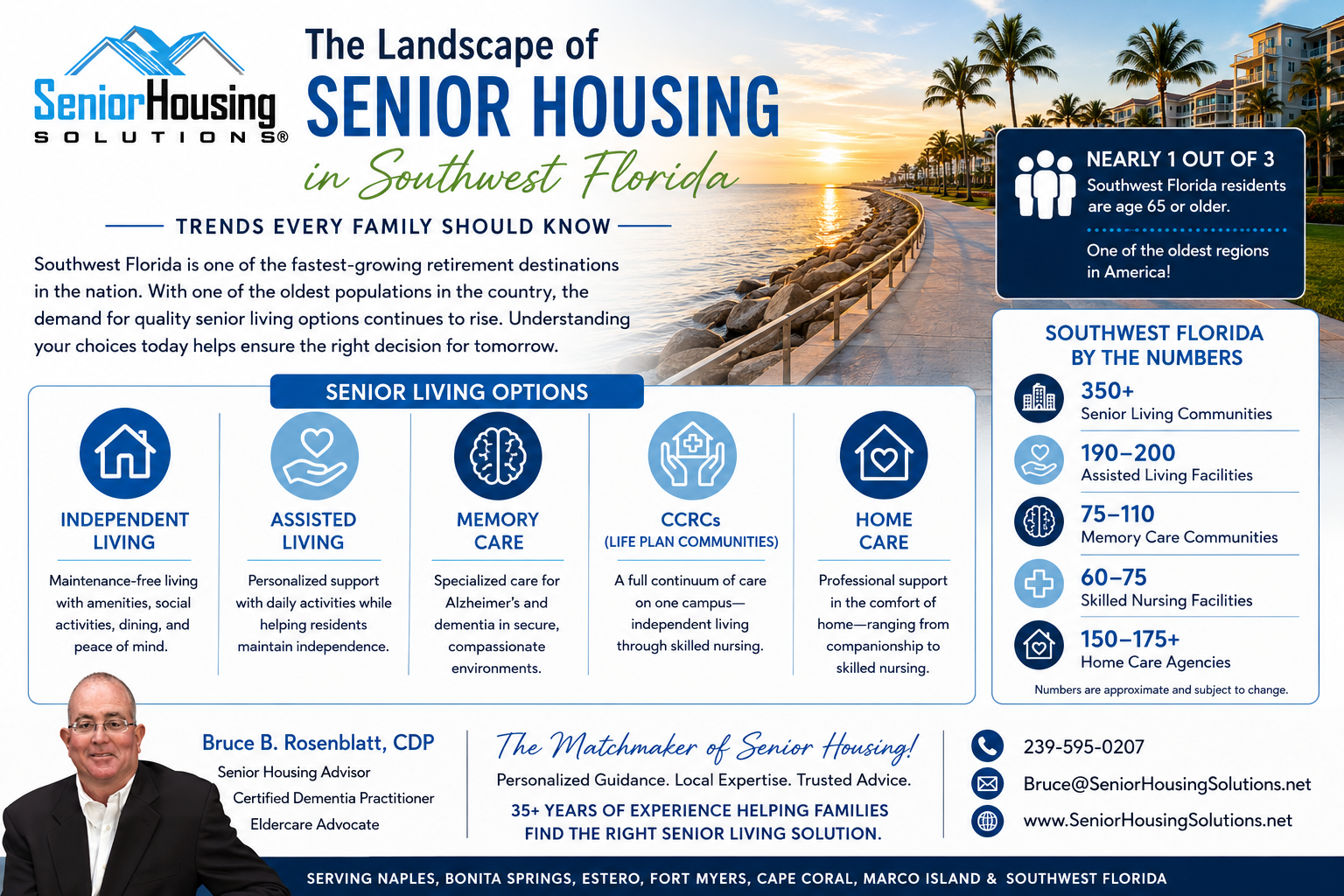
Nearly one-third of Southwest Florida residents are age 65 or older, significantly higher than both the Florida and national averages. This demographic shift is creating increased demand for senior housing, healthcare services, home care, and dementia care throughout the region.
The area's combination of favorable weather, no state income tax, abundant recreational opportunities, and quality healthcare continues to attract retirees from New York, New Jersey, Pennsylvania, Illinois, Ohio, Michigan, and other northern states.
As a result, senior housing providers are expanding services and developing new communities to meet growing demand.
Understanding Your Senior Living Options
One of the biggest misconceptions families have is that all senior living communities are the same. In reality, there are several distinct housing and care options designed to meet different needs.
Independent Living
Independent Living communities are ideal for active older adults who want a maintenance-free lifestyle without the responsibilities of homeownership.
Residents typically enjoy:
- Restaurant-style dining
- Housekeeping services
- Transportation
- Fitness programs
- Social activities
- Wellness programming
Many seniors move to Independent Living for convenience, socialization, and peace of mind rather than healthcare needs.
Assisted Living
Assisted Living communities provide support with activities of daily living while helping residents maintain as much independence as possible.
Services often include:
- Medication management
- Bathing assistance
- Dressing assistance
- Three daily meals
- Housekeeping
- Scheduled transportation
Assisted Living remains one of the fastest-growing segments of senior housing in Southwest Florida.
Memory Care
Memory Care communities specialize in caring for individuals living with Alzheimer's disease and other forms of dementia.
These communities offer:
- Dementia-trained staff
- Secure environments
- Specialized programming
- Cognitive engagement activities
- Enhanced supervision
As the number of dementia diagnoses continues to rise, Memory Care is expected to see significant growth throughout Southwest Florida over the next decade.
Continuing Care Retirement Communities (CCRCs)
Also known as Life Plan Communities, CCRCs offer multiple levels of care on a single campus.
Residents can transition between:
- Independent Living
- Assisted Living
- Memory Care
- Skilled Nursing
This model provides long-term security and peace of mind for seniors who want to plan ahead for future healthcare needs.
Why Families Are Starting Their Search Earlier
One of the most important trends in senior housing today is earlier planning.
Historically, many families waited until a medical crisis occurred before exploring senior living options. Today, more families are touring communities, attending educational seminars, and developing long-term plans before immediate care is needed.
Planning ahead offers several advantages:
- More community choices
- Better financial planning
- Reduced family stress
- Smoother transitions
- Access to waitlist opportunities
As I often tell families:
"It's better to be five years too early than five minutes too late."
The Growing Role of Home Care
Many older adults prefer to remain in their homes as long as possible. Southwest Florida has more than 150 home care providers offering services ranging from companionship and personal care to skilled nursing and rehabilitation.
While aging in place can be an excellent solution, families should understand that home care costs can increase significantly as care needs grow. For some seniors, senior living communities may ultimately provide greater social engagement, safety, and value.
Future Trends in Southwest Florida Senior Housing
Several trends are expected to shape the future of senior living throughout Naples and Southwest Florida.
Increased Demand for Memory Care
As the Baby Boomer generation ages, demand for specialized dementia care will continue to rise.
Technology-Enhanced Care
Senior living communities are increasingly implementing:
- Telehealth services
- Fall detection systems
- Smart-home technology
- Remote health monitoring
- Artificial intelligence tools
More Focus on Wellness
Today's seniors want more than healthcare. They seek communities that promote active lifestyles, lifelong learning, fitness, social engagement, and overall wellness.
Greater Demand for Affordable Options
One of the biggest challenges facing Southwest Florida is the need for more middle-market senior housing options that bridge the gap between luxury communities and government-assisted programs.
How a Senior Housing Advisor Can Help
With hundreds of senior living communities throughout Southwest Florida, finding the right fit can feel overwhelming.
A professional Senior Housing Advisor can help families:
- Understand available options
- Narrow community choices
- Schedule personalized tours
- Compare costs
- Review contracts
- Evaluate care levels
- Avoid common mistakes
Most importantly, an experienced advisor helps families make confident decisions during what is often an emotional time.
Frequently Asked Questions
What is the difference between Assisted Living and Memory Care?
Assisted Living provides support with daily activities, while Memory Care offers specialized care and secure environments for individuals living with dementia.
When should I start researching senior living options?
Ideally, families should begin researching before a healthcare crisis occurs. Early planning provides more options and reduces stress.
Are Senior Housing Advisor services expensive?
In many cases, Senior Housing Solutions' placement services are provided at no cost to families because communities pay referral fees after a successful move-in.
What is the best senior living option in Southwest Florida?
The best community depends on a person's health, lifestyle preferences, financial resources, and future care needs.
Let Senior Housing Solutions Help
Choosing the right senior living community is one of the most important decisions a family will make.
With more than 35 years of senior housing experience, Bruce Rosenblatt, CDP, provides personalized guidance to help families find the right Independent Living, Assisted Living, Memory Care, or Continuing Care Retirement Community in Southwest Florida.
Contact Senior Housing Solutions today for a complimentary consultation.
Bruce Rosenblatt, CDP
Senior Housing Solutions – Assisted Living Advisors
📞 239-595-0207
🌐 www.SeniorHousingSolutions.net
About the Author
Bruce Rosenblatt, CDP, is a Senior Housing Advisor, Eldercare Advocate, and Certified Dementia Practitioner with more than 35 years of experience in senior living. Known as "The Matchmaker of Senior Housing," Bruce has helped thousands of families navigate senior living options throughout Southwest Florida.
- To view the original version of this article visit seniorhousingsolutions.net/the-landscape-of-senior-housing-in-southwest-florida-trends-every-family-should-know/
- Seniors Blue Book was not involved in the creation of this content.
Other Articles You May Like
How to Navigate the Healthcare System When You Have a Chronic Illness
Living with a chronic illness can be challenging in many ways. Beyond managing symptoms and making lifestyle adjustments, individuals with long-term medical conditions often face the ongoing responsibility of navigating a complicated healthcare system. From scheduling appointments and coordinating with specialists to understanding treatment options and managing medications, keeping up with healthcare needs can quickly become overwhelming.Conditions such as diabetes, lupus, heart disease, multiple sclerosis, arthritis, and other chronic illnesses often require continuous medical attention. Patients may work with several healthcare providers, undergo routine testing, manage multiple prescriptions, and make important decisions about their treatment and long-term health.While managing a chronic illness can sometimes feel like a full-time job, understanding how to navigate the healthcare system can make the process easier. Having the right information, staying organized, communicating with healthcare professionals, and knowing where to find support can help patients take a more active role in their healthcare journey.Understanding the Challenges of Living With a Chronic IllnessA chronic illness is generally a health condition that lasts for an extended period and often requires ongoing medical management. Some conditions can be controlled with medication and lifestyle changes, while others may involve complex treatments, frequent appointments, and periods when symptoms become more severe.For example: Diabetes: Requires ongoing blood sugar monitoring, medication management, regular testing, and attention to nutrition and physical activity. Lupus: An autoimmune disease that can affect multiple parts of the body and may require care from several specialists. Heart Disease: Often involves monitoring heart health, managing medications, making lifestyle changes, and attending regular medical appointments. Multiple Sclerosis (MS): A neurological condition that may require specialized treatment, symptom management, rehabilitation, and ongoing monitoring. Arthritis: Can cause chronic pain, stiffness, and mobility challenges that require medication, physical therapy, and other forms of treatment. Although each condition is different, patients often face similar challenges when managing their healthcare.They may need to coordinate appointments with multiple specialists, understand complicated medical information, keep track of treatment plans, and communicate changes in their symptoms. These responsibilities can become especially difficult when someone is already dealing with pain, fatigue, or other symptoms associated with their illness.Understanding how the healthcare system works and knowing how to access the right resources can make a meaningful difference.Build a Strong Relationship With Your Primary Care PhysicianOne of the most important steps in managing a chronic illness is establishing a good relationship with a primary care physician.Your primary care provider can serve as a central point of contact for your healthcare needs. They can help monitor your overall health, coordinate referrals, review medications, and communicate with specialists involved in your treatment.Even if you see several specialists, maintaining regular appointments with your primary care physician helps ensure that your overall health is not overlooked.A primary care physician can also help identify changes in your condition and determine whether additional testing or specialized care may be necessary.Patients should feel comfortable discussing their symptoms, concerns, and treatment goals with their physician. Open communication helps providers better understand individual needs and make appropriate recommendations.Understand Your Medical Condition and Treatment OptionsLiving with a chronic illness often means becoming familiar with medical terminology, test results, medications, and treatment recommendations.However, understanding complicated medical information can be difficult, particularly when patients are dealing with a newly diagnosed condition or an unexpected change in their health.Taking time to learn about your diagnosis can help you become a more informed participant in your healthcare decisions.Start by asking your healthcare provider questions such as: What exactly does my diagnosis mean? How will this condition affect my overall health? What treatment options are available? What are the potential benefits and risks of each treatment? What symptoms should I watch for? Are there lifestyle changes that could help manage my condition? How often should I schedule follow-up appointments? When should I contact my doctor if my symptoms change? Do not hesitate to ask your physician to explain something again if you do not understand it. You deserve to have your questions answered and to understand the recommendations being made about your health.It can also be helpful to request written instructions or reliable educational resources that you can review after your appointment.Coordinate Care Among Multiple SpecialistsMany people with chronic illnesses receive care from several different medical specialists.For example, someone with diabetes and heart disease may see an endocrinologist, cardiologist, primary care physician, and nutrition specialist. A patient with lupus may work with a rheumatologist, nephrologist, dermatologist, and other specialists depending on which parts of the body are affected.Although each provider contributes valuable expertise, coordinating care between multiple medical professionals can become complicated.Patients may receive different recommendations, have difficulty transferring medical records, or struggle to remember which provider is responsible for specific aspects of their treatment.To make coordination easier, consider the following steps:Keep a List of Your Healthcare Providers: Maintain an updated list of doctors, specialists, clinics, and other healthcare professionals involved in your care.Organize Your Medical Records: Keep copies of important test results, diagnoses, treatment plans, and medical reports in one accessible location.Share Important Health Information: Make sure each provider has accurate information about your medical history, current medications, allergies, and other relevant health concerns.Track Appointments and Follow-Ups: Use a calendar or scheduling application to keep track of appointments, testing, and recommended follow-up visits.Ask Who Is Coordinating Your Care: Find out which provider should be your primary contact when questions involve multiple aspects of your treatment.Effective communication among healthcare providers can help patients receive more coordinated care and reduce confusion when managing complex medical conditions.Keep Track of Your MedicationsMedication management is another important part of living with a chronic illness.Some patients take several medications to control symptoms, prevent complications, or manage multiple health conditions. Keeping track of prescriptions, dosage instructions, refill dates, and potential side effects can become challenging.To stay organized, maintain an updated medication list that includes: The name of each medication. The prescribed dosage. When and how often it should be taken. The reason it was prescribed. Any known medication allergies or reactions. The prescribing healthcare provider. Bring this list to medical appointments and update it whenever a medication is started, stopped, or changed.It is also important to tell your healthcare providers about vitamins, supplements, and over-the-counter medications you use, since these may interact with prescription medications.If you experience side effects or have concerns about your prescriptions, contact your healthcare provider or pharmacist. Never stop or change a prescribed medication without discussing it with the appropriate medical professional.Medication reminders, pill organizers, and pharmacy refill services can also help make medication management easier.Prepare for Medical AppointmentsWhen living with a chronic illness, medical appointments may become a regular part of your routine. Preparing ahead of time can help you make the most of each visit.Patients sometimes forget important questions or struggle to remember changes in their symptoms when speaking with their doctors.Before an appointment, consider writing down: Any new or worsening symptoms. Changes in pain, energy levels, or mobility. Questions about medications or treatment recommendations. Concerns about side effects. Results from recent testing. Changes in your daily activities or quality of life. If you monitor certain health measurements at home, such as blood pressure or blood glucose, bring relevant records to your appointment.You may also want to bring a trusted family member or friend who can help take notes, remember instructions, and provide additional support.Being prepared can help you communicate more effectively and ensure that important concerns are addressed.Learn How to Advocate for YourselfSelf-advocacy is an important part of managing a chronic illness. It means taking an active role in your healthcare by asking questions, expressing concerns, and making sure your needs are understood.Patients sometimes hesitate to speak up because they do not want to question their physician or appear difficult. However, asking questions and requesting clarification are important parts of receiving appropriate care.If something does not seem right, or if you do not understand a treatment recommendation, it is reasonable to ask for more information.Effective self-advocacy may include: Speaking up when symptoms change or become worse. Asking for clarification when medical instructions are confusing. Discussing treatment options and personal preferences. Requesting copies of medical records and test results. Asking how different treatments may affect daily life. Seeking another medical opinion when appropriate. Remember that you are an important member of your healthcare team. Your experiences, concerns, and treatment goals deserve to be heard.Consider Getting a Second Medical OpinionA chronic illness may require ongoing treatment and long-term medical decisions. In some situations, patients may benefit from receiving another professional opinion about their diagnosis or treatment plan.A second opinion can provide additional information, confirm an existing diagnosis, or help patients better understand alternative treatment options.This may be particularly helpful when: You have received a complicated or unexpected diagnosis. Your current treatment is not producing the expected results. You are considering a major medical procedure. You are experiencing significant side effects. You want to explore additional treatment approaches. You feel uncertain about the recommendations you have received. Seeking a second opinion does not mean you distrust your current physician. It is simply another opportunity to become informed and feel confident about your healthcare decisions.A healthcare advocate may also help patients understand the process of obtaining another opinion and organizing the medical records needed for a consultation.Use Technology to Manage Your HealthcareTechnology has made it easier for many patients to access medical information and stay connected with their healthcare providers.Patient portals, mobile applications, and telehealth services can help individuals manage some of the everyday responsibilities associated with chronic illness.Depending on the healthcare provider and available services, technology may allow patients to: Review laboratory results and medical records. Request prescription refills. Schedule appointments. Send secure messages to healthcare providers. Participate in virtual medical visits. Track health measurements and symptoms. Receive appointment reminders. Some patients also use mobile applications to monitor blood pressure, blood glucose, physical activity, medication schedules, or other health information.These tools can help patients stay organized and provide useful information to share with their medical team.However, technology should complement, not replace, communication with healthcare professionals. Patients should discuss concerning symptoms and unexpected changes with their providers rather than relying solely on information from an application.Understand Your Health Insurance and Healthcare CostsManaging a chronic illness can involve significant financial responsibilities. Regular appointments, specialist visits, medications, laboratory testing, medical equipment, and treatment procedures can add up over time.Understanding your health insurance coverage can help you avoid unexpected expenses and make more informed decisions about your care.Important things to review include: Your insurance plan's coverage for specialist visits. Prescription medication coverage and pharmacy requirements. Deductibles, copayments, and out-of-pocket maximums. Whether referrals are required to see specialists. Coverage for physical therapy and other supportive services. Available financial assistance programs. If you are unsure about coverage, contact your insurance company or healthcare provider's billing department for clarification.Hospital and clinic social workers may also be able to connect patients with financial assistance programs, medication resources, and community organizations.Understanding your options can help reduce financial stress while ensuring you have access to the services you need.The Role of a Healthcare Advocate in Managing Chronic IllnessNavigating the healthcare system can be especially challenging when managing a long-term medical condition. Patients may spend considerable time coordinating appointments, communicating with specialists, understanding treatment recommendations, and organizing medical information.For individuals who feel overwhelmed by these responsibilities, working with a healthcare advocate may provide valuable support.A healthcare advocate helps patients understand and navigate the healthcare system while keeping their needs and preferences at the center of the process.Depending on the services offered, a healthcare advocate may help with:Understanding Medical Information: Helping patients organize information about their diagnosis, treatment recommendations, and healthcare options so they can have more informed conversations with their physicians.Coordinating Appointments: Assisting with scheduling and organizing appointments with multiple specialists and healthcare providers.Preparing for Doctor Visits: Helping patients identify questions, organize medical records, and prepare for important healthcare discussions.Improving Communication: Helping patients communicate concerns and understand instructions from their medical team.Exploring Additional Resources: Identifying support services, community programs, and other resources that may help patients manage their condition.Supporting Informed Decisions: Helping patients understand the information available so they can discuss treatment choices and personal preferences with their healthcare providers.A healthcare advocate does not replace a physician, diagnose medical conditions, or make treatment decisions. Instead, they provide guidance and support to help patients become more confident and informed participants in their healthcare journey.For patients managing multiple medical conditions or working with several specialists, having someone help organize the process can make a meaningful difference.Build a Support System to Help Manage Your ConditionLiving with a chronic illness can sometimes feel isolating, particularly when symptoms interfere with everyday activities or require ongoing lifestyle changes.Having a reliable support system can make managing a long-term condition easier.Family members and friends may be able to provide transportation, help with household responsibilities, attend medical appointments, or offer emotional encouragement.Patients may also benefit from connecting with support groups and organizations focused on their specific medical condition.For example, individuals living with diabetes, lupus, heart disease, or multiple sclerosis may find educational resources and support communities through national health organizations and local programs.In addition, counselors, social workers, registered dietitians, and other healthcare professionals may provide specialized assistance depending on individual needs.Having people who understand your challenges and are willing to help can reduce stress and make it easier to stay engaged in your healthcare.Take an Active Role in Your Long-Term HealthLiving with a chronic illness requires ongoing attention, patience, and commitment. While some days may be more challenging than others, taking small steps to stay organized and informed can make a significant difference.Understanding your diagnosis, maintaining communication with your healthcare providers, keeping track of medications, and coordinating appointments can help you feel more in control of your medical care.It is also important to remember that you do not have to manage every aspect of your healthcare alone. Family members, medical professionals, support organizations, and healthcare advocates can all play valuable roles in helping you navigate the process.You Don't Have to Navigate Chronic Illness AloneManaging a chronic illness involves much more than attending medical appointments and taking prescribed medications. It requires ongoing coordination, communication, decision-making, and adjustments to everyday life.For patients living with conditions such as diabetes, lupus, heart disease, multiple sclerosis, and other long-term illnesses, the healthcare system can sometimes feel complicated and overwhelming.Having the right support can help make the journey easier.A knowledgeable healthcare advocate can help patients understand medical information, prepare for appointments, coordinate care, and identify resources that may improve their healthcare experience.Vital Voice Healthcare Navigation understands that managing a chronic illness can be challenging. Having someone to help you navigate the healthcare system, communicate with medical professionals, and better understand your healthcare options can make a meaningful difference. You deserve to feel informed, supported, and confident as you take an active role in managing your long-term health.
How to Choose an Executor in Pennsylvania
Choosing an executor can look like one of the simplest parts of creating an estate plan. Many people name a spouse, adult child, sibling, or close friend because that person is trustworthy and knows the family well.Trust matters, but it is only part of the decision.Serving as an executor can become a substantial administrative job at a time when that person is also grieving. The executor may need to locate and protect assets, manage property, communicate with beneficiaries, address bills and creditor claims, handle tax filings, maintain detailed records, and eventually distribute estate property according to the will and Pennsylvania law.That is why the better question is not simply, "Who do I trust?" It is, "Who is prepared to handle this responsibility?"For Pennsylvania families, the answer can become even more important when the person you want to name lives in another state. Bond requirements and other administrative considerations may affect how easily that person can serve.This article focuses specifically on choosing the right executor. For a broader explanation of what happens after someone dies, Entrusted Legacy Law's guide to what families should know about Pennsylvania probate explains the overall process from opening the estate through distribution.What Is an Executor in Pennsylvania?An executor is the person nominated in a will to administer the deceased person's probate estate. Once properly appointed, that person serves as the estate's personal representative.If someone dies without a valid will, the person appointed to administer the estate is generally called an administrator rather than an executor. Both executors and administrators are personal representatives, and both can have substantial legal and financial responsibilities.Pennsylvania law gives personal representatives authority over estate property, but that authority comes with duties. Under Pennsylvania's Probate, Estates and Fiduciaries Code, a personal representative generally has the right and responsibility to take possession of, maintain, and administer estate property.This is one reason the role should not be treated as an honorary family title. The person accepting the appointment is taking on a legal position with real work attached to it.Families dealing with an estate after a death can learn more about Entrusted Legacy Law's Pennsylvania probate services and the steps that may be involved.What Does an Executor Actually Have to Do?The exact work depends on the estate. A modest estate with a few clearly documented accounts may be very different from an estate involving real estate, business interests, investment accounts, multiple beneficiaries, debts, tax concerns, or property in several states.Still, several responsibilities commonly fall to the personal representative.Identify and Protect Estate AssetsOne of the first challenges may simply be determining what the deceased person owned.The executor may need to locate financial accounts, real estate records, insurance information, vehicles, personal property, business interests, digital assets, and other property. They may also need to determine which assets are part of the probate estate and which transfer outside probate because of joint ownership, beneficiary designations, trusts, or other arrangements.Pennsylvania law requires personal representatives to file a verified inventory of estate property subject to the statutory requirements. The inventory generally reports the fair value of assets as of the date of death. Pennsylvania's statutory inventory requirements for personal representatives That can require more organization than families expect, particularly when records are incomplete or assets were accumulated over many decades.Maintain Property While the Estate Is OpenThe job does not stop once property is identified.An executor may have to protect a vacant home, maintain insurance, arrange necessary repairs, monitor accounts, collect income, safeguard valuables, or make other reasonable expenditures while administration is underway.Pennsylvania law specifically addresses a personal representative's responsibility to take possession of and administer estate property and to make reasonable expenditures necessary to preserve it.Someone who lives far away, travels frequently, or has little available time may find these practical responsibilities difficult even if they are completely trustworthy.Address Bills, Debts, and Creditor IssuesAn executor is also responsible for properly handling financial obligations of the estate.That does not necessarily mean immediately paying every bill that arrives. Claims may need to be reviewed, estate assets may need to be preserved for higher-priority obligations, and the executor needs to understand what can appropriately be paid and when.Distributing estate assets too early can create problems if taxes, valid debts, expenses, or other obligations remain unresolved.This is one of several reasons estate administration often requires patience. An executor may have family members asking when they will receive an inheritance while the executor is legally responsible for making sure necessary administration occurs first.Executors May Have Significant Tax ResponsibilitiesTaxes are another part of the role that people may not consider when selecting an executor.Pennsylvania imposes an inheritance tax on certain transfers following death. Rates and exemptions depend on factors including the beneficiary's relationship to the deceased person. The Pennsylvania Department of Revenue explains that inheritance tax payments become delinquent nine months after death and provides a discount for certain payments made within three months. Pennsylvania inheritance tax guidance The state's current instructions for the Pennsylvania Inheritance Tax Return also identify the personal representative as the person generally responsible for filing the return and disclosing property of the deceased person that comes to the representative's knowledge.Depending on the estate, there may also be income tax returns for the deceased person or the estate and, in a smaller number of cases, federal estate tax requirements.The Internal Revenue Service describes the general responsibilities of an estate administrator as collecting the deceased person's assets, paying creditors, and distributing the remaining assets to heirs or beneficiaries. Internal Revenue Service guidance for decedents and estate administrators The executor does not have to personally prepare every tax return. Accountants, attorneys, appraisers, financial professionals, and other advisers may assist. The executor still needs enough judgment and organization to coordinate the work and make sure responsibilities are addressed.Why Executor Selection Is About Skill Set, Not Birth OrderMany estate plans follow an unwritten family rule:"The oldest child will be executor."Sometimes that is an excellent choice. Sometimes it is not.Birth order does not tell you whether someone is organized, financially responsible, comfortable with paperwork, available to communicate with professionals, or able to remain calm when beneficiaries disagree.Imagine a parent with three adult children.One child lives nearby and loves the family deeply, but already has significant work and caregiving demands. Another lives several hours away but is meticulous with finances and deadlines. The third gets along with everyone but avoids difficult conversations.There is no automatic answer about who should serve. The decision depends on the family, assets, relationships, geography, and complexity of the plan.A useful executor often has several qualities: Reliability and follow-through Strong organization and recordkeeping habits Comfort working with financial and legal information The ability to communicate clearly with beneficiaries Enough time to participate in the process Sound judgment during emotional situations Willingness to ask for professional guidance when needed You do not need to choose the person with the most financial knowledge. Professional advisers can help with technical matters. The executor does need to be someone capable of managing the process responsibly.Can an Executor Be Personally Responsible for Mistakes?Serving as personal representative is a fiduciary responsibility. That means the person is managing property and making decisions on behalf of the estate and its beneficiaries, rather than simply dealing with their own money.Personal liability is not triggered by every innocent mistake, and the consequences of a particular action depend on the facts. Still, Pennsylvania law recognizes duties and potential liabilities for personal representatives.Pennsylvania Department of Revenue guidance, for example, states that an executor, administrator, or trustee can remain liable for certain unpaid Pennsylvania tax obligations after discharge when the fiduciary had notice of the obligation or failed to exercise due diligence before distributing assets. Pennsylvania guidance on estate and trust fiduciary tax duties The practical lesson is not that families should be afraid of serving. It is that the person accepting the role should understand that estate administration needs to be handled carefully.When a loved one has already passed away, Entrusted Legacy Law's trust and estate administration services are designed to help executors, trustees, and families work through these responsibilities.What If Your Executor Lives Outside Pennsylvania?Many Pennsylvania parents eventually face this issue.Their adult children may live in Florida, New Jersey, New York, Ohio, Texas, or somewhere else entirely. That does not automatically mean an out-of-state person cannot serve as executor.Pennsylvania's bond rules, however, deserve attention.Under Pennsylvania law, personal representatives generally must provide a bond unless a statutory exception applies. For an individual named as executor in a will, the law provides several circumstances in which bond is not required, including when the person is aPennsylvania resident, when the will expressly excuses bond, or, under certain conditions, when a nonresident serves with a qualifying Pennsylvania co-personal representative. A court can still order a bond in appropriate circumstances. Pennsylvania Probate Code Section 3174 on when a personal representative's bond is not required The situation can be different when someone dies without a will.A nonresident person seeking appointment as administrator is not included in the same statutory exemption that applies to certain resident administrators. As a result, a nonresident administrator may be required to post a bond before letters are granted, depending on the circumstances.This distinction is worth considering while you still have the ability to plan.If the person you want to manage your estate lives outside Pennsylvania, an estate planning attorney can evaluate whether the language of your will, the selection of additional representatives, your asset structure, or another planning strategy should be considered.Should You Name More Than One Executor?Some people consider naming two children together because it feels fair.Fair does not always mean practical.Co-executors may work well when both people communicate effectively, live reasonably close to one another, and have complementary strengths. They can also create additional administrative work when signatures, decisions, bank transactions, property issues, or disagreements require coordination.Before naming co-executors, consider how those two people actually make decisions together.If siblings routinely disagree, live on opposite sides of the country, or have very different approaches to money, requiring them to jointly administer an estate may introduce tension that did not need to exist.Naming one executor and one or more successors may sometimes provide a cleaner structure. The right arrangement depends on the family's circumstances and the estate plan.Ask the Person Before Naming ThemAn executor nomination should not have to come as a surprise after death.A conversation now gives the person an opportunity to understand the role and tell you whether they are willing to serve.You do not need to walk them through every account balance or disclose information you would prefer to keep private. They should at least know that you are considering naming them, where important estate planning documents can be found, who your advisers are, and how to locate the information needed to begin.Someone who does not want the responsibility can say so while you still have time to select someone else.That conversation can prevent a family from discovering after a death that the first-choice executor is unwilling or unable to serve.Your Estate Plan Can Make the Executor's Job EasierChoosing a capable executor is important, but the quality and organization of the estate plan matter too.An organized plan can reduce the number of unanswered questions the executor must resolve.For example, it can help when: Estate planning documents are current and accessible Beneficiary designations have been reviewed Asset ownership has been coordinated with the plan Important financial information can be located Successor fiduciaries are identified Family circumstances have been considered Instructions are legally documented rather than left only in conversation A will by itself does not necessarily keep an estate out of probate. How assets are owned and how the broader estate plan is structured can affect what happens after death. Families who are still planning can review Entrusted Legacy Law's Pennsylvania estate planning services to learn how the pieces of a comprehensive plan can work together.The goal is not to eliminate every task for the executor. Some responsibilities will remain. Good planning can give that person a clearer roadmap instead of leaving them to reconstruct your financial life while grieving.Review Your Executor Choice as Life ChangesThe person who made sense as executor ten years ago may no longer be the right choice.Children move. Relationships change. People develop health concerns. Careers become more demanding. A trusted sibling may get older. Someone who once lived nearby may now live across the country.Your own estate may also become more complicated.A business may have grown. You may have purchased additional real estate. Your investment accounts may be substantially larger. Your family may now include grandchildren, a blended family, or a beneficiary who needs additional planning.Executor selection is therefore worth revisiting when you review the rest of your estate plan.You are not judging someone's worth as a family member when you choose someone else. You are matching a job with the person best positioned to carry it out.Make the Choice With the Job in MindAn executor may be asked to step into a legal, financial, and administrative role during a difficult moment for your family. Choosing carefully now can provide much-needed structure later.Consider the person's time, temperament, organizational abilities, location, willingness to serve, and ability to work with advisers. If your preferred executor lives outside Pennsylvania, it is also worth discussing how Pennsylvania's bonding rules could apply to your specific plan.Entrusted Legacy Law helps families throughout Pennsylvania create estate plans that reflect not only who should inherit, but also who will be responsible for carrying out the plan. If you would like to review your executor choice or create a plan for the first time, you can schedule an introductory consultation with Entrusted Legacy Law.This article is for educational purposes only and is not legal advice. The application of Pennsylvania law depends on the facts of each estate.Choosing an executor in Pennsylvania means selecting someone who is trustworthy, organized, available, and capable of handling legal and financial responsibilities. An executor may manage assets, debts, taxes, records, and distributions. Out-of-state representatives can serve in many cases, but Pennsylvania bonding requirements may apply depending on the will and appointment circumstances.
What Higher Mortgage Rates Mean for Home Sellers
Higher mortgage rates don't just affect buyers. They can change what it takes to sell your house, too.That's because today's buyers are paying close attention to affordability. And when rates rise, even a relatively small change can make a noticeable difference in their monthly payment. So, they're looking for ways to make the numbers work. And in some markets, new construction is giving them exactly that.If you're planning to sell, that doesn't mean you can't compete. But it does mean you need to understand what builders are doing to win over buyers and what options you have, too.Builders Are Competing on the Monthly PaymentNew construction has something interesting going for it right now. While existing-home sales (homes that have previously been lived in) continue to struggle under the weight of higher mortgage rates, new-home sales are holding up a bit better.In a recent interview, Logan Mohtashami, Chief Economist at HousingWire explains new-home sales are at an 8-month high and are now running around 2019 levels. On the flip side, existing home sales are lagging behind and fall about 1 million home sales short of 2019 levels.One big reason builders have been able to navigate higher rates differently is incentives. According to Realtor.com, nearly 1 in 5 (18.8%) newly built homes come with some kind of buyer incentive advertised up front:The most common may surprise you. As the graph shows, many builders are offering reduced rates, sometimes through something called a mortgage rate buydown.Its essentially where they pay upfront costs to help buyers get a lower rate, and by extension, a lower monthly payment. It has obvious draws for buyers. For homebuilders, it helps them get their houses sold. So, a lot of builders see it as a win-win. Thats why reduced rates are a part of 13.8% of new home listings.In some cases, builders are offering rates below 6%, maybe even far below 6%. And that can help buyers shave hundreds off their monthly payment. That's a big difference to a buyer who are feeling the pinch right now.So, How Can Sellers Like You Compete?First, don't assume a mortgage rate buydown is something only a builder can offer. Sellers can contribute toward a buyer's rate buydown too, depending on the loan and transaction. Does that mean you should offer one? Or that you have to if you want to compete? Not necessarily.A buydown is just one possible lever. Depending on your market and the buyer, it may make more sense to negotiate on price, contribute toward your buyers closing costs, make repairs, or make sure your house stands out in ways a new build can't. That's why working with an agent who knows your local competition matters. Joel Berner, Senior Economist at Realtor.com, says:Sellers of existing homes are facing a lot of competition from the new-home space. . . so sellers should highlight the local amenities of their neighborhoods in contrast to the more suburban or exurban communities where many new homes are built.A great agent will do this naturally anyways. Knowing what makes your house different and showcasing that in your listing can help your house stand out. And remember, being open to making a few compromises or throwing in some concessions can make a bigger difference for buyers than you may think.Today's Market Rewards Sellers Who AdaptBuilders have also been quicker to adjust their prices based on what buyers can actually afford and where demand is. That's putting pressure on the resale market in some areas. Robert Dietz, Chief Economist at the National Association of Home Builders (NAHB), explains:. . . existing homeowners now have to do the price discovery that builders have been doing since 2022.That's an important message if you're hoping to sell.You don't automatically need to slash your price or offer a big concession. But you do need to price and market your house based on what buyers can pay today not what sellers could get a few years ago.And remember, this varies tremendously by location. New construction represents a much bigger share of the competition in some markets than others, and builder incentives aren't equally common everywhere. So, lean on an agent to see how big of a factor builders are in your area.Bottom LineHigher mortgage rates are making buyers more cost-conscious. Builders know that, and many are responding with reduced rate, closing-cost help, price reductions, and other incentives.If you're thinking about selling, let's look at what buyers are getting from other homes in our area including new construction and make sure your house is positioned to compete.
Local Services By This Author

Senior Housing Solutions
Housing ResourcesWelcome to Your Trusted Senior Housing Expert in Southwest FloridaYour Journey to the Right Senior Living Solution Begins HereAt [Your Company Name], we understand how overwhelming and emotional the process of finding the right senior housing can be. With over 30 years of experience in the senior housing industry, we have helped countless families make the right decision for their loved ones. We are committed to simplifying this process for you, offering expert advice and personalized service every step of the way.Why Choose Us?Over 30 Years of Expertise: With decades of experience, we have a deep understanding of the senior housing landscape and the unique needs of each individual.Locally Owned & Operated: Unlike national franchises, we are independently operated and deeply rooted in the Southwest Florida community. We genuinely care about the families we serve and treat every client like they are part of our family.No Cost to You: Our services are completely free for you. We are here to guide you through every step of the process at no cost.Personalized Assistance: We offer a tailored approach to help you find the best community, taking into consideration your unique needs, preferences, and budget.Our Process: Tailored to YouWe know that every familys needs are different. Thats why our process is personalized and designed to ensure that you make an informed decision. Heres how we can help:Initial Consultation: We begin with a one-on-one consultation where we listen carefully to your needs. Well take the time to understand whats important to you and your loved ones.In-Depth Community Analysis: Our team will provide a thorough review of the senior living options in Southwest Florida. We analyze every community in detail, so you can make the best choice for your situation.Education and Guidance: We educate you about the different types of senior living communities, from independent living to memory care and everything in between. Our goal is to help you understand all your options.Narrowing Down Choices: Based on your preferences and needs, well narrow down the list of communities and recommend the best matches for you.Tours and Visits: Well schedule and accompany you on community tours, helping you explore each option in person. We will be there every step of the way to answer questions and ensure you feel confident in your choices.Contract and Fee Negotiation: Once youve found the right community, we assist with understanding the contract terms and can help negotiate fees to ensure you are getting the best deal.Ongoing Support: Our commitment doesnt end after the move. We stay in touch to ensure a smooth transition and offer ongoing support. Were always available to address any questions or concerns.Additional Services to Make the Transition EasierOur goal is to provide comprehensive support throughout your senior housing journey. Beyond finding the right community, we also offer valuable resources to help with:Selling Your Home: Trusted connections to real estate professionals who specialize in selling homes for seniors.Veterans Benefits: Guidance on how to access Veterans Benefits that may help cover senior housing costs.Legal, Financial, and Medical Assistance: Referrals to trusted professionals who can provide legal, financial, or medical advice as you navigate this transition.Contact Us TodayFinding the right senior housing solution doesnt have to be stressful. Let us guide you through the process with personalized advice and expertise. Contact us today to schedule a free consultation and begin your journey to finding the perfect community for you or your loved one.Call Us at 239.595.0207 or fill out the form below to get started.
Senior Housing Solutions
Housing Placement & Resource SpecialistsWelcome to Your Trusted Senior Housing Expert in Southwest FloridaYour Journey to the Right Senior Living Solution Begins HereAt [Your Company Name], we understand how overwhelming and emotional the process of finding the right senior housing can be. With over 30 years of experience in the senior housing industry, we have helped countless families make the right decision for their loved ones. We are committed to simplifying this process for you, offering expert advice and personalized service every step of the way.Why Choose Us?Over 30 Years of Expertise: With decades of experience, we have a deep understanding of the senior housing landscape and the unique needs of each individual.Locally Owned & Operated: Unlike national franchises, we are independently operated and deeply rooted in the Southwest Florida community. We genuinely care about the families we serve and treat every client like they are part of our family.No Cost to You: Our services are completely free for you. We are here to guide you through every step of the process at no cost.Personalized Assistance: We offer a tailored approach to help you find the best community, taking into consideration your unique needs, preferences, and budget.Our Process: Tailored to YouWe know that every familys needs are different. Thats why our process is personalized and designed to ensure that you make an informed decision. Heres how we can help:Initial Consultation: We begin with a one-on-one consultation where we listen carefully to your needs. Well take the time to understand whats important to you and your loved ones.In-Depth Community Analysis: Our team will provide a thorough review of the senior living options in Southwest Florida. We analyze every community in detail, so you can make the best choice for your situation.Education and Guidance: We educate you about the different types of senior living communities, from independent living to memory care and everything in between. Our goal is to help you understand all your options.Narrowing Down Choices: Based on your preferences and needs, well narrow down the list of communities and recommend the best matches for you.Tours and Visits: Well schedule and accompany you on community tours, helping you explore each option in person. We will be there every step of the way to answer questions and ensure you feel confident in your choices.Contract and Fee Negotiation: Once youve found the right community, we assist with understanding the contract terms and can help negotiate fees to ensure you are getting the best deal.Ongoing Support: Our commitment doesnt end after the move. We stay in touch to ensure a smooth transition and offer ongoing support. Were always available to address any questions or concerns.Additional Services to Make the Transition EasierOur goal is to provide comprehensive support throughout your senior housing journey. Beyond finding the right community, we also offer valuable resources to help with:Selling Your Home: Trusted connections to real estate professionals who specialize in selling homes for seniors.Veterans Benefits: Guidance on how to access Veterans Benefits that may help cover senior housing costs.Legal, Financial, and Medical Assistance: Referrals to trusted professionals who can provide legal, financial, or medical advice as you navigate this transition.Contact Us TodayFinding the right senior housing solution doesnt have to be stressful. Let us guide you through the process with personalized advice and expertise. Contact us today to schedule a free consultation and begin your journey to finding the perfect community for you or your loved one.Call Us at 239.595.0207 or fill out the form below to get started.
Senior Housing Solutions
Transition SpecialistsWelcome to Your Trusted Senior Housing Expert in Southwest FloridaYour Journey to the Right Senior Living Solution Begins HereAt [Your Company Name], we understand how overwhelming and emotional the process of finding the right senior housing can be. With over 30 years of experience in the senior housing industry, we have helped countless families make the right decision for their loved ones. We are committed to simplifying this process for you, offering expert advice and personalized service every step of the way.Why Choose Us?Over 30 Years of Expertise: With decades of experience, we have a deep understanding of the senior housing landscape and the unique needs of each individual.Locally Owned & Operated: Unlike national franchises, we are independently operated and deeply rooted in the Southwest Florida community. We genuinely care about the families we serve and treat every client like they are part of our family.No Cost to You: Our services are completely free for you. We are here to guide you through every step of the process at no cost.Personalized Assistance: We offer a tailored approach to help you find the best community, taking into consideration your unique needs, preferences, and budget.Our Process: Tailored to YouWe know that every familys needs are different. Thats why our process is personalized and designed to ensure that you make an informed decision. Heres how we can help:Initial Consultation: We begin with a one-on-one consultation where we listen carefully to your needs. Well take the time to understand whats important to you and your loved ones.In-Depth Community Analysis: Our team will provide a thorough review of the senior living options in Southwest Florida. We analyze every community in detail, so you can make the best choice for your situation.Education and Guidance: We educate you about the different types of senior living communities, from independent living to memory care and everything in between. Our goal is to help you understand all your options.Narrowing Down Choices: Based on your preferences and needs, well narrow down the list of communities and recommend the best matches for you.Tours and Visits: Well schedule and accompany you on community tours, helping you explore each option in person. We will be there every step of the way to answer questions and ensure you feel confident in your choices.Contract and Fee Negotiation: Once youve found the right community, we assist with understanding the contract terms and can help negotiate fees to ensure you are getting the best deal.Ongoing Support: Our commitment doesnt end after the move. We stay in touch to ensure a smooth transition and offer ongoing support. Were always available to address any questions or concerns.Additional Services to Make the Transition EasierOur goal is to provide comprehensive support throughout your senior housing journey. Beyond finding the right community, we also offer valuable resources to help with:Selling Your Home: Trusted connections to real estate professionals who specialize in selling homes for seniors.Veterans Benefits: Guidance on how to access Veterans Benefits that may help cover senior housing costs.Legal, Financial, and Medical Assistance: Referrals to trusted professionals who can provide legal, financial, or medical advice as you navigate this transition.Contact Us TodayFinding the right senior housing solution doesnt have to be stressful. Let us guide you through the process with personalized advice and expertise. Contact us today to schedule a free consultation and begin your journey to finding the perfect community for you or your loved one.Call Us at 239.595.0207 or fill out the form below to get started.