Beacon Therapy of Utah
Mental Health & Counseling


About Beacon Therapy of Utah
At Beacon Therapy of Utah, we strive to provide the light on the shore and be the calm, soothing voice of direction, especially since weve experienced our storms and appreciated the beacons that helped us.
Is Senior Mental Health Therapy Right for Your Loved One?
Who this service helps:
- Seniors living in skilled nursing facilities or single-family homes
- Older adults struggling with depression, anxiety, isolation, or grief
- Individuals experiencing emotional difficulties due to physical decline or loss of independence
- Families seeking peace of mind and coordinated care with facility staff
Who it may not be a fit for:
- Seniors requiring primarily physical or occupational therapy rather than mental health support
- Individuals needing emergency medical intervention
- Those who do not reside in the service area for mobile visits
Serving: Salt Lake City, Taylorsville & all of Utah via telehealth.
See More
Continue Your Search! Explore More Local Options.
Start SearchingLet’s engage and get educated!
Browse through thousands of expert articles in over 100 different categories.
Browse NowArticles You May Like
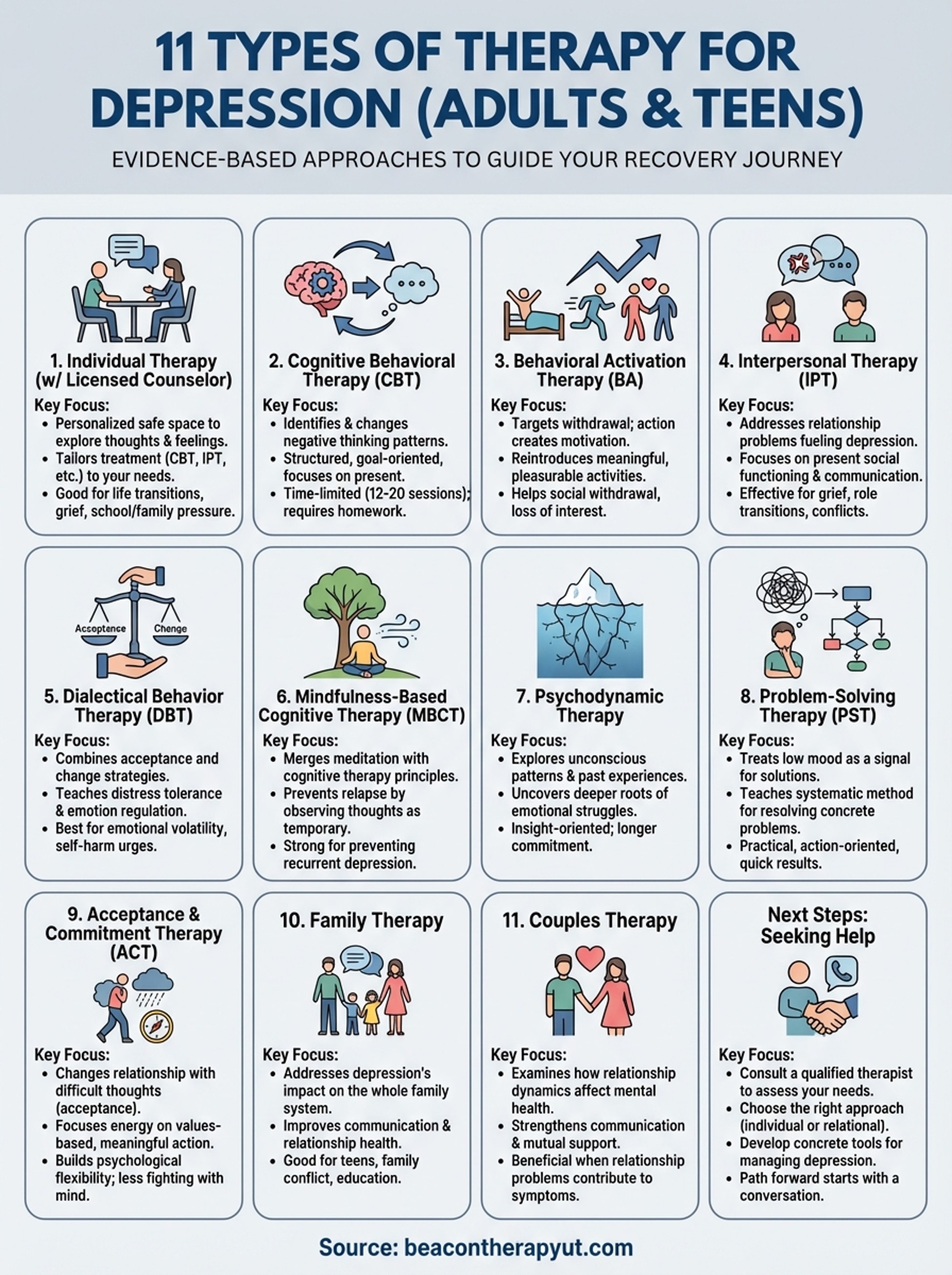
11 Types Of Therapy For Depression For Adults And Teens
Depression doesnt come with a one-size-fits-all solution. What works for one person may not work for another, which is why understanding the types of therapy for depression matters when youre ready to seek help. Whether youre an adult navigating a difficult season or a parent watching your teenager struggle, knowing your options puts you in a stronger position to make informed decisions about treatment.At Beacon Therapy, we work with adults and teens across Utah who have reached a turning point, people whove tried pushing through on their own and found that sheer willpower isnt cutting it anymore. Depression often responds well to professional intervention, but choosing the right therapeutic approach can feel overwhelming when you dont know whats available. The good news: several evidence-based treatments have proven effective, and many can be tailored to fit your specific circumstances.This guide breaks down 11 therapeutic approaches used to treat depression in adults and adolescents. Youll learn how each method works, who its best suited for, and what to expect during treatment. Some focus on changing thought patterns, others address past trauma, and a few combine multiple techniques. By the end, youll have a clearer picture of which direction might be right for you or your teen, and the confidence to take that next step toward feeling like yourself again.1. Individual therapy with a licensed counselorIndividual therapy with a licensed counselor forms the foundation of most depression treatment plans. This approach involves meeting one-on-one with a trained mental health professional who creates a safe space where you can explore your thoughts, feelings, and behaviors without judgment. For many adults and teens dealing with depression, this personalized attention becomes the cornerstone of recovery.What it isIndividual therapy pairs you with a licensed mental health counselor who tailors treatment to your specific situation. Your therapist draws from various evidence-based techniques depending on what you need most, whether thats changing negative thought patterns, processing past trauma, or developing concrete coping skills. This flexibility makes individual therapy one of the most adaptable types of therapy for depression, since your counselor can shift approaches as your needs evolve throughout treatment.What sessions look likeYoull typically meet with your counselor for 50-minute sessions once per week, though the frequency can adjust based on your symptoms and progress. During appointments, youll talk through whats been happening in your life, identify patterns that keep you stuck, and practice new skills between sessions. Your therapist might assign homework like journaling, tracking moods, or trying specific behavioral changes that support your healing.Your therapist acts as both guide and accountability partner, helping you build momentum when depression makes forward movement feel impossible.Who it helps mostThis approach works well for adults navigating life transitions, relationship problems, or grief, and for teens struggling with school pressure, identity questions, or family conflict. Youll benefit most if youre ready to be honest about your struggles and willing to try new strategies outside the therapy room. People whove been white-knuckling through life and finally realize they need professional support often find individual therapy gives them the direction theyve been missing.Pros and limitsThe biggest advantage is personalized care that adapts to your unique circumstances and changes over time. You control the pace, and your therapist maintains complete confidentiality. However, progress takes consistent effort, and insurance limitations might restrict how many sessions you can access. Some people also need medication alongside therapy for severe depression symptoms.What to ask when choosing a therapistAsk potential therapists about their training and experience with depression in your age group, whether theyve worked with issues similar to yours, and what therapeutic approaches they typically use. Find out their availability, cancellation policies, and whether they offer telehealth options if you cant always come to their office.Typical cost and insurance notesSessions typically run $100 to $250 without insurance, depending on your location and the therapists credentials. Most insurance plans cover mental health counseling but may require copays between $20 and $50 per visit. Check whether your plan limits the number of sessions per year and confirm your therapist accepts your insurance before your first appointment.2. Cognitive behavioral therapyCognitive behavioral therapy (CBT) stands out among types of therapy for depression as one of the most researched and validated approaches available. This structured, goal-oriented treatment focuses on the connection between your thoughts, feelings, and behaviors, helping you identify and change the negative thinking patterns that fuel depression. Rather than dwelling on past events, CBT teaches you practical skills to address current problems and prevent future episodes. What it isCBT operates on the principle that your thoughts directly influence how you feel and act. Your therapist helps you recognize distorted thought patterns like all-or-nothing thinking, catastrophizing, or personalizing negative events. Youll learn to challenge these automatic thoughts and replace them with more balanced perspectives that reduce depressive symptoms.What sessions look likeSessions follow a structured format with specific goals for each meeting. Your therapist might ask you to track thoughts and moods between appointments, then review these patterns together. Youll practice cognitive restructuring techniques and receive homework assignments that reinforce new skills in real-world situations.CBT gives you concrete tools to interrupt the cycle between negative thoughts and depressed mood, making it one of the most practical approaches for daily life.Who it helps mostThis method works particularly well for people who want a time-limited, focused treatment and those who prefer a logical, problem-solving approach. Youll benefit most if youre willing to complete homework assignments and actively participate in your recovery rather than expecting the therapist to fix everything for you.Pros and limitsCBT typically shows results in 12 to 20 sessions, making it relatively brief compared to other therapies. The skills you learn continue working after treatment ends. However, some people find the homework requirements demanding, and it may not address deeper emotional wounds that contribute to depression.What to ask when choosing a therapistConfirm the therapist has specific CBT training and certification rather than just familiarity with the approach. Ask how they structure sessions and what you should expect for homework between appointments.Typical cost and insurance notesCBT costs mirror individual therapy rates, typically $100 to $250 per session without insurance. Most insurance plans cover this treatment, though youll need to verify your therapist is in-network.3. Behavioral activation therapyBehavioral activation therapy (BA) takes a different route among types of therapy for depression by targeting what you do rather than what you think. This approach recognizes that depression often traps you in a cycle of withdrawal and inactivity, which then worsens your mood. Instead of analyzing thoughts first, BA helps you break this pattern through action, getting you back into activities that once brought meaning and pleasure to your life.What it isBA works on the principle that behavior change leads to mood improvement. Your therapist helps you identify activities youve stopped doing since depression began, from socializing with friends to pursuing hobbies or maintaining daily routines. Youll create a structured plan to reintroduce these behaviors gradually, even when motivation feels absent.What sessions look likeYour therapist starts by mapping out how you spend your time and which activities lift versus drain your energy. Together youll set small, achievable goals for the week ahead, like taking a 10-minute walk or calling a friend. Each session reviews what you accomplished, addresses obstacles you encountered, and adjusts your activity plan based on results.Behavioral activation proves that action creates motivation, not the other way around, making it particularly effective when depression has you completely stuck.Who it helps mostThis method works well for people whose depression shows up as social withdrawal, loss of interest in former hobbies, or spending excessive time in bed or on screens. Youll respond best if youre willing to push through initial discomfort and try activities even when you dont feel like it.Pros and limitsBA delivers results relatively quickly, often within 8 to 15 sessions, and requires less focus on analyzing thoughts compared to CBT. The straightforward approach appeals to people who prefer action over introspection. However, it may not address underlying trauma or complex thought patterns that contribute to depression.What to ask when choosing a therapistAsk whether the therapist has specific training in behavioral activation and how they track progress between sessions. Find out if theyll help you create activity schedules and how they handle situations when you cant complete assigned activities.Typical cost and insurance notesBA sessions typically cost $100 to $250 without insurance coverage. Most insurance plans cover this treatment under standard mental health benefits, though youll need to confirm your copay amount and session limits.4. Interpersonal therapyInterpersonal therapy (IPT) addresses depression by focusing on your relationships and social functioning. This time-limited approach recognizes that depression both affects and gets affected by how you interact with the people around you. Unlike other types of therapy for depression that emphasize thoughts or behaviors, IPT zeroes in on specific relationship problems that trigger or maintain your depressive symptoms, whether thats unresolved grief, role transitions, relationship conflicts, or social isolation.What it isIPT operates on the understanding that depression rarely exists in isolation from your social world. Your therapist helps you identify which relationship patterns contribute most to your current depression, then works with you to improve communication skills, resolve conflicts, or adjust to major life changes. The focus stays on present relationships rather than childhood experiences, making this a practical approach for addressing current interpersonal stressors.What sessions look likeTreatment typically spans 12 to 16 weekly sessions with a clear structure. Early meetings identify your main interpersonal problem area, while middle sessions focus on developing strategies to address that specific issue. Youll practice new communication techniques and explore how relationship changes impact your mood. Your therapist may ask you to try different approaches with family members or friends between appointments.IPT recognizes that fixing your relationships can fix your depression, since the two feed into each other in ways that keep you stuck.Who it helps mostThis method works particularly well for people whose depression started after a significant life change like divorce, job loss, or death of a loved one. Youll benefit most if ongoing relationship conflicts drain your energy or if isolation has become your default response to feeling down.Pros and limitsIPT shows strong research support and delivers results in a relatively brief timeframe. The relationship focus resonates with people who recognize their social connections need attention. However, it may not help as much if your depression stems primarily from biological factors rather than interpersonal issues.What to ask when choosing a therapistConfirm the therapist has formal IPT training and experience treating depression specifically. Ask which interpersonal problem areas they typically address and how they measure relationship improvements throughout treatment.Typical cost and insurance notesSessions cost $100 to $250 without insurance coverage. Most insurance plans cover IPT under mental health benefits, though your copay and session limits will depend on your specific plan.5. Dialectical behavior therapyDialectical behavior therapy (DBT) brings a unique approach among types of therapy for depression by combining acceptance and change strategies. Originally developed for people with intense emotional swings, DBT has proven effective for depression that comes with strong feelings of emptiness, relationship turmoil, or self-destructive behaviors. This skills-based treatment teaches you how to tolerate distress, regulate emotions, and navigate relationships more effectively.What it isDBT balances two opposing ideas: accepting yourself as you are while simultaneously working to change problematic patterns. Your therapist teaches you four core skill sets that include mindfulness, distress tolerance, emotion regulation, and interpersonal effectiveness. This comprehensive approach addresses both the emotional intensity and behavioral problems that often accompany depression.What sessions look likeYoull typically participate in individual therapy sessions plus weekly group skills training. Individual appointments focus on your specific challenges and help you apply DBT skills to real-life situations. Group sessions teach the four skill modules through structured lessons and practice exercises, creating a classroom-like environment where you learn alongside others.DBT gives you practical tools to manage overwhelming emotions without making your situation worse, which proves critical when depression triggers destructive impulses.Who it helps mostThis method works best for teens and adults whose depression includes emotional volatility, relationship problems, or urges toward self-harm. Youll benefit most if you struggle with intense feelings that seem to come out of nowhere and push you toward actions you later regret.Pros and limitsDBT provides concrete skills you can use immediately when emotions spike. The group component offers peer support and reduces isolation. However, treatment requires significant time commitment for both individual and group sessions, and the structured format may feel rigid to some people.What to ask when choosing a therapistConfirm the therapist completed comprehensive DBT training and follows the full model including both individual and group components. Ask about their experience treating depression specifically with DBT.Typical cost and insurance notesIndividual sessions cost $100 to $250, while group skills training adds $50 to $100 per week. Most insurance plans cover DBT, though youll need to verify coverage for both components separately.6. Mindfulness-based cognitive therapyMindfulness-based cognitive therapy (MBCT) merges meditation practices with cognitive therapy principles to create a powerful prevention tool for depression. This structured program teaches you to notice your thoughts and feelings without getting caught up in them, making it particularly effective for people whove experienced multiple depressive episodes. By training your mind to stay present rather than ruminating on past regrets or future worries, MBCT helps you break the thought patterns that trigger depression relapses.What it isMBCT combines mindfulness meditation techniques with elements from cognitive behavioral therapy. You learn to observe your thoughts as temporary mental events rather than facts you must believe or act on. This shift in perspective helps you catch negative thought spirals before they pull you back into depression, creating a buffer between difficult thoughts and depressive episodes.What sessions look likeTreatment follows an eight-week group format with weekly two-hour sessions plus daily homework. Youll practice guided meditations, gentle yoga stretches, and cognitive exercises that build awareness of thought patterns. Between sessions, you practice meditation for 45 minutes daily using recorded audio guides.MBCT trains your brain to step back from thoughts rather than wrestling with them, which proves more effective than trying to force yourself into positive thinking.Who it helps mostThis approach works best for people whove had three or more depressive episodes and want to prevent future relapses. Youll benefit most if youre willing to commit to daily practice and prefer group learning environments.Pros and limitsMBCT shows strong evidence for preventing relapse, reducing your risk by about 40 to 50 percent. Skills continue working after the program ends. However, the time commitment demands discipline, and it may not help acute depression as effectively as other types of therapy for depression.What to ask when choosing a therapistAsk about the instructors meditation training and experience leading MBCT groups specifically. Confirm they follow the standard eight-week protocol.Typical cost and insurance notesGroup programs typically cost $300 to $600 total for eight weeks. Insurance coverage varies, so verify whether your plan covers group mental health services.7. Psychodynamic therapyPsychodynamic therapy takes a different route among types of therapy for depression by exploring how past experiences shape present emotions. This insight-oriented approach helps you understand the unconscious patterns and unresolved conflicts that fuel your depression. Rather than focusing solely on symptoms, your therapist works with you to uncover the deeper roots of your emotional struggles, often tracing connections between current feelings and earlier relationships or experiences.What it isPsychodynamic therapy examines how unconscious thoughts and childhood experiences influence your current mood and behaviors. Your therapist helps you recognize recurring patterns in relationships, defense mechanisms youve developed, and internal conflicts that contribute to depression. This approach assumes that bringing hidden emotions and motivations into conscious awareness allows you to process them and make meaningful changes.What sessions look likeSessions typically feel more open-ended and exploratory than structured therapies like CBT. Your therapist encourages you to talk freely about whatever comes to mind, then helps you notice patterns and themes that emerge. Youll explore how past relationships mirror current ones and examine feelings that surface during therapy itself as windows into deeper issues.Psychodynamic therapy reveals how patterns you developed years ago still run your emotional life today, which explains why the same problems keep showing up in different situations.Who it helps mostThis method works well for people whose depression connects to relationship patterns, childhood experiences, or recurring life themes they cant quite understand. Youll benefit most if youre interested in self-exploration and willing to examine uncomfortable feelings rather than seeking quick symptom relief.Pros and limitsPsychodynamic therapy offers deep personal insight and lasting change by addressing root causes rather than surface symptoms. However, treatment typically requires longer commitment, often six months to several years, and progress may feel slower than with symptom-focused approaches.What to ask when choosing a therapistConfirm the therapist has formal psychodynamic training and experience treating depression. Ask about their typical treatment length and how they measure progress.Typical cost and insurance notesSessions cost $100 to $250 depending on location and credentials. Insurance coverage varies, so verify your plan covers long-term psychotherapy rather than short-term treatment only.8. Problem-solving therapyProblem-solving therapy (PST) takes a practical approach among types of therapy for depression by treating your low mood as a signal that specific problems need solutions. This structured treatment teaches you a systematic method for identifying, analyzing, and resolving the concrete challenges that fuel your depression. Rather than focusing on emotions or thought patterns first, PST helps you develop effective problem-solving skills that reduce stress and improve your sense of control over life circumstances.What it isPST operates on the principle that depression often stems from ineffective responses to everyday problems. Your therapist teaches you a step-by-step process for tackling issues: defining the problem clearly, brainstorming multiple solutions, evaluating options, choosing an action plan, and reviewing results. This learnable framework applies to any challenge you face, from relationship conflicts to work stress.What sessions look likeTreatment typically runs six to 12 sessions with a highly structured format. Your therapist guides you through the problem-solving steps using current issues in your life as practice material. Youll identify specific problems to work on, generate potential solutions together, and create action plans to implement between sessions.PST proves that depression often lifts when you handle lifes problems more effectively, making it one of the most action-oriented approaches available.Who it helps mostThis method works well for people whose depression connects to concrete stressors like financial problems, work difficulties, or relationship conflicts. Youll benefit most if you prefer logical, solution-focused approaches over exploring emotions or past experiences.Pros and limitsPST delivers quick results and teaches skills youll use long after therapy ends. The practical focus appeals to people who want tangible progress. However, it may not address deeper emotional wounds or biological factors contributing to depression.What to ask when choosing a therapistAsk about their PST training and how they structure the problem-solving process. Confirm they have experience using this approach for depression specifically.Typical cost and insurance notesSessions cost $100 to $250 without insurance. Most plans cover PST under standard mental health benefits with typical copays between $20 and $50.9. Acceptance and commitment therapyAcceptance and commitment therapy (ACT) stands apart among types of therapy for depression by teaching you to change your relationship with difficult thoughts rather than trying to eliminate them. This values-based approach helps you stop struggling against painful emotions and instead focus energy on building a meaningful life despite depressions presence. ACT recognizes that fighting your thoughts often makes them stronger, so it trains you to accept uncomfortable feelings while still moving toward what matters most to you.What it isACT uses six core processes to increase psychological flexibility: acceptance, cognitive defusion, being present, self as context, values, and committed action. Your therapist helps you identify what truly matters in your life, then teaches you skills to pursue those values even when depression tells you to withdraw. Instead of arguing with negative thoughts, you learn to observe them without getting hooked.What sessions look likeSessions combine experiential exercises, metaphors, and mindfulness practices to teach ACT skills. Your therapist guides you through activities that illustrate how struggling against thoughts creates suffering, then helps you clarify your personal values and set concrete goals aligned with them. Youll practice noticing thoughts without believing them and taking action based on values rather than feelings.ACT proves you dont need to feel better before you can live better, which breaks the waiting game that keeps many people stuck in depression.Who it helps mostThis method works well for people whove spent years trying to control or suppress their thoughts without success. Youll benefit most if youre willing to stop fighting your mind and instead redirect that energy toward meaningful activities.Pros and limitsACT teaches practical skills that apply beyond depression, helping with anxiety and stress too. The values focus provides direction when motivation fails. However, the philosophical approach may feel abstract to people who prefer concrete, symptom-focused treatment.What to ask when choosing a therapistConfirm the therapist completed formal ACT training and uses the full model. Ask how they help clients identify values and measure behavioral changes related to those values.Typical cost and insurance notesSessions cost $100 to $250 without insurance. Most plans cover ACT under mental health benefits with standard copay requirements.10. Family therapyFamily therapy recognizes that depression doesnt exist in a vacuum but ripples through entire household systems. This collaborative approach brings family members together to address how depression affects everyone and how family dynamics either help or hinder recovery. Unlike individual types of therapy for depression that focus solely on the person experiencing symptoms, family therapy treats the whole family system as the client, working to improve communication patterns and relationship health that impact depressive symptoms. What it isFamily therapy examines how family interactions, roles, and communication patterns contribute to or maintain depression in one member. Your therapist helps everyone understand depressions impact on family functioning while identifying changes that support recovery. This approach recognizes that families often develop unhelpful patterns around the depressed person, like excessive caretaking or walking on eggshells, that unintentionally reinforce symptoms.What sessions look likeSessions typically include the depressed person plus key family members who live together or have significant involvement in daily life. Your therapist facilitates conversations about difficult topics, teaches communication skills, and helps family members express concerns productively. Youll practice new interaction patterns and receive guidance on supporting recovery without enabling avoidance.Family therapy proves that healing happens faster when your support system understands depression and learns healthier ways to respond to it.Who it helps mostThis method works well for adolescents and teens whose depression connects to family conflict or when parents need guidance supporting their child. Adults benefit when family relationships contribute to depression or when loved ones need education about the condition.Pros and limitsFamily therapy addresses systemic issues that individual therapy might miss and educates everyone simultaneously. However, not all family members may be willing to participate, and old patterns can be hard to change when everyone has established roles.What to ask when choosing a therapistAsk about their training in family systems theory and experience treating depression within families. Confirm they can work with your specific family configuration.Typical cost and insurance notesSessions cost $100 to $300 depending on how many people attend. Most insurance plans cover family therapy with copays between $20 and $50.11. Couples therapyCouples therapy addresses depression by recognizing that romantic relationships can both contribute to and help alleviate depressive symptoms. This collaborative approach brings both partners into treatment to examine how relationship dynamics affect mental health and how depression impacts the partnership. Unlike other types of therapy for depression that focus on the individual, couples therapy treats the relationship itself as a factor in recovery, working to strengthen communication and support while reducing patterns that worsen symptoms.What it isCouples therapy for depression examines how relationship conflict, emotional disconnection, or lack of support either triggers or maintains depressive episodes. Your therapist helps both partners understand depressions impact on intimacy and daily functioning while teaching skills to support each other more effectively. This approach recognizes that relationship distress and depression often feed into each other, creating a cycle where each problem makes the other worse.What sessions look likeBoth partners attend weekly 50 to 90-minute sessions together. Your therapist facilitates conversations about how depression affects your relationship, teaches communication techniques, and helps you identify interaction patterns that need adjustment. Youll practice expressing needs clearly and responding supportively when your partner struggles.Couples therapy proves that partners who understand depression and learn effective support strategies become powerful allies in recovery rather than additional sources of stress.Who it helps mostThis method works well for people whose depression connects to relationship problems or when a partner feels confused about how to help. Youll benefit most if both people commit to attending sessions and making relationship changes.Pros and limitsCouples therapy addresses relationship factors that individual therapy might miss and equips your partner with concrete support strategies. However, it requires both partners participation, and some relationship problems may need resolution before tackling depression effectively.What to ask when choosing a therapistAsk about their training in couples therapy and experience treating depression within relationships. Confirm they can balance addressing both relationship issues and depressive symptoms.Typical cost and insurance notesSessions cost $125 to $300 depending on length and location. Insurance coverage varies, with copays typically between $30 and $75 per session.Next stepsYouve now explored eleven different types of therapy for depression, each offering distinct approaches to help you or your teen find relief. The variety might feel overwhelming, but understanding your options puts you in control of your treatment journey. Most people benefit from starting with individual therapy, where your counselor can assess your situation and recommend the specific approach that matches your needs, whether thats CBT for thought patterns, IPT for relationship issues, or another method entirely.Depression doesnt improve through willpower alone, and recognizing that truth shows strength rather than weakness. The next move involves reaching out to a qualified therapist who can guide you through the options and create a treatment plan tailored to your circumstances. At Beacon Therapy, we work with adults and teens across Utah whove reached the point where pushing through stops working. Our licensed counselors help you regain direction and develop concrete tools for managing depression rather than just talking through problems week after week. Your path forward starts with a conversation about which therapeutic approach fits your situation best.
Sep 02, 2026

Essential Tips for Caring for Aging Parents:
Essential Tips for Caring for Aging Parents: A Guide for Family Caregivers Caring for aging parents is a journey filled with both challenges and rewards. As our loved ones age, their needs often become more complex, requiring dedicated support and thoughtful planning. Whether youre just starting this caregiving journey or have been navigating it for years, having the right tools and knowledge can make all the difference. Below is essential caring for aging parents tips, practical advice, and insights into family caregiver support that will guide you in providing the best care for your elderly loved ones.Understanding Your Parents NeedsOne of the first steps in caring for aging parents is understanding their specific needs. Everyone will require a unique approach based on their health, mobility, cognitive abilities, and emotional state. Health Assessments: Regular health assessments are crucial. Ensure that your parents are visiting their doctor routinely and that their medications are regularly reviewed. Physical Needs: Evaluate their physical abilities. Are they able to perform daily tasks such as bathing, dressing, or eating independently? Recognizing areas where they need assistance helps ensure their safety and well-being. Mental Health: Aging can sometimes lead to depression, anxiety, or cognitive decline. Being aware of their mental and emotional health allows for early intervention and appropriate care. Organizing Finances and Legal AffairsElderly care often requires navigating financial and legal matters. Helping your aging parents organize their finances and legal affairs is an important aspect of being a family caregiver. Financial Planning: Begin by discussing your parents financial situation. Ensure they have the means to cover medical expenses, long-term care, or other related costs. You might consider speaking with a financial advisor to plan for future needs. Legal Documents: Ensure essential legal documents such as wills, power of attorney, and healthcare directives are in place. These documents help make critical decisions easier during emergencies. Creating a Safe Living EnvironmentAging parents often experience changes in mobility and balance, increasing the risk of falls or accidents. Adapting their living environment to suit their current needs is a key part of elderly care. Home Modifications: Simple modifications like installing grab bars in bathrooms, removing tripping hazards, and improving lighting can make a significant difference in creating a safer environment for your aging parents. Assistive Devices: Consider using assistive devices such as walkers, canes, or stairlifts to help maintain your parents mobility and independence. Building a Support NetworkAs a family caregiver, you dont have to handle everything on your own. Building a strong support network is essential for both your well-being and the well-being of your aging parents. Family Involvement: Involve other family members in caregiving. Whether its dividing tasks or providing emotional support, having a team approach reduces stress and ensures your loved one is cared for properly. Professional Support: Sometimes, the level of care required exceeds what family members can provide. In such cases, consider hiring professional caregivers, whether for full-time care or respite care, to give you a much-needed break. Maintaining Open CommunicationEffective communication between family caregivers and their aging parents is critical in ensuring that their needs are met and their preferences are honored. Regular Conversations: Engage in regular conversations with your parents about their care, preferences, and concerns. Keep communication open, honest, and respectful. Respecting Their Wishes: Even though youre making decisions in their best interest, its important to respect their wishes whenever possible. Whether its about living arrangements, medical treatments, or personal care, their input should be considered. Prioritizing Your Own Well-BeingCaring for aging parents can be emotionally and physically taxing. Its easy to focus entirely on their needs, but neglecting your own health and well-being can lead to caregiver burnout. Self-Care: Take time to care for your own physical and mental health. Regular exercise, proper sleep, and relaxation techniques can help you recharge and be more effective in your caregiving role. Support Groups: Family caregivers can benefit from joining support groups where they can share experiences, advice, and encouragement. Many local communities and online forums offer these groups, providing a place for caregivers to connect. Managing Medical and Personal CareMany aging parents will need help managing their medical appointments and personal care routines. Understanding the best way to offer support in these areas is essential for family caregiver support. Scheduling Medical Appointments: Help your parent schedule and attend medical appointments. Keep a record of their medications, treatments, and doctors recommendations. Assisting with Personal Hygiene: Personal hygiene can become challenging for elderly individuals. Provide respectful assistance with bathing, grooming, and dressing if necessary. Adapting to Changing NeedsAs your parents age, their needs will continue to evolve. Being flexible and adaptable in your caregiving approach is key to providing the best care possible. Monitoring Health Changes: Regularly monitor your parents health and be mindful of any signs of physical or cognitive decline. This will allow you to adjust care plans as needed. Long-Term Care Options: At some point, you may need to explore long-term care options like assisted living or nursing homes if your parents care needs become too demanding. Research these options ahead of time to make informed decisions when the time comes. Addressing Emotional and Social NeedsAging can often lead to feelings of loneliness, isolation, or sadness. Ensuring your parents emotional and social needs are met is just as important as their physical care. Encouraging Social Engagement: Encourage your parents to stay socially active. Whether through community events, senior centers, or simply spending time with family and friends, social interaction is crucial for emotional well-being. Providing Emotional Support: Offer a listening ear when your parents want to talk. Let them express their fears, frustrations, and hopes. Emotional support plays a key role in elderly care. Seeking Outside ResourcesThere are numerous resources available to help family caregivers on their journey. From community services to government programs, finding the right support can alleviate many burdens. Community Resources: Many communities offer resources like meal delivery services, transportation assistance, or in-home care support for elderly individuals. These services can supplement your caregiving efforts. Government Programs: Investigate government programs such as Medicare, Medicaid, or veterans benefits that can help cover some of the costs associated with elderly care. Planning for the FutureWhile its essential to focus on the present, planning for the future is equally important when caring for aging parents. End-of-Life Care: Have conversations with your parents about their end-of-life wishes, including whether they want hospice care or have specific preferences for how they want to spend their final days. Funeral and Estate Planning: These discussions can be difficult, but planning for funeral arrangements and estate distribution will make things easier for the family when the time comes. ConclusionCaring for aging parents is a meaningful and sometimes difficult responsibility. By following these caring for aging parents tips and seeking out elderly care advice, you can ensure that your parents physical, emotional, and social needs are met while also maintaining your own well-being. With a strong support system, open communication, and careful planning, family caregivers can provide the best possible care for their aging loved ones.As you move forward on this journey, remember that family caregiver support is available through community resources, professional services, and the shared experiences of others. By staying informed and prepared, youll be better equipped to provide compassionate and effective care.Need Professional Mental Health Therapy in Salt Lake City, UT?Here at Beacon Therapy of Utah, we understand that life can bring challenges that feel overwhelming, but you dont have to face them alone. Our personalized and compassionate care is here to guide you through those tough times, offering support and tools for emotional healing and personal growth. If youre ready to take the next step toward a healthier, more resilient you, we invite you to reach out and schedule a session with us today. Lets work together to find your path to peace and transformation.
Sep 02, 2026
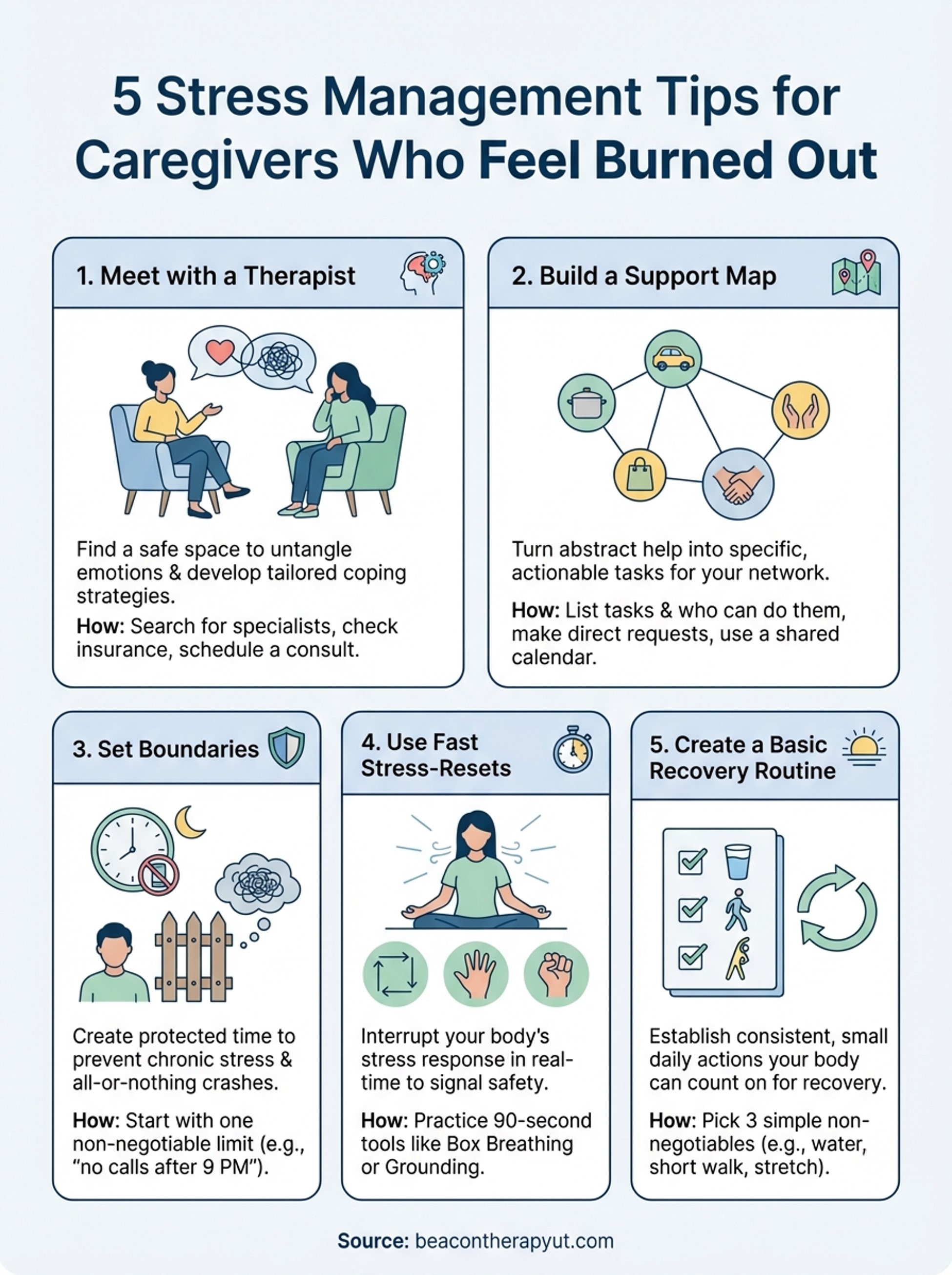
5 Stress Management Tips for Caregivers Who Feel Burned Out
Caring for a loved one is one of the most meaningful things you can do, and one of the most exhausting. If youve landed here searching for stress management for caregivers, chances are youre running on empty. You might be skipping meals, losing sleep, or feeling like your own needs have completely disappeared from the priority list.Caregiver burnout doesnt happen overnight. It builds slowly, through missed doctors appointments of your own, through saying Im fine when youre not, through the guilt that creeps in whenever you consider taking a break. The exhaustion becomes your normal, and at some point, you realize that pushing through isnt working anymore. Your patience wears thin. Your body aches. The person you used to be feels distant.The good news: burnout isnt a dead end. With the right strategies, and sometimes the right support, you can reclaim your energy and sense of self. In this article, well walk through five practical tips to help you manage stress without abandoning the person who depends on you. At Beacon Therapy, we work with caregivers across Utah who are navigating this exact struggle, offering concrete tools rather than empty advice. Whether youre caring for an aging parent, a spouse, or a child with special needs, these strategies can help you find balance again.1. Meet with a therapist who understands caregivingWorking with a therapist who specializes in caregiver stress gives you a safe space to be honest about feelings you might not share anywhere else. Many caregivers struggle with guilt, resentment, or anger toward the person theyre helping, and those emotions need somewhere to go. A therapist doesnt just listen. They help you untangle complicated feelings, identify patterns that drain you, and develop coping strategies tailored to your situation.Why this worksTherapy offers structure that your daily life might lack right now. When youre constantly reacting to someone elses needs, you lose the ability to reflect on your own emotional state. A trained therapist helps you recognize warning signs before you hit a crisis point. They teach you practical skills like cognitive reframing, stress tolerance techniques, and boundary setting that apply directly to caregiving challenges. Research also shows that caregivers who work with mental health professionals experience lower rates of depression and anxiety compared to those who try to manage alone.Professional support isnt a sign youre failing. Its a tool that helps you show up as the caregiver you want to be.How to do it in real lifeStart by looking for therapists who list caregiver stress, family systems work, or grief counseling among their specialties. Check your insurance coverage first to understand whats included, then search provider directories or ask your primary care doctor for referrals. At Beacon Therapy in Salt Lake City, we offer both in-person and telehealth sessions across Utah, making stress management for caregivers accessible even when leaving home feels impossible. Schedule a consultation call before committing to see if the therapist understands your specific caregiving situation.Watch-outs and when to get extra helpIf you notice thoughts of harming yourself or the person you care for, reach out immediately to a crisis line or emergency services. Therapy works best when you attend consistently, but dont force yourself to stick with a therapist who doesnt feel right. Finding the right match matters more than loyalty to the first person you try. When your caregiving role involves medical decisions or legal complexity, consider asking your therapist to coordinate with social workers or case managers who can address those practical layers.2. Build a support map and ask for specific helpMost caregivers try to handle everything alone because asking for help feels like admitting defeat. You might worry about burdening others or feel guilty for not being able to do it all yourself. Creating a support map breaks caregiving tasks into specific pieces that different people in your life can actually handle. Instead of vague requests like I need help, you identify concrete tasks like picking up prescriptions, cooking one meal per week, or sitting with your loved one for two hours on Saturday afternoons.Why this worksSpecific requests remove the guesswork that makes people hesitate to offer help. When someone says let me know if you need anything, they genuinely mean it, but they dont know what would actually be useful. A support map turns abstract goodwill into actionable support. Research shows that caregivers with reliable help networks experience lower stress levels and better physical health compared to those who work in isolation. People want to help but need clear direction about what matters most.Asking for specific help isnt weakness. Its the most practical form of stress management for caregivers who want to sustain their role long term.How to do it in real lifeWrite down every caregiving task you handle in a week, from medication management to meal prep to transportation. Next to each task, note who in your life could realistically help with that specific thing. Then reach out with direct requests: Could you drive Mom to her Tuesday appointment? or Would you be able to bring dinner every other Thursday? Keep a shared calendar or group chat where helpers can see whats covered and whats still needed.Watch-outs and when to get extra helpSome people will say yes and then disappear when you need them. Build backup options for critical tasks so youre never left scrambling. If your entire support network lives far away or nobody steps up, contact local caregiver resource centers or Area Agencies on Aging for information about respite care programs and volunteer services.3. Set boundaries that protect your time and energySaying no feels impossible when someone depends on you for their daily needs. You might answer every phone call, agree to every request, or stay available around the clock because you believe thats what good caregiving requires. Boundaries arent about caring less. Theyre about creating space for you to function as a person who has needs beyond caregiving, which ultimately makes you more capable when your loved one genuinely requires your attention.Why this worksYour body and mind werent designed for constant availability. Chronic stress without breaks leads to physical illness, emotional numbness, and decision fatigue that makes you less effective as a caregiver. When you protect specific hours for sleep, personal appointments, or recovery time, you create predictable rest periods that your nervous system can count on. This approach to stress management for caregivers prevents the all-or-nothing crash that happens when you finally hit your limit after months of ignoring warning signs.Boundaries let you care for someone else without disappearing from your own life.How to do it in real lifeStart with one non-negotiable boundary this week, like no caregiving calls after 9 PM except for emergencies. Communicate this limit clearly to your loved one and anyone else involved in their care. Use I cant instead of Ill try when you need to refuse a request that conflicts with your protected time. Turn off notifications during designated breaks, and redirect non-urgent questions to specific check-in times rather than responding immediately every time.Watch-outs and when to get extra helpExpect pushback at first, especially if youve trained others to expect constant availability. Guilt will show up, but consistency matters more than comfort in the early stages. If your loved ones safety genuinely requires 24-hour monitoring, contact adult protective services or hospital discharge planners about care arrangements that split responsibility rather than placing everything on your shoulders.4. Use fast stress-reset skills during the dayWaiting until bedtime to deal with stress means you carry tension through every interaction with the person youre caring for. Quick reset techniques that take five minutes or less help you manage stress in the moment rather than letting it accumulate. These arent about fixing everything. Theyre about interrupting your bodys stress response before it escalates into physical symptoms or emotional outbursts that you regret later.Why this worksYour nervous system responds to stress in real time, flooding your body with cortisol and adrenaline that prepare you for danger. Brief interventions signal safety to your brain, triggering a shift from fight-or-flight mode back to baseline functioning. Physical techniques like breathing exercises or grounding methods work faster than trying to think your way out of stress because they target the bodys automatic responses directly. Research shows that even 90 seconds of focused breathing can lower heart rate and blood pressure, making these tools especially valuable for stress management for caregivers who cant step away for extended breaks.Small resets throughout the day prevent the total collapse that happens when you ignore stress until you cant anymore.How to do it in real lifeKeep three simple techniques memorized that you can do anywhere. Box breathing (inhale for four counts, hold for four, exhale for four, hold for four) works in bathrooms, parking lots, or while sitting next to someone whos sleeping. The 5-4-3-2-1 grounding method pulls you back to the present by naming five things you see, four you can touch, three you hear, two you smell, and one you taste. Progressive muscle tension (squeeze your fists tight for five seconds, then release) helps when anger or frustration builds. Practice these during calm moments so your body recognizes them as stress signals when you actually need them.Watch-outs and when to get extra helpThese techniques work for everyday stress, not crisis situations. If your stress includes chest pain, difficulty breathing that doesnt improve, or thoughts of harming yourself or others, seek immediate medical attention. Reset skills also dont replace sleep, nutrition, or proper treatment for anxiety disorders. When you notice yourself using these tools constantly just to make it through basic tasks, thats a sign you need more substantial support rather than better coping mechanisms.5. Create a basic recovery routine you can keepMost stress management for caregivers advice pushes elaborate self-care rituals that require time you dont have. A recovery routine works differently. Its not about bubble baths or meditation apps. Its about three to five specific actions you repeat daily that help your body recover from chronic stress, even when your schedule stays chaotic. This routine becomes automatic, requiring no decision-making energy when youre already exhausted.Why this worksConsistency matters more than perfection when youre fighting burnout. Your body needs predictable signals that recovery time exists, even if its brief. Small daily actions compound over weeks, gradually lowering baseline stress levels instead of waiting for a vacation that might never come. Recovery routines target specific stress symptoms like poor sleep, tension headaches, or digestive issues rather than trying to solve everything at once.Repeating the same small actions daily creates recovery your body can count on.How to do it in real lifePick three non-negotiable actions youll do every day, like drinking water before coffee, taking a ten-minute walk, and stretching before bed. Schedule these at times when interruptions are least likely. Keep supplies ready so you dont waste energy gathering what you need. Track your routine for two weeks to identify patterns where you consistently skip steps, then adjust timing rather than abandoning the practice.Watch-outs and when to get extra helpYour routine will break sometimes. Return to it the next day without guilt or catching up. If you cant maintain even three small actions consistently, that signals you need immediate professional support or respite care arrangements. Physical symptoms that worsen despite a recovery routine require medical evaluation, not just better self-care.A calmer next weekYou dont need to master all five strategies at once. Pick one approach that matches your current situation, whether thats scheduling a therapy appointment or asking your neighbor for one specific task. Change happens through small, repeated actions rather than dramatic overhauls when youre already exhausted.Burnout builds slowly, and recovery works the same way. The techniques in this article for stress management for caregivers target the daily patterns that drain you rather than promising instant transformation. Some days youll manage stress effectively. Other days youll barely survive. Both outcomes are normal when youre carrying this much responsibility.If youre ready to work with someone who understands the specific challenges of caregiving, Beacon Therapy offers both in-person sessions in Salt Lake City and telehealth appointments throughout Utah. We focus on practical tools rather than generic advice, helping you find direction when everything feels overwhelming. You deserve support that recognizes caregiving as the demanding role it actually is.
Aug 18, 2026
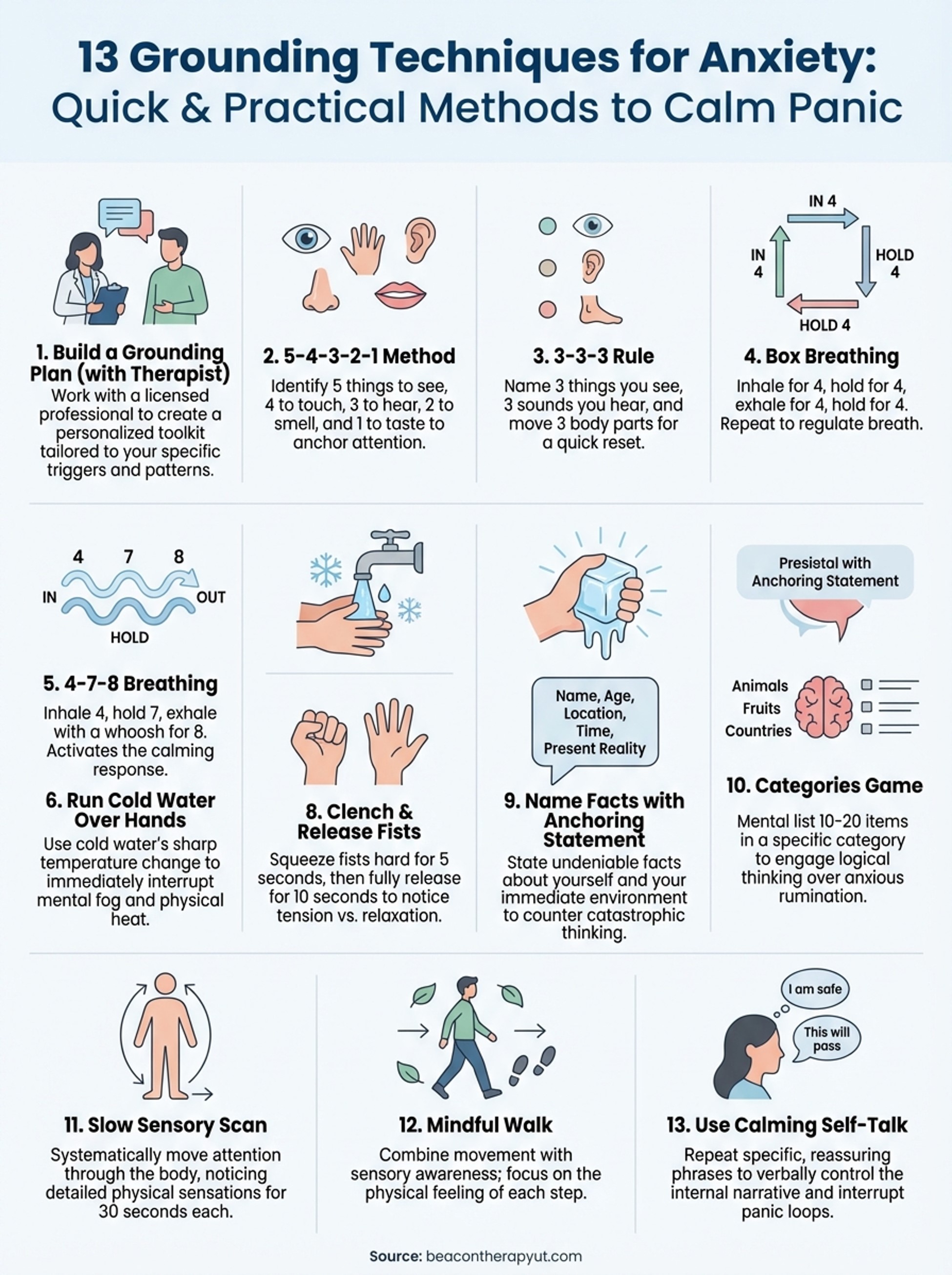
13 Grounding Techniques for Anxiety to Calm Panic Quickly
Your heart races. Your thoughts spiral. Your chest tightens and the world feels like its closing in. When anxiety hits, you need something that works right now, not a theory, not a long-term plan, but a tool you can use in the moment. Thats exactly what grounding techniques for anxiety provide: practical methods to interrupt panic and bring you back to the present.Maybe youve tried to push through these moments before. Youve told yourself to calm down, taken deep breaths that didnt seem to help, or waited for the wave to pass on its own. When those self-management strategies stop working, its easy to feel stuck, like youre doing something wrong or that nothing will actually help.At Beacon Therapy, we work with clients across Utah who experience exactly this. Weve seen firsthand how the right grounding technique can shift someone from overwhelm to manageable in minutes. This article shares 13 specific, evidence-based methods, including the popular 5-4-3-2-1 technique, that you can start using today. Some focus on your senses, others on movement or mental exercises. Not every technique works for every person, so weve included variety to help you find what clicks for you.1. Build a grounding plan with Beacon TherapyWorking with a licensed therapist creates a foundation that makes every other grounding technique on this list more effective. At Beacon Therapy, we help you identify which grounding techniques for anxiety actually work for your specific triggers and thought patterns. This isnt about generic advice. Its about building a personalized toolkit that you trust and can reach for when panic starts.What it helps withA therapist can help you recognize the early warning signs of anxiety before it escalates into full panic. Youll learn to spot the physical sensations, thought loops, and situations that signal trouble ahead. This awareness gives you a critical window to use grounding techniques when theyre most effective, not after youre already in crisis mode.Beyond immediate symptom management, therapy addresses the underlying patterns that keep anxiety cycling back. Youll work through unresolved trauma, develop healthier thought processes, and build long-term coping skills that reduce how often you need crisis intervention in the first place.How to do itYou can schedule in-person sessions at our Salt Lake City office or access telehealth services from anywhere in Utah. During your first appointment, youll discuss your anxiety symptoms, what triggers them, and what youve already tried. Your therapist will assess your specific needs and start building a grounding plan tailored to your life.The right grounding technique for you depends on how your anxiety shows up, and a therapist can help you figure that out faster than trial and error alone.Sessions typically focus on testing different techniques together, adjusting them to fit your reactions, and creating a written plan you can reference during difficult moments. Your therapist becomes a partner who helps you troubleshoot when something isnt working and celebrates progress when you successfully manage an anxious episode.Make it work in real lifeStart by contacting Beacon Therapy to set up an initial consultation. You dont need to have everything figured out before your first session. Come ready to talk honestly about whats happening and what you need help with.Between sessions, practice the techniques your therapist recommends in low-stress situations first. This builds muscle memory so the methods feel natural when anxiety hits hard. Keep notes on what works and what doesnt, then bring those observations to your next appointment. This feedback loop helps your therapist refine your grounding plan continuously, making it stronger each time you meet.2. Use the 5-4-3-2-1 methodThis technique pulls your attention away from racing thoughts and anchors it in your immediate physical surroundings. The 5-4-3-2-1 method is one of the most widely recommended grounding techniques for anxiety because it works through sensory engagement rather than trying to think your way out of panic.What it helps withThe 5-4-3-2-1 method interrupts the thought spiral that fuels anxiety. When your mind is stuck in worst-case scenarios or reliving past trauma, this technique forces you to shift focus to concrete, observable details around you. It creates mental distance from overwhelming emotions by redirecting your attention to whats actually happening right now.This method also helps with physical symptoms like rapid heartbeat, shallow breathing, and feeling disconnected from your body. By systematically engaging each sense, you ground yourself in the present moment where the threat isnt as immediate as your mind makes it feel.How to do itStart by naming five things you can see. Look around and identify specific items: a blue pen, a crack in the wall, a tree outside the window. Next, name four things you can touch and actually touch them: your shirt fabric, the chair under you, the cool surface of your phone, your hair.Then identify three things you can hear: traffic outside, the hum of the refrigerator, your own breathing. After that, notice two things you can smell. If you cant smell anything nearby, think of two scents you like. Finally, name one thing you can taste, even if its just the inside of your mouth.The 5-4-3-2-1 method works because its impossible to fully focus on sensory details while simultaneously spiraling into panic.Make it work in real lifePractice this technique when youre calm so it feels automatic during anxiety. You dont need to move through all five senses in order or complete every step. If focusing on what you can see helps you stabilize, stay there longer. Adapt the method to fit your environment and whats accessible in the moment. Keep the basic framework in mind, but let your actual experience guide how you use it.3. Try the 3-3-3 ruleThe 3-3-3 rule offers a simpler alternative to the 5-4-3-2-1 method when you need something faster or feel too overwhelmed to work through five steps. This technique uses only three observations in each category, making it less demanding when your cognitive resources are already stretched thin by anxiety.What it helps withThis method works particularly well for quick interruption of anxious thoughts when youre in public or professional settings. You can complete the entire exercise in under a minute without drawing attention to yourself. The simplicity makes it accessible during high-stress moments when more complex techniques feel impossible to remember or execute.The 3-3-3 rule also helps when anxiety makes you feel physically frozen or stuck. By adding a movement component, this technique reconnects you with your body and breaks the paralysis that often accompanies panic attacks.How to do itLook around and identify three things you can see. Say them out loud or in your head: the door handle, a light switch, someones jacket. Next, identify three sounds you can hear right now: voices in the next room, your breathing, a car passing by.Finally, move three parts of your body. Rotate your ankles, roll your shoulders back, wiggle your fingers. The movement component distinguishes this from other grounding techniques for anxiety and adds a physical reset to the mental one.The 3-3-3 rule combines sensory awareness with physical movement to address both the mental and physical symptoms of anxiety simultaneously.Make it work in real lifePractice this technique in different environments so you can adapt it anywhere. If youre in a meeting and cant move obviously, make subtle movements like pressing your feet into the floor or flexing your hands in your lap. Keep the basic structure but adjust the visibility of your actions based on your situation and comfort level.4. Do box breathingBox breathing uses equal counts for each phase of your breath cycle, creating a predictable rhythm that your nervous system can latch onto when anxiety spikes. Military personnel, athletes, and emergency responders use this technique because it delivers measurable results during high-pressure situations where you cant afford to lose focus.What it helps withThis technique directly counters the shallow, rapid breathing that accompanies panic attacks. When anxiety hits, your breathing pattern shifts automatically, which signals your body that danger is present. Box breathing reverses this signal by deliberately slowing your breath and deepening your oxygen intake.The structured counting gives your mind a concrete task to focus on instead of anxious thoughts. Each breath cycle takes about 16 seconds, and after just three or four cycles, most people notice their heart rate dropping and their thoughts clearing.How to do itBreathe in through your nose for four counts. Hold your breath for four counts. Exhale through your mouth for four counts. Hold empty for four counts. Repeat this square pattern for several cycles.Box breathing works as one of the most reliable grounding techniques for anxiety because it gives you complete control over a physical process when everything else feels chaotic.You can visualize tracing the four sides of a square as you count, which adds a visual element to the physical practice and makes the pattern easier to maintain.Make it work in real lifeStart practicing box breathing when youre calm so the count of four feels natural. If four counts feels too long when youre anxious, drop to three counts per side and work back up as you stabilize. Set a daily reminder to practice for two minutes so your body recognizes the pattern immediately when panic starts.5. Use 4-7-8 breathingThe 4-7-8 breathing pattern extends your exhale longer than your inhale, which activates your parasympathetic nervous system and tells your body to shift from fight-or-flight mode into rest mode. This technique comes from ancient yogic breathing practices and has been adapted by medical professionals as one of the most effective grounding techniques for anxiety when you need to reset your nervous system quickly.What it helps withThis breathing pattern works particularly well for racing thoughts and physical tension that wont release with simpler methods. The extended exhale forces your body to slow down its stress response by reducing cortisol levels and lowering blood pressure. Youll notice your shoulders dropping and your jaw unclenching within the first few breath cycles.How to do itPlace the tip of your tongue against the ridge of tissue behind your upper front teeth and keep it there throughout the entire exercise. Exhale completely through your mouth with a whooshing sound. Close your mouth and inhale quietly through your nose for four counts.Hold your breath for seven counts. Exhale completely through your mouth for eight counts, making the same whooshing sound. This completes one breath cycle. Repeat for four cycles total.The 4-7-8 breathing pattern works because the extended hold and exhale trigger your bodys natural relaxation response, making it impossible to stay in panic mode.Make it work in real lifeStart with just four breath cycles when youre learning this technique. Doing too many cycles at first can make you feel lightheaded. Practice twice daily when youre calm so your body recognizes the pattern during anxious moments. If holding for seven counts feels uncomfortable, reduce all counts proportionally and build up gradually over several weeks.6. Run cold water over your handsCold water creates immediate physical sensation that cuts through the mental fog of anxiety and forces your nervous system to respond to something concrete and present. This technique falls into the category of temperature-based grounding techniques for anxiety and works because your body prioritizes processing strong physical sensations over abstract worries and fears.What it helps withRunning cold water over your hands interrupts the dissociative feeling that often accompanies panic attacks, where you feel disconnected from your body or like youre watching yourself from outside. The sharp temperature change demands your attention and pulls you back into physical awareness.This method also helps with the physical heat and sweating that comes with anxiety. Cold water lowers your skin temperature and provides relief from the uncomfortable sensation of overheating that makes panic worse. Youll notice your breathing slowing down as your body responds to the cooling effect.How to do itTurn on the cold tap and hold both hands under the running water. Focus on the specific sensations: the temperature, the pressure of water hitting your palms, how it feels different on your fingertips versus your wrists. Keep your hands under the water for at least 30 seconds.Cold water grounding works because your nervous system cant ignore intense physical sensation, making it one of the fastest ways to interrupt a panic spiral.You can also splash cold water on your face and the back of your neck for additional cooling effect.Make it work in real lifeKeep this technique accessible by identifying where cold water sources are in the places you spend time: bathrooms at work, kitchen sinks at home, water fountains in public spaces. If youre somewhere without immediate access to running water, carry a small water bottle in your bag that you can use to wet your hands when anxiety hits.7. Hold an ice cube or something coldHolding something cold in your hand provides a more intense sensory experience than running water and works when you need stronger physical input to break through severe anxiety or dissociation. This technique uses sustained cold pressure rather than flowing water, giving you continuous tactile feedback thats harder for your anxious mind to ignore.What it helps withThis method addresses intense dissociation and numbness that can accompany panic attacks when you feel like youre floating outside your body or watching yourself from a distance. The sharp, persistent cold sensation forces your nervous system to focus on immediate physical input instead of abstract threats. Holding ice also helps when anxiety makes you feel physically overheated or trapped in your own skin, providing relief through temperature regulation that your body cant dismiss.How to do itGrab an ice cube from your freezer or a cold can from your refrigerator. Hold it in your closed fist for as long as you can tolerate, typically 30 to 60 seconds. Focus on the exact sensations: the burning cold, how it numbs your palm, water melting against your skin, the hardness of the cube. Switch hands when one gets too uncomfortable. You can also press a frozen water bottle against your wrists or the back of your neck if holding ice feels too intense.Sustained cold pressure works as one of the most powerful grounding techniques for anxiety because your brain prioritizes processing strong physical discomfort over ruminating on fears.Make it work in real lifeKeep ice packs in your freezer at home and store cold gel packs in your work refrigerator if your workplace allows it. When youre out, cold drinks from convenience stores provide immediate access to something cold. Practice this technique when youre calm so you know your tolerance level and can use it effectively during actual panic episodes.8. Clench and release your fistsClenching and releasing your fists uses progressive muscle relaxation in a simplified form that you can do anywhere without drawing attention. This technique works through physical tension and release, creating a clear contrast between tight and relaxed states that helps your body remember what calm actually feels like when anxiety has you wound up tight.What it helps withThis method addresses the muscular tension that builds in your body during anxious episodes, particularly in your shoulders, neck, and jaw. When you deliberately tighten and release specific muscles, you train your body to recognize the difference between tension and relaxation. The physical release often triggers a mental release as well, breaking the feedback loop where physical tightness reinforces anxious thoughts and anxious thoughts increase physical tightness.How to do itMake tight fists with both hands, squeezing as hard as you can for five full seconds. Focus on the sensation of tension in your hands, forearms, and how it radiates up into your shoulders. Release suddenly and let your hands go completely limp for 10 seconds. Notice the warmth, tingling, and relaxation flowing into your fingers and palms.Progressive muscle techniques work as effective grounding techniques for anxiety because they give you direct control over physical symptoms when your mind feels out of control.Repeat this cycle three to five times until you feel the tension draining from your upper body.Make it work in real lifePractice this technique in neutral moments so your muscles learn the pattern before you need it during panic. You can do this under a desk, in your lap during meetings, or while sitting in traffic without anyone noticing. Pair it with slow breathing between clenches for a stronger calming effect.9. Name facts with an anchoring statementAnchoring statements combine verbal affirmations with observable facts to create a mental anchor point when anxiety makes reality feel unstable or threatening. This technique helps you separate whats actually happening from what your anxious mind tells you is happening. You build a bridge back to the present by stating simple, undeniable truths about your current situation.What it helps withAnchoring statements interrupt catastrophic thinking patterns where your mind jumps to worst-case scenarios that feel real even when theyre not. When you name basic facts about your immediate environment and identity, you create mental stability that counters the feeling that everything is falling apart or spinning out of control. This method works particularly well for panic attacks triggered by uncertainty or situations where you feel overwhelmed by too many unknowns at once.How to do itStart with your name and age: My name is Sarah. I am 34 years old. Add your location: I am sitting in my living room in Salt Lake City. State whats happening right now: It is Wednesday afternoon. I am safe. This feeling will pass. Continue with observable facts: My feet are on the floor. I can see the window. I am breathing.Anchoring statements work as reliable grounding techniques for anxiety because they replace racing thoughts with concrete, verifiable reality that your mind cant argue against.Make it work in real lifeWrite down your personal anchoring statement template before you need it. Keep it in your phone notes or on a card in your wallet. Practice saying it out loud when youre calm so the words feel natural during panic. Adapt the facts to match wherever you are, but keep the basic structure consistent so your brain recognizes the pattern immediately.10. Play the categories gameThe categories game forces your brain to shift from anxious rumination to active problem-solving, engaging the logical part of your mind when emotions threaten to take over. This mental exercise works as one of the most portable grounding techniques for anxiety because you can do it silently anywhere without anyone noticing. You create mental distance from panic by giving your mind a specific task that requires focus but isnt emotionally loaded.What it helps withThis technique interrupts intrusive thoughts and worst-case scenario thinking by redirecting your mental energy toward a neutral challenge. When your mind is busy naming state capitals or listing types of fruit, it cant simultaneously spiral through catastrophic predictions. The game helps with racing thoughts that bounce from one worry to another by forcing sequential, organized thinking instead of chaotic mental jumping.How to do itPick a category like animals, countries, colors, or foods. Set a mental goal to name 10 to 20 items from that category. Go through the alphabet if you need structure: apple, banana, cantaloupe, dates. Count each item as you go. When you complete one category, move to another: types of transportation, musical instruments, movie titles.The categories game works because your anxious brain cant maintain a panic spiral while simultaneously organizing information into logical sequences.Make it work in real lifeKeep a mental list of categories that work well for you so you dont waste time choosing when anxiety hits. Pick categories with enough options that you wont run out quickly but not so obscure that you get frustrated. If one category feels too hard mid-panic, switch immediately to something easier. The goal is engagement, not perfection.11. Do a slow sensory scanA slow sensory scan moves your attention systematically through your body and immediate environment, creating a detailed inventory of physical sensations and surroundings. This technique differs from the 5-4-3-2-1 method because you spend more time with each observation, going deeper into the texture and quality of what you notice. You train your mind to focus intensely on one thing at a time instead of jumping between multiple anxious thoughts.What it helps withThis method helps when anxiety creates mental fragmentation where your thoughts scatter in multiple directions simultaneously and you cant hold onto a single idea long enough to ground yourself. The slow, deliberate pace forces your racing mind to match the rhythm of careful observation. Sensory scanning also addresses physical numbness or disconnection that happens during panic when you lose awareness of your bodys boundaries and feel like youre floating or detached from reality.How to do itStart with your feet and notice every sensation: pressure against the floor, temperature, any tingling or tension. Spend 30 full seconds just on your feet. Move up to your legs, then your torso, continuing this detailed scan all the way to the top of your head. At each body part, name specific sensations out loud or silently: My shoulders feel tight. My jaw is clenched. My stomach is warm.Slow sensory scanning works as one of the most thorough grounding techniques for anxiety because it forces your attention to move at a deliberate pace that panic cant sustain.Make it work in real lifeSet a timer for three to five minutes when practicing this technique so you dont rush through it. If you lose focus partway through, return to wherever you last remember and continue from there. You can combine this with lying down in a quiet space or do it sitting at your desk between tasks.12. Take a mindful walkWalking combines physical movement with sensory engagement, making it one of the most accessible grounding techniques for anxiety when you need to discharge physical tension while simultaneously calming your mind. Movement gets your blood flowing differently and changes your physical state in ways that sitting still cant match. A mindful walk shifts your environment completely, removing you from whatever space triggered your anxiety.What it helps withMindful walking addresses restless energy that makes you feel like you need to pace or escape when anxiety spikes. The physical activity burns off adrenaline and cortisol flooding your system during panic while giving your mind something concrete to focus on. This technique works particularly well for repetitive anxious thoughts that loop endlessly when youre stationary, because movement naturally interrupts mental patterns by changing what you see and experience moment to moment.How to do itStep outside or walk through your building, moving at a slower pace than normal. Notice how each foot feels hitting the ground: heel, then ball, then toes. Pay attention to your arms swinging, air temperature on your skin, sounds around you. Count your steps if you need structure: one, two, three, four. Focus on physical sensations rather than trying to solve problems or plan anything.Mindful walking works because it combines the calming effects of physical movement with the mental anchoring of sensory awareness.Make it work in real lifeKeep shoes near your workspace so you can walk immediately when anxiety hits. Start with just five minutes around your building or block. You dont need nature or a specific destination. The act of moving mindfully matters more than where you go or how far you walk.13. Use calming self-talk you can repeatCalming self-talk replaces anxious internal dialogue with deliberate, reassuring statements that your brain can latch onto when panic tries to take over. This technique gives you verbal control over the narrative running through your head, turning down the volume on catastrophic predictions and turning up messages of safety and capability. You create a mental script that counters the automatic negative thoughts anxiety generates.What it helps withRepeated calming phrases interrupt the feedback loop between anxious thoughts and physical symptoms. When your mind tells you something terrible is happening, a rehearsed phrase like I am safe right now or This feeling is temporary provides an immediate counterpoint thats harder to dismiss than trying to think your way out of panic. Self-talk also helps when anxiety convinces you that youre losing control or going crazy by reminding you of concrete truths you can rely on even when everything feels overwhelming.How to do itChoose three to five short phrases that feel true and calming to you personally. Examples include Ive handled this before, This will pass, I am breathing, or I am exactly where I need to be. Say your chosen phrases out loud or repeat them silently, focusing on the rhythm and repetition rather than forcing yourself to believe them completely.Calming self-talk works as one of the most accessible grounding techniques for anxiety because you carry it with you everywhere and can use it the instant panic starts.Make it work in real lifeWrite your phrases down and keep them in your phone where you can reference them quickly. Practice saying them during calm moments so they feel natural and automatic when anxiety hits. Adjust the specific wording until you find phrases that resonate personally rather than using generic statements that dont match how you actually talk to yourself.Next stepsYou now have 13 specific grounding techniques for anxiety that you can start using immediately. Some will work better for you than others, and thats exactly how it should be. Your anxiety shows up differently than someone elses, so your toolkit needs to match your specific symptoms and triggers.Start by testing two or three methods this week in low-stress situations. Practice when youre calm so the techniques feel automatic when panic hits. Keep notes on what works and what doesnt, then adjust your approach based on actual results rather than what you think should work.If youre tired of managing anxiety alone or need help building a personalized grounding plan, Beacon Therapy offers both in-person and telehealth services across Utah. We help you identify which techniques match your specific anxiety patterns and provide ongoing support as you build skills that actually stick.
Aug 18, 2026
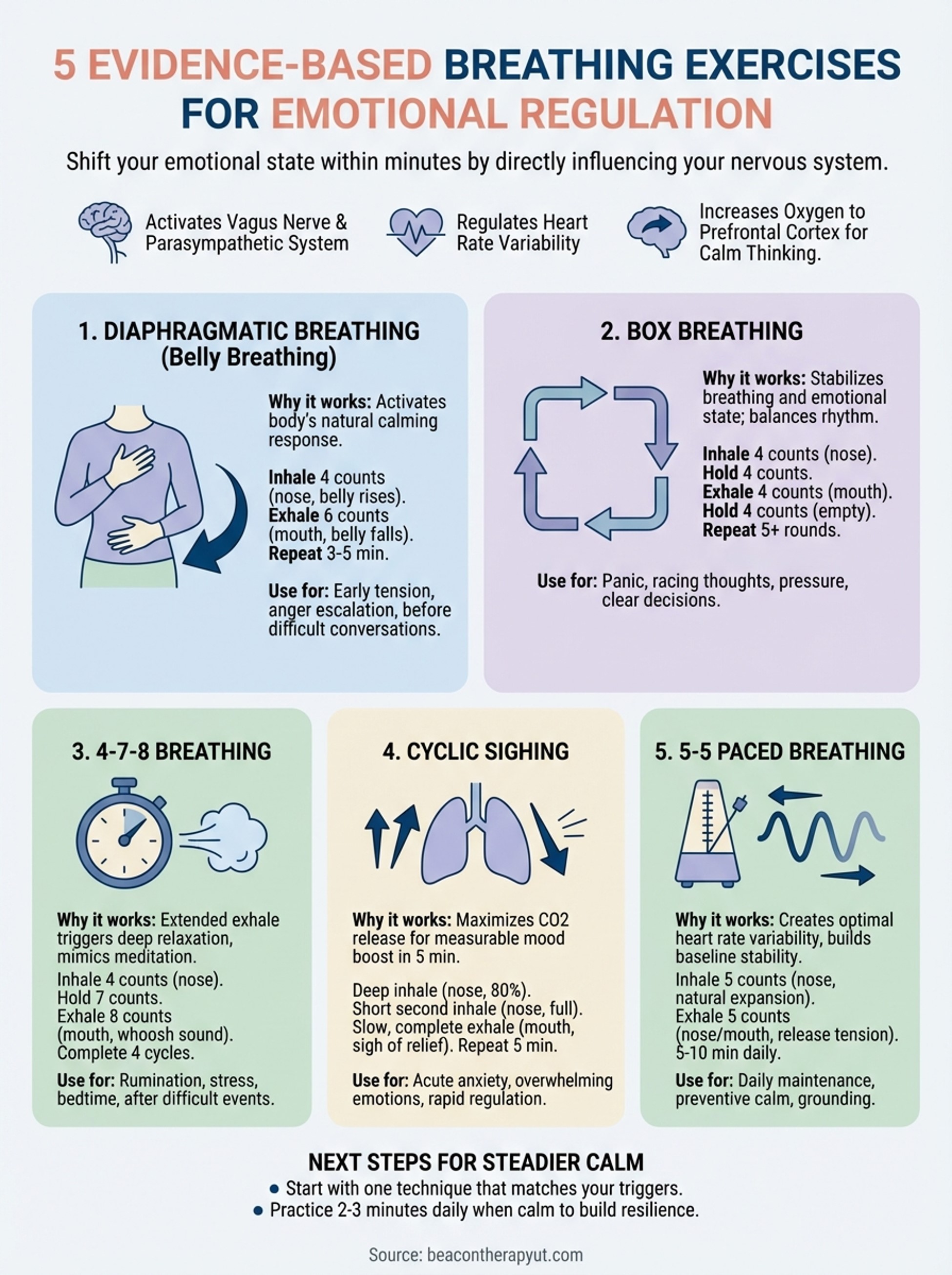
5 Breathing Exercises For Emotional Regulation That Work
Your heart races. Your thoughts spiral. You know you should calm down, but just relax feels impossible when emotions run high. Heres what most people dont realize: breathing exercises for emotional regulation arent just wellness trends, theyre evidence-based tools that directly influence your nervous system and can shift your emotional state within minutes.At Beacon Therapy, we teach these techniques to clients in Salt Lake City and across Utah because they work when you need them most. Whether youre navigating grief, managing anxiety, or helping your teen through a difficult season, controlled breathing offers immediate relief and builds long-term resilience. The best part? You can practice these methods anywhere, no appointment required.In this guide, youll learn five specific breathing methods, including 4-7-8 breathing, box breathing, and cyclic sighing. Youll also understand the science behind why they calm your body and mind, so you can use them with confidence when stress hits hardest.1. Diaphragmatic breathing with Beacon TherapyDiaphragmatic breathing sits at the core of nearly every breathing practice because it activates your bodys natural calming response. When you breathe deeply into your belly instead of your chest, you engage the vagus nerve, which tells your nervous system to shift out of fight-or-flight mode. This foundational technique is one of the first breathing exercises for emotional regulation we teach clients at Beacon Therapy because it works across nearly every emotional trigger.Why belly breathing calms the nervous systemYour diaphragm is a dome-shaped muscle that sits below your lungs. When you breathe into your belly, you stimulate the parasympathetic nervous system, which lowers heart rate and blood pressure. Chest breathing, by contrast, keeps you in a sympathetic stress state, even when the immediate danger has passed. This is why you feel tense after a stressful day even though nothing is actively threatening you.Belly breathing sends a direct signal to your brain that you are safe, which allows your body to finally stand down.How to do it step by stepPlace one hand on your chest and the other on your belly. Inhale slowly through your nose for 4 counts, letting only your belly rise while your chest stays relatively still. Exhale through your mouth for 6 counts, feeling your belly fall. Repeat this cycle for 3 to 5 minutes, maintaining a steady rhythm without forcing the breath.When to use it for anxiety, anger, and overwhelmUse diaphragmatic breathing when you first notice tension building in your shoulders, jaw, or chest. It works well before difficult conversations, after receiving bad news, or when anger starts to escalate. Parents of teens often find it helpful during emotional standoffs when both parties need to reset before continuing a conversation.Common mistakes that keep it from workingMany people force the breath or breathe too quickly, which creates more tension instead of releasing it. Others give up after 30 seconds because they dont feel instant relief. Effective regulation takes 2 to 3 minutes of consistent practice to shift your nervous system. Avoid shallow breathing or holding your breath between cycles.How a therapist can tailor it to your triggersAt Beacon Therapy, we help you identify your specific emotional patterns and adjust the rhythm to match your needs. Some clients need longer exhales for anxiety, while others need shorter cycles to prevent lightheadedness. A therapist can also integrate this technique with trauma-informed care if past experiences make deep breathing feel unsafe.2. Box breathingBox breathing creates a perfectly balanced rhythm that stabilizes both your breathing rate and your emotional state. Military personnel and first responders use this method to stay focused under extreme pressure because it gives your mind a concrete task while calming your body. Among breathing exercises for emotional regulation, box breathing stands out for its simplicity and immediate effectiveness during acute stress.What box breathing changes in your bodyThe equal counts in box breathing regulate your heart rate variability, which improves your bodys ability to adapt to stress. This technique increases oxygen flow to your prefrontal cortex, the part of your brain responsible for rational thinking and emotional control. When panic clouds your judgment, box breathing restores cognitive function within 2 to 3 minutes.How to do it step by step using a 4-4-4-4 count Inhale through your nose for 4 counts, feeling your lungs fill completely. Hold your breath for 4 counts without tension. Exhale through your mouth for 4 counts, releasing all the air. Hold empty for 4 counts before beginning the next cycle. Repeat this pattern for at least 5 rounds.Equal breathing creates equal emotions, which means your nervous system shifts from chaos to control.When to use it for panic, racing thoughts, and frustrationPractice box breathing when you feel your thoughts spiraling or when anger makes you want to react impulsively. It works during panic attacks, before public speaking, or when you need to make a clear decision under pressure. Parents find it helpful during bedtime battles with teens when emotions run high on both sides.How to adjust the count if 4 seconds feels too longStart with a 3-3-3-3 count if 4 seconds creates strain or makes you feel breathless. You can also try 5-5-5-5 for deeper regulation once the basic pattern feels comfortable. The key is maintaining equal counts across all four phases rather than hitting a specific number.Common mistakes and quick fixesHolding your breath too tightly causes tension instead of relaxation. Keep the holds gentle and natural, not forced. Some people rush through the counts when anxiety spikes, which defeats the purpose. Use a visual timer or count slowly in your head to maintain the rhythm even when your mind races.3. 4-7-8 breathingThe 4-7-8 method uses an extended exhale to trigger deep relaxation faster than most other breathing exercises for emotional regulation. Created by Dr. Andrew Weil, this technique mimics the calming effect of meditation without requiring years of practice. When you need to shift from high alert to genuine rest, this pattern delivers results in under 2 minutes.Why longer exhales help you downshiftYour exhale activates the parasympathetic nervous system more powerfully than your inhale. By making your exhale nearly twice as long as your inhale, you force your body to release tension it might otherwise hold. This creates a natural sedative effect without medication.How to do it step by stepInhale through your nose for 4 counts, keeping your tongue resting behind your upper teeth. Hold your breath for 7 counts without strain. Exhale completely through your mouth for 8 counts, making a gentle whooshing sound. Complete 4 full cycles.The extended exhale tells your body the threat has passed and its safe to rest.When to use it for stress, bedtime, and ruminationPractice 4-7-8 breathing when your mind wont stop replaying stressful events or when you need to fall asleep despite racing thoughts. It works well after difficult therapy sessions or when worry keeps you awake past midnight.Modifications for beginners and sensitive breathersShorten the pattern to 2-3-4 if the full count feels uncomfortable or makes you dizzy. You can gradually increase the duration as your lung capacity improves.Signs you should switch to a gentler techniqueStop immediately if you feel dizzy, anxious, or more activated instead of calm. Some people with trauma histories find breath holds triggering, which means diaphragmatic breathing may suit you better.4. Cyclic sighingCyclic sighing leverages your bodys natural stress-relief mechanism to deliver measurable mood improvements in just 5 minutes. Stanford researchers found that this technique reduced anxiety and improved positive mood more effectively than meditation when practiced daily. Unlike other breathing exercises for emotional regulation, cyclic sighing focuses on the exhale as the primary release point for tension.What research suggests about cyclic sighing and moodA 2023 Stanford study showed that participants who practiced cyclic sighing for 5 minutes daily experienced greater reductions in anxiety and negative emotions compared to mindfulness meditation. The technique works by maximizing carbon dioxide release, which signals your nervous system to relax. You get measurable results because the double inhale followed by an extended exhale creates physiological changes your body cannot ignore.How to do it step by stepTake a deep breath through your nose, filling your lungs about 80% full. Add a second shorter inhale through your nose to completely fill your lungs. Exhale slowly and completely through your mouth as if you are sighing with relief. Repeat this pattern for 5 minutes without pausing between cycles.When to use it for acute anxiety and tensionPractice cyclic sighing when anxiety feels physical and overwhelming or when tension locks your chest and shoulders. It works immediately before stressful events or when you need rapid emotional regulation during a crisis moment.Sighing is your bodys built-in pressure valve, and cyclic sighing teaches you to use it intentionally.What it should feel like and what it should notYou should feel your shoulders drop and your jaw soften with each exhale. Your breathing should become easier and deeper as you continue. Avoid forcing the breath or creating tension in your throat during the exhale.Safer alternatives if sighing makes you lightheadedSwitch to diaphragmatic breathing if you feel dizzy, tingly, or more anxious after a few rounds. Some people need gentler techniques when their nervous system is highly activated, which means box breathing may serve you better until you stabilize.5. 5-5 paced breathingPaced breathing at a 5-5 rhythm creates optimal heart rate variability, which means your body becomes more adaptable to stress over time. Unlike techniques designed for crisis intervention, this method builds baseline emotional stability when practiced consistently. Among breathing exercises for emotional regulation, this one works best as daily preventive maintenance rather than emergency response.How paced breathing supports steady regulationThe 5-5 pattern matches your natural resonance frequency, which is the breathing rate where your heart rate variability reaches its peak. This creates a synchronized relationship between your cardiovascular and nervous systems that strengthens your stress resilience. Regular practice makes emotional regulation easier because your body learns to maintain balance automatically.How to do it step by step using a 5-5 rhythmInhale through your nose for 5 counts, allowing your belly to expand naturally. Exhale through your nose or mouth for 5 counts, releasing tension from your shoulders. Continue this equal pattern for 5 to 10 minutes daily, ideally at the same time each day to build consistency.Equal breathing trains your nervous system to stay centered even when life gets chaotic.When to use it for daily maintenance and in-the-moment calmPractice this technique every morning to set your emotional baseline for the day or during your commute to work. You can also use it when stress starts building but hasnt peaked yet, giving you control before emotions escalate.How to pair it with grounding for stronger resultsCombine paced breathing with physical grounding by pressing your feet firmly into the floor or holding a cold object in your hands. This combination anchors both your body and breath, creating dual pathways for regulation.How to build a realistic practice you will stick withStart with just 2 minutes daily rather than attempting 10-minute sessions that feel overwhelming. Attach the practice to an existing habit like your morning coffee or evening wind-down routine, which makes consistency automatic rather than reliant on motivation.Next steps if you want steadier, calmerYou now have five proven breathing exercises for emotional regulation that work when stress hits hardest. The techniques you learned (diaphragmatic breathing, box breathing, 4-7-8, cyclic sighing, and 5-5 paced breathing) give you immediate tools for managing anxiety, anger, and overwhelm without relying on medication or waiting for a crisis to pass on its own.Start with one technique that matches your specific triggers rather than trying to master all five at once. Practice your chosen method for 2 to 3 minutes daily when you feel calm, which makes it accessible when emotions spike. Your nervous system learns fastest through consistent repetition in low-stress moments.Some emotional patterns need more than breathing techniques alone. If you still feel stuck after practicing these methods consistently, professional support can identify whats blocking your progress and help you develop a personalized regulation strategy. Beacon Therapy in Salt Lake City offers both in-person and mobile therapy services tailored to your specific emotional needs and life circumstances.
Sep 02, 2026

Navigating Mental Health Challenges for Seniors in Assisted Living
Mental health is an integral part of overall well-being, yet it often goes overlookedespecially for seniors living in assisted living communities. As the aging population grows, the importance of understanding and addressing mental health support for seniors in assisted living cannot be overstated. This blog delves into common emotional challenges faced by seniors in assisted living, the importance of mental health care, and resources to promote senior mental wellness.Understanding the Mental Health Needs of SeniorsMental health issues in seniors often go unnoticed or are mistakenly attributed to aging. While the physical challenges of aging are widely acknowledged, emotional and psychological struggles receive less attention. However, these struggles can profoundly impact a seniors quality of life.Common Emotional Challenges in Assisted Living CommunitiesTransitioning to an assisted living community can be daunting. Seniors may face emotional challenges such as: Loneliness and Isolation: Leaving behind familiar surroundings, friends, and sometimes family can lead to feelings of abandonment and loneliness. Loss of Independence: The shift from an independent lifestyle to a more supervised environment can affect self-esteem and trigger feelings of helplessness. Grief and Loss: Many seniors grapple with the loss of loved ones, physical abilities, or their previous lifestyle. Cognitive Decline: Conditions like dementia or Alzheimers exacerbate emotional challenges, creating confusion and frustration. Depression and Anxiety: These are common but often undiagnosed in seniors, especially when symptoms overlap with other health issues. Why Mental Health Support is EssentialUntreated mental health issues can lead to severe consequences, including physical health deterioration, weakened social connections, and reduced quality of life. Providing mental health support for seniors in assisted living helps mitigate these risks and fosters a nurturing environment where seniors can thrive emotionally and socially.Strategies to Support Mental Wellness in Assisted LivingAssisted living communities play a pivotal role in promoting mental wellness for their residents. Here are some effective strategies:Building a Sense of CommunityCreating opportunities for social engagement is crucial. Group activities, shared meals, and recreational events help seniors build connections and reduce feelings of isolation. Activities like book clubs, gardening, and exercise classes promote both mental and physical well-being.Encouraging Open CommunicationMany seniors hesitate to express their emotional struggles due to stigma or fear of being misunderstood. Assisted living staff and family members should foster an environment where seniors feel safe discussing their emotions. Regular Check-ins: Scheduling routine one-on-one conversations allows caregivers to monitor emotional changes. Support Groups: Peer support groups enable seniors to share experiences and feel less alone. Offering Professional Mental Health ResourcesAccess to professional mental health care is vital. Many assisted living communities now partner with therapists, counselors, and psychiatrists to provide on-site or virtual services. This ensures timely intervention for issues like depression, anxiety, and grief.Tailoring Activities for Cognitive HealthEngaging seniors in activities that stimulate cognitive function can enhance mental health. Memory games, puzzles, and workshops tailored to their interests help maintain cognitive abilities and boost confidence.Resources for Senior Mental WellnessSupporting mental health for seniors requires a combination of professional care, community involvement, and family support. Here are some resources to consider:Professional Mental Health Services Therapy and Counseling: Licensed therapists can help seniors process emotions and develop coping strategies. Telehealth Options: For seniors with mobility challenges, virtual counseling sessions provide accessible mental health support. Psychiatric Care: Psychiatrists can diagnose and treat complex mental health conditions with appropriate medication management. Assisted Living ProgramsMany assisted living communities now offer specialized mental health programs. These include: On-site therapy sessions Wellness workshops Activities focused on emotional resilience Family InvolvementFamily members play a crucial role in supporting a seniors mental health. Visiting regularly, staying connected through calls or video chats, and participating in their daily lives helps seniors feel valued and loved.Promoting Emotional Wellness Among SeniorsPromoting emotional wellness goes beyond treating mental health conditions; its about cultivating an environment where seniors feel fulfilled and purposeful.Encouraging Physical ActivityPhysical activity is a powerful tool for improving mood and reducing anxiety. Activities like walking, yoga, or light aerobics can enhance physical health while boosting mental well-being.Providing Creative OutletsCreative pursuits like painting, writing, or playing music allow seniors to express themselves and process emotions in a constructive way. Assisted living communities can host workshops or provide materials to support these endeavors.Recognizing AchievementsAcknowledging accomplishments, no matter how small, fosters a sense of pride and self-worth. Celebrating birthdays, anniversaries, or personal milestones keeps seniors motivated and engaged.Addressing Spiritual NeedsFor many seniors, spirituality plays a significant role in emotional well-being. Providing access to chaplains, meditation sessions, or faith-based gatherings caters to this important aspect of mental health.The Role of Caregivers and Staff in Mental Health SupportCaregivers and staff in assisted living communities are on the front lines of senior care, making their role in mental health support critical.Training in Mental Health AwarenessEquipping staff with training to recognize signs of depression, anxiety, or cognitive decline ensures timely intervention. Mental health first aid courses can be invaluable.Balancing Independence with AssistanceProviding support while respecting a seniors independence can boost confidence and reduce feelings of helplessness. Caregivers should involve seniors in decision-making whenever possible.Patience and EmpathyCaring for seniors with mental health challenges requires patience and empathy. Building trust is essential for effective communication and support.Overcoming Stigma Around Mental Health in SeniorsDespite growing awareness, stigma around mental health remains a barrier for many seniors. They may view mental health struggles as a sign of weakness or fear being judged.Educating Seniors and FamiliesEducation is key to breaking down stigma. Workshops, informational sessions, and open discussions can normalize mental health challenges and emphasize the importance of seeking help.Creating an Inclusive CultureAssisted living communities should create a culture where mental health support is as routine as physical health care. Openly discussing mental wellness and offering visible resources can encourage seniors to seek help.The Future of Mental Health Care in Assisted LivingAs society continues to prioritize mental health, the future of senior care will likely see more emphasis on holistic approaches to wellness. Innovations such as virtual reality therapy, AI-powered cognitive games, and integrative health programs may become standard offerings in assisted living communities.Investing in mental health support for seniors in assisted living not only improves their quality of life but also creates a positive and thriving community environment. Families, caregivers, and communities must work together to ensure seniors receive the care and support they deserve.
Aug 18, 2026
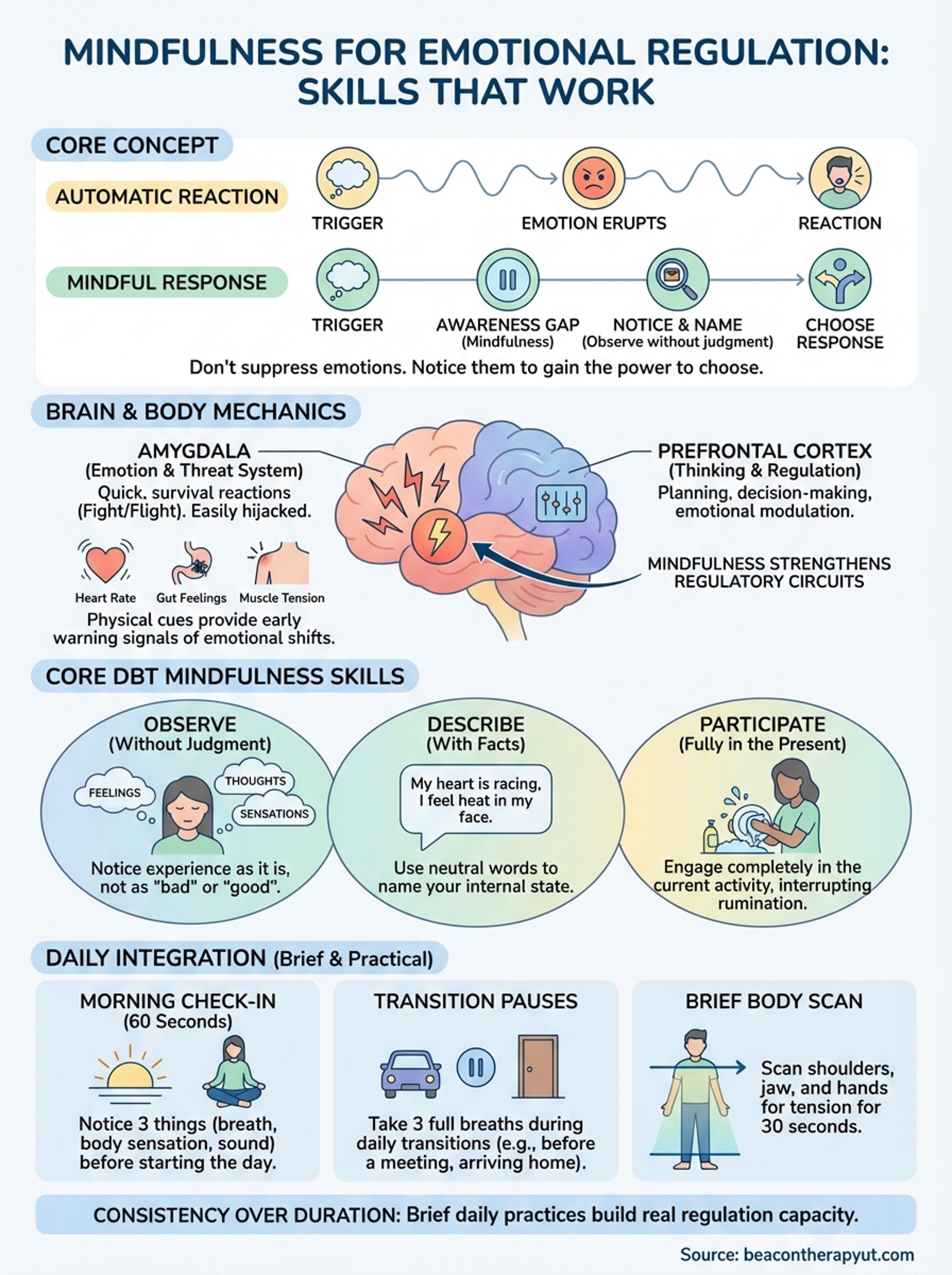
Mindfulness for Emotional Regulation: Skills That Work
Emotions can feel like theyre running the show, one moment youre managing fine, the next youre overwhelmed by anger, sadness, or anxiety that seems to come from nowhere. If youve tried pushing through or telling yourself to just calm down, you already know that approach has limits. Mindfulness for emotional regulation offers something different: a way to work with your emotions rather than against them, using skills that actually stick.At Beacon Therapy, we help clients in Utah develop practical tools for emotional wellness, not just talking about problems, but building real capabilities for handling lifes challenges. Mindfulness-based techniques are among the most effective approaches we use, particularly for people who feel stuck in cycles of emotional reactivity they cant seem to break.This article explains how mindfulness supports emotional regulation, walks through specific techniques you can start using today, and covers DBT-based skills and worksheets that therapists recommend. Whether youre dealing with grief, trauma, life transitions, or simply want better control over your emotional responses, these evidence-based practices can help you respond to difficult feelings with clarity instead of being hijacked by them.Why mindfulness helps regulate emotionsEmotional regulation isnt about suppressing what you feel or forcing yourself into a better mood. Its the ability to notice your emotions as they arise and choose how you respond rather than being controlled by automatic reactions. This distinction matters because most people have spent years strengthening reactive patterns without realizing theres an alternative approach that actually works.The core reason for mindfulness for emotional regulation succeeds where other methods fail is deceptively simple: you cant manage what you dont notice. Most emotional reactions happen so quickly that youre already yelling, withdrawing, or spiraling into anxiety before your conscious mind catches up. Mindfulness creates a brief gap between stimulus and response, and in that space, you gain the option to respond differently.The awareness gap between trigger and responseTraditional coping strategies often focus on what to do after youre already overwhelmed. Mindfulness works earlier in the emotional cycle, right when feelings first emerge and while theyre still manageable. Instead of waiting until your frustration has built into full anger, you notice the tightness in your chest or the heat rising in your face as early warning signals.When you can identify emotions at their beginning stages, you have significantly more control over how they develop and how you express them.This early detection system develops through practice. You start recognizing physical sensations that accompany different emotions: the hollow feeling that comes before sadness, the buzzing energy that precedes anxiety, or the muscle tension that signals building anger. These bodily cues give you actionable information about your internal state before your thinking gets hijacked by intense emotion.How to notice changes what you can controlAwareness alone has regulatory power. Simply naming an emotion reduces its intensity, a phenomenon neuroscientists call affect labeling. When you internally note Im feeling anxious or this is anger, your brains prefrontal cortex becomes more active while the emotional centers calm slightly. Youre not fighting the feeling or pretending it doesnt exist; youre acknowledging it with neutral observation.Mindful observation also reveals that emotions change on their own. Most feelings, even intense ones, naturally peak and subside within 90 seconds to a few minutes if you dont feed them with reactive thoughts or behaviors. People who chronically struggle with emotional regulation often inadvertently extend their distress by mentally replaying triggers, catastrophizing consequences, or taking actions that escalate situations.Why trying harder doesnt work (but mindfulness does)Efforts to control emotions through willpower typically backfire. Telling yourself not to feel something activates the very emotion youre trying to avoid, similar to how dont think about a white bear makes it impossible not to think about one. This is why people who constantly suppress their feelings eventually experience emotional flooding, where everything theyve been holding back erupts at once, often at inappropriate times.Mindfulness replaces resistance with acceptance, which paradoxically gives you more influence over your emotional experience. You allow feelings to exist without immediately acting on them or getting swept away by them. This approach requires less energy than constant suppression and produces steadier results because youre working with your natural emotional processes rather than against them.Your emotions carry information about your needs, values, and circumstances. Mindfulness helps you extract that useful information without being overwhelmed by the emotional intensity itself. When you can observe anger without becoming aggressive or notice anxiety without avoiding everything that triggers it, youve developed genuine emotional regulation rather than just better suppression.What happens in your brain and bodyUnderstanding the biological mechanics behind emotional regulation helps you recognize why mindfulness for emotional regulation works at a fundamental level. Your brain operates through interconnected systems that either amplify or modulate emotional responses, and mindfulness directly influences which system takes the lead. This isnt abstract theory; these are measurable changes that happen each time you practice mindful awareness.Your amygdalas role in emotional hijackingYour amygdala functions as your brains threat detection system, constantly scanning for danger and triggering immediate survival responses before your conscious mind processes whats happening. This structure works at incredible speed because evolutionary survival required split-second reactions. The problem arises when your amygdala treats modern stressors like life-threatening emergencies, activating the same intense responses for a critical email that it would for actual physical danger.When your amygdala activates strongly, it floods your body with stress hormones including cortisol and adrenaline while simultaneously reducing activity in your rational brain centers. This explains why you sometimes say or do things during emotional moments that you later regret. Your thinking brain literally goes offline while survival circuits take over. Chronic amygdala activation from ongoing stress keeps you in a state of heightened emotional reactivity where minor triggers produce outsized responses.How mindfulness strengthens regulatory circuits Mindfulness practice strengthens connections between your prefrontal cortex and limbic system, the parts of your brain responsible for rational thought and emotional processing respectively. Your prefrontal cortex handles planning, decision-making, and emotional modulation, but it needs activation to override automatic amygdala responses. Regular mindfulness increases gray matter density in these regulatory regions, giving you more neural resources for managing difficult emotions.Research shows that consistent mindfulness practice can reduce amygdala reactivity while strengthening the prefrontal cortexs ability to regulate emotional responses.Even brief mindfulness interventions produce measurable brain changes. Studies using brain imaging reveal that people who practice mindfulness show decreased amygdala activation when exposed to emotional stimuli and increased prefrontal cortex activity during regulation tasks. These arent permanent transformations from a single session, but they demonstrate that your brains emotional circuitry responds to the skills you practice.Physical sensations as emotional dataYour body provides constant feedback about your emotional state through physical sensations that emerge before conscious emotional awareness. These signals include changes in heart rate, breathing patterns, muscle tension, and gut sensations that accompany different emotions. Learning to notice these physical cues gives you early warning of emotional shifts while you still have maximum control over your response.Core mindfulness skills from DBTDialectical Behavior Therapy provides structured mindfulness skills specifically designed for emotional regulation. These arent vague concepts about being present; theyre concrete techniques with clear steps you can practice and measure. DBT breaks mindfulness into three core skills: observe, describe, and participate. Each skill addresses a different aspect of how you engage with your internal experience, and together they form a complete system for working with difficult emotions.Observe without judgmentThe observe skill teaches you to notice your thoughts, feelings, and sensations without immediately reacting to them. You watch your internal experience the way youd watch clouds move across the sky: with attention but without trying to change what you see. This skill directly counters the tendency to either suppress uncomfortable emotions or get swept away by them.Practicing observation means stepping back from your immediate experience enough to recognize it as something happening within you rather than something that defines you completely. You notice anger is present rather than I am angry, which creates psychological distance that makes regulation possible. When you observe a racing heart during anxiety, tight shoulders during stress, or heavy limbs during sadness, you gather data about your emotional state without adding judgment that intensifies the feeling.Describe what you noticeDescription involves putting words to your observations with factual accuracy rather than interpretation. Instead of thinking this situation is terrible and I cant handle it, you describe my heart rate increased, my thoughts are racing, and Im breathing shallowly. This translation from feeling overwhelmed to specific observable facts activates your rational brain centers and reduces emotional intensity.Accurate description of your emotional experience reduces its power over you by engaging the parts of your brain capable of perspective and choice.The describe skill for mindfulness for emotional regulation requires precision without drama. Youre not telling a story about how awful things are; youre creating an inventory of your present moment experience. This might sound like splitting hairs, but the difference between Im having the thought that Ill fail and Im going to fail profoundly affects how trapped you feel by that thought.Participate fully in the presentParticipation means engaging completely with whatever youre doing right now rather than operating on autopilot while your mind rehashes the past or worries about the future. This skill builds your capacity to stay grounded during emotional difficulty by anchoring your attention in immediate sensory experience and concrete action.Full participation interrupts rumination and catastrophizing, the mental habits that extend emotional distress far beyond its natural duration. When you participate mindfully, youre washing dishes and feeling the water temperature, not washing dishes while replaying an argument. Youre walking and noticing your footsteps, not walking while catastrophizing about tomorrows meeting. This intentional present-focus starves the thought patterns that fuel emotional dysregulation.Daily mindfulness exercises that fit real lifeFormal meditation practice helps, but the most effective mindfulness for emotional regulation happens in ordinary moments throughout your day. You dont need a quiet room, special equipment, or even much time. What matters is building brief practices into your existing routine so they become automatic responses when emotions intensify. The following exercises work because they fit into real life instead of requiring you to create a separate meditation practice youll likely abandon.Morning check-ins that take 60 secondsStarting your day with deliberate awareness sets your baseline for emotional regulation rather than letting your mind immediately jump into worry or planning mode. Before you reach for your phone or get out of bed, spend one minute noticing three things: your breath moving in and out, physical sensations in your body, and one sound in your environment. This quick practice activates your observational awareness before your days stress begins.Consistent morning mindfulness creates neural pathways that make emotional regulation easier throughout the day, even under pressure.You can expand this check-in by asking yourself what emotions are present right now. Not what you think about them or why theyre there, just naming them: anxious, calm, irritated, hopeful. This morning emotional inventory helps you recognize your starting point so youre not surprised when stress builds on existing tension you didnt know you were carrying.Using transitions as mindfulness anchorsYour daily transitions between activities offer natural opportunities for brief mindfulness resets that prevent emotional buildup. Before you start your car, walk into a meeting, or open your laptop for work, pause for three full breaths while noticing physical sensations. These micro-practices accumulate throughout your day, creating multiple points where you reset your nervous system instead of carrying stress from one activity into the next.Transitions work particularly well for emotional regulation because theyre predictable and frequent. You move between activities dozens of times daily, giving you dozens of chances to practice awareness. Each pause reinforces your capacity to step out of automatic reactivity and choose your emotional state rather than being controlled by momentum from previous experiences.Body scan for emotional awarenessA body scan involves systematically noticing sensations in different body parts without trying to change them. Start with your feet and slowly move your attention upward through legs, torso, arms, and head, spending 5 to 10 seconds on each area. This practice reveals where youre holding tension or numbness that signals unprocessed emotional material.You dont need to complete a full body scan to benefit. Scanning just your shoulders, jaw, and hands takes 30 seconds and catches the most common physical manifestations of stress and anxiety. Regular scanning teaches you to recognize emotional buildup before it becomes overwhelming, giving you the chance to address feelings while you still have full access to your regulatory capabilities.Troubleshooting and when to get extra supportMindfulness for emotional regulation doesnt always feel natural or produce immediate results. You might sit down to practice and find your mind racing faster than ever, or you might notice emotions without knowing what to do with them. These challenges dont mean youre failing at mindfulness; theyre normal parts of developing a skill that goes against years of ingrained patterns. Understanding common obstacles helps you adjust your approach rather than abandoning practices that could eventually work.Common obstacles in mindfulness practiceYour mind wandering during observation isnt a problem you need to fix. Noticing that your attention drifted and gently redirecting it is actually the practice itself, not a failure of the practice. Each time you catch yourself lost in thought and return to the present moment, youre strengthening the exact neural pathways that support emotional regulation. People often quit mindfulness because they believe their busy mind means theyre doing it wrong, when in fact that busy mind is what makes practice necessary.Physical discomfort or restlessness during mindfulness exercises signals activation of stored stress rather than ineffective technique. Your nervous system may initially resist slowing down because staying vigilant has felt necessary for survival. If sitting still feels intolerable, start with movement-based mindfulness like mindful walking or progressive muscle relaxation that gives your body something concrete to do while you practice awareness.Signs you need professional supportSome emotional struggles require more than self-practice can provide. Persistent emotional dysregulation that interferes with work, relationships, or daily functioning indicates you could benefit from professional intervention. If you find yourself unable to maintain jobs, friendships, or stability despite genuine effort, or if emotional reactions frequently lead to consequences you regret, therapy offers structured support that self-directed mindfulness cannot replace.When emotional patterns feel completely automatic and unchangeable despite consistent practice, professional guidance can identify underlying factors you cant address alone.Trauma, severe anxiety, depression, or grief often require therapeutic expertise to process safely. These conditions create biological and psychological barriers that make mindfulness difficult or even temporarily overwhelming without professional support. Trying harder with self-help approaches when you need clinical intervention wastes time and can worsen your sense of being broken or incapable.What therapy adds to self-practiceProfessional therapy provides personalized assessment of your specific emotional patterns and targeted interventions beyond general mindfulness techniques. At Beacon Therapy, we help Utah residents develop practical emotional regulation skills through evidence-based approaches including DBT, trauma therapy, and grief counseling. Our therapists identify which techniques will work best for your particular challenges rather than leaving you to guess which skills to prioritize.Therapy creates accountability and expert feedback that accelerates your progress beyond what self-practice typically achieves. You gain access to clinical expertise in recognizing patterns you cant see yourself and adjusting approaches when initial strategies dont produce results. Whether you need in-person sessions in Salt Lake City or prefer mobile therapy services, professional support gives you concrete tools tailored to your specific emotional regulation needs rather than generic advice you find overwhelming to implement. Next steps for steadier emotionsBuilding effective mindfulness for emotional regulation takes consistent practice rather than perfect execution. You dont need to master every technique in this article before seeing results. Start with one or two practices that fit naturally into your existing routine, whether thats morning check-ins, transition pauses, or brief body scans. Consistency matters more than duration; three minutes daily beats occasional hour-long sessions that you abandon after two weeks.Track what works for your specific emotional patterns. Some people respond better to physical awareness practices, while others gain more from cognitive observation skills. Your progress wont follow a straight line, but if youre noticing emotions earlier and responding with slightly more choice, youre developing real regulation capacity.When self-practice reaches its limits or you need faster progress on patterns that significantly impact your life, professional support accelerates your development. Beacon Therapy provides practical tools and expert guidance for Utah residents building genuine emotional wellness through evidence-based approaches that create lasting change.